
Principes (Polybian)
Class: heavy · Category: infantry · Men per unit: 40
Reforms: Unlocked by Polybian Reform · Older units become this one with Polybian Reform · No longer recruitable after The Late Republican Reforms · Becomes a newer unit with A New Man: Gaius Marius (switched off), The Late Republican Reforms
Description
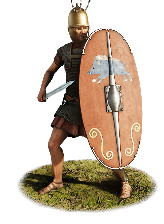
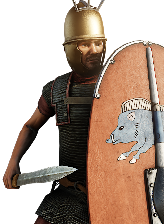
In the army of the Mid-Roman Republic, these Principes make up the second line of battle. They are described as being in “the prime of their life” (Polyb. VI.21.7), which makes them more experienced than the younger hastati, whose youth gives them the impetus to deliver the first effective charge. The name “principes” also points to their origin as the most important line in the Roman army, though the standardization of the Mid-Republic makes them virtually indistinguishable from the hastati, apart from their age.
Historical background
For the beginnings of the principes, view the description of the Early Principes. For the Mid-Republic, our best description comes from Polybios of Megalopolis (ca. 200-120 BC). An Achaian historian, he was a hostage in Rome in the 160s to 150s BC and wrote a history of its rise to hegemony in the Mediterranean. As part of the famous Roman army description of his sixth book, Polybios explains the levying of the Roman army, with the principes being those in the prime of their life (Polyb. VI.21.7). In a legion, they are put into a line of 1,200 men, separated into 10 companies (which Polybios calls “speirai” and which is usually translated via Livy’s “maniples”; Polyb. VI.21.8-9).
Polybios summarizes their equipment as being “armed in the same manner as the hastati, which includes a scutum shield, described by Polybios as an oblong shield with a convex surface, covered with hide, measuring two and a half feet in width and four feet in length, the top and bottom being reinforced with iron edging and the handle with an iron boss (VI.23.1). They carry a sword of the “Iberian type”, commonly called a gladius hispaniensis, as well as two javelins called pila, characterized by a long iron shank which is able to penetrate shields further than a normal javelin. Actually, the Romans at the time used two different kinds of javelins, one being more akin to a hunting spear, according to Polybios, which we could not represent in RIS (Polyb. VI.23.6-11). Their helmet is of the Montefortino type, very prominently represented in Roman art and archaeology, with a crest of three black or red feathers intended to strike fear into their enemies (VI.23.12-13). They are armoured with a bronze pectoral breastplate which Polybios calls a “heart-protector” (kardiophylax), two spans in diameter, to which the closest analogy could be those kardiophylakes portrayed in the Campanian context (VI.15; Devereaux, The Material and Social costs of Roman Warfare (2018), pp. 246-250). They also wear a greave (Polybios uses the singular “proknemis” implying a single greave), likely on the leading left leg. Those rated above 10,000 drachmae in the census were expected to bring mail armour to the levy. Since the principes usually had more experience, they would likely have accumulated more wealth, for instance from opportunities to loot armour from their enemies in preceding wars, like the bronze muscle cuirass that this unit is equipped with. The strength of the principes was set at roughly 1,200 per legion in Polybios’ standardized description, though he adds that all sections of the army, except for the triarii, could be increased in size if deemed necessary (VI.21.9).
The principes’ most famous explicit battle appearance is probably that in the battle of Zama in 202 BC, where Publius Cornelius Scipio (later Africanus) uses the standard Roman deployment that Polybios had previously explained, the hastati being in the first line with certain intervals between their maniples, which the principes of the second line could reinforce (Polyb. XV.9.7; XV.13.7). The officers of the principes had to be very attentive to the situation among the hastati to find the right moment to intervene and march forward. Thus, after the hastati had been thrown into confusion by the determined attack of Hannibal’s mercenaries, so the centurions of the principes brought up their ranks for assistance and cut the Carthaginians to pieces (Polyb. XV.13.7). Being positioned in the second line, presumably the principes are often just called ‘the reserves’ in early accounts. At multiple points in Livy’s narrative, it is mentioned that the reserves were brought up, but without explicitly calling them ‘principes’ (e.g. Liv. VI.24.5; VIII.36.3; IX.27.9; IX.32.9; IX.36.8 etc.).
Towards the end of the 2nd and into the 1st century BC, the maniple seems to have been replaced by the cohort as the main tactical unit of the Roman army. The maniple and their respective officers still defined the sections of the cohort in the 1st century BC, however, as demonstrated by Caesar. He mentions the first centurion of the principes as the sole surviving officer of the first cohort at the Battle of Dyrrhachium 48 BC (“omnibus primae cohortis centurionibus interfectis praeter principem priorem”; Caes. BC. III.64.4).
Stats
| Rank in roster | ||
|---|---|---|
| Men per unit | 40 | ███······· 30% |
| Attack | 13 | ██████···· 57% |
| Charge bonus | 12 | ████······ 42% |
| Defence | 41 | ████████·· 76% |
| · armour | 11 | ██████···· 64% |
| · defence skill | 25 | ███████··· 74% |
| · shield | 5 | ██████···· 57% |
| Morale | 12 | ██████···· 57% |
| Discipline | Normal | |
| Training | Highly trained | |
| Recruitment cost | 1,552 dn | ██········ 20% |
| Upkeep per turn | 568 dn | ███······· 33% |
| Turns to recruit | 3 |
Weapons
| Primary | Secondary | Primary | Secondary | Primary | Secondary | Primary | Secondary | ||||
|---|---|---|---|---|---|---|---|---|---|---|---|
| Attack | 13 | 13 | Charge bonus | 12 | 14 | Type | thrown · blade | melee · blade | Damage | piercing | piercing |
| Projectile | pilum_early | — | Range | 40 | — | Ammunition | 2 | — | Properties | Armour-piercing (counts only half the target's armour) · used just before charging into combat | — |
Defence
| Primary | Secondary | Primary | Secondary | Primary | Secondary | Primary | Secondary | ||||
|---|---|---|---|---|---|---|---|---|---|---|---|
| Total | 41 | — | Armour | 11 | — | Defence skill | 25 | — | Shield | 5 | — |
Condition and terrain
| Hit points | 1 | Ground: scrub / sand / forest / snow | 0 / -1 / 0 / -1 | Charge distance | 30 | Formations | Square |
Technical stats
| Time between blows (primary / secondary) | 2.5 s / 2.5 s | Extra fatigue in hot climates | 3 | Collision mass per man (1.0 is normal) | 1.25 | Spacing between men: close / loose | 1 × 1.2 m / 2 × 2.4 m |
| Default ranks | 5 |
In battle: Can sap · Good stamina
Who can recruit it
A core roster unit for 4 factions, each able to raise it anywhere they hold the right building:
Roman Rebels (first civil war) · Roman Rebels (second civil war) · Rome · The Roman Senate
Exactly what a settlement must have, route by route (2)
| Building | Also requires | Building | Also requires | ||||
|---|---|---|---|---|---|---|---|
| Direct Rule | Tier 3 Military Industrial Complex · Tier 2 Colony · Polybian Reform · not The Late Republican Reforms | Homeland | Tier 2 Military Industrial Complex · Polybian Reform · not The Late Republican Reforms |