
Description
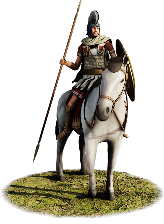
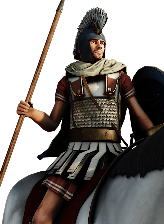
Illyrian Noble Cavalry are a dangerous, if rare unit to encounter. They combine the best of Illyrian and Greek tactics and technology to defeat their enemies. Each cavalryman holds a Sibyna spear, a long Illyrian knife, as well as a Greek shield – the aspis. These men are unusually heavily equipped for Illyrians as they actually wear armour, in this case a Linothorax – tough linen armour that was either imported or looted from Greek artisans. Their heads are well-protected, too, as they use the iconic Illyrian and Monunius helmets, which guard their faces and ears with a durable layer of bronze. This unit represents the heaviest cavalry available to the Illyrians, a deadly encounter for both enemy medium cavalry and infantry!
Historical background
Nobles, chiefs, bigmen, all sorts of words are used to discuss the hierarchy of Iron Age Illyria. The Illyrians by and large started out as pastoral peoples, practicing transhumance by raising goats and sheep, consisting of small groups of people led by warrior chiefs. As time went on, these groups grew in size and complexity, but the basic principles of following a local inspiring leader remained the same. They were just scaled up. In 423 BC, Brasidas (IV.126.2) described Illyrian society as “the few rule the many, the few having no other title to their despotic power than superiority in fighting”. These warrior chiefs and later military elites were experienced at horse-riding, in order to better protect their flocks and wealth from predators such as bears, lions, and wolves, and more importantly to raid rival tribes and clan warfare (Hammond, Illyrians And North-West Greeks (1994), p. 428). This is coherent with Late Iron Age continental European social habits, characterised by the appearance of bands of horsemen (comitatus), united by semi-sacred bonds of loyalty used by the ‘big men’ to exert their will. The further militarisation of the Illyrian elites as horsemen appears to be a reaction to outside factors, such as an increasing demand for slaves on Mediterranean markets (Dzino, Contesting Identities of pre-Roman Illyricum (2012), p. 73).
Illyrian Noble Cavalry as a unit in RIS represent the distillation and integration of Illyrian, Greek, and Hellenic equipment and accumulated experience of several centuries of war. As far back as 436 BC, the Illyrians were known to Thucydides (1.24) for successfully warring on Greeks. In this case, the Taulantii were allies of the polis of Korkyra, when they “brought low and deprived of the greatest part of its power” the city of Epidamnos. Subsequently, they assisted king Arrabaios of Lynkos in defeating the Macedonian king Perdikkas and the Spartan leader Brasidas near Lakes Ohrid and Prespa (Dzino, ‘Illyrians’ in ancient ethnographic discourse (2014), pp. 49-50). Here, we can witness an interesting contrast in the disposition of forces. While the Macedonians focussed mostly on using cavalry, with the possible addition of vassal hoplites, and seemed to lack a strong infantry component, their adversaries had a more balanced force that made use of Illyrian mobility in conjunction with heavy infantry (Stefanovski, Warfare In Archaic Macedonia (2023), p. 88).
Later in 385 BC, the Illyrians under their King Bardylis allied with Syracuse, ruled by the tyrant Dionysios, to invade Epirus and restore the exiled ruler Alketas the Molossian to his throne. As part of the deal, Dionysios sent the Illyrians 2,000 Greek soldiers (likely mercenaries) and 500 linothorakes to distribute as they saw fit. “The Illyrians distributed the suits of armour among their choicest warriors and incorporated the soldiers among their own troops” and managed to slay more than “fifteen thousand Molossians” before a relief force of Spartans made them retreat (Diodorus 15.13.1-3). However, this retreat was actually nothing more than a feint! As soon as the Spartans left, the Illyrians went straight back to pillaging Epirus, and controlled the area with enough strength that they forced the Molossian king Arybbas to retreat to Anatolia. This would have far-reaching effects upon history, as his daughter Olympias was then used in a marriage alliance with a Macedonian – the later King Philip II (Alexander the Great’s father) –, in order to curtail the Illyrian threat (Howe, Illyrian Influences on Argead Military Development (2017), p. 103). This shows how even in the late fourth century BC, the Illyrians would already have access to Greek equipment and would integrate local and Greek-style soldiers and tactics wherever appropriate.
The Illyrian style of warfare, that of combining skirmishers, melee infantry, and cavalry, may seem very obvious to a modern Total War player, but seemed quite influential on Macedonian military thinking as well as among other neighbouring peoples. In 359 BC, the Illyrians were once more warring with the Macedonians, ruled by Phillip II’s brother and ruling predecessor Perdikkas III. At this point, before the military reforms under Phillip II and Alexander, the Macedonians relied strongly on noble Companion Cavalry and citizen militias of hoplites. They found themselves crushed by the more professionalised combined arms of the Illyrian forces led by Bardylis. Phillip was given to the Illyrians as a hostage, and it is due to this experience of having lived among the Illyrians that inspired him to remodel the Macedonian army to be able to successfully face the Illyrians and their mobility (Howe (2017), p. 104). Of course, this would eventually lead to the defeat of Bardylis’ kingdom, but it still shows that the impact of his integrated military was profound.
The Illyrian Noble Cavalry have a strong basis in history and archaeology, as the appearance of the unit itself is inspired by, and based upon the Gradiste belt-plate. This belt-plate displays an Illyrian horseman, wielding a spear and aspis shield, whilst wearing an Illyrian helmet and what could be a linothorax. The linothorax was uncommon for the Illyrians, but as mentioned previously, Diodorus Siculus’ (15.13.1) account of Illyrians using gifted Syracusan linothorakes to bedeck their “choicest warriors” is compelling evidence that their elite cavalry could indeed wear armour on occasion. As for other equipment, the Noble Cavalry use the ubiquitous Illyrian helmet and Sibyna spear that are found regularly in Illyrian grave sites such as Skocjan, Dolensko, and Novi Pazar, along with the Monunius helmet, named after a Dardanian king. The Gradiste belt-plate is already reasonable evidence to show that the Illyrians used horses in battle, and this is further supported by findings in Dolensko of horse-harnesses and even spurs from the fifth century BC (Wilkes, The Illyrians (1996), pp. 55, 60, and 106). Perhaps the most interesting part of the cavalry’s panoply is their aspis shield. This is also found on an image in the National Archaeological Museum in Tirana, which depicts noble Illyrians with a large round shield, and on the Prozor belt buckle, where they look like an aspis with shield buckle (Borsic, Dzino, and Radic Rossi, Liburnians and Illyrian Lembs (2021), pp. 46-48).
Stats
| Rank in roster | ||
|---|---|---|
| Men per unit | 30 | █········· 8% |
| Attack | 11 | ███······· 34% |
| Charge bonus | 27 | █████████· 85% |
| Defence | 34 | ██████···· 55% |
| · armour | 13 | ████████·· 75% |
| · defence skill | 16 | ███······· 28% |
| · shield | 5 | ██████···· 57% |
| Morale | 11 | ████······ 39% |
| Discipline | Normal | |
| Training | Trained | |
| Recruitment cost | 2,107 dn | █████····· 54% |
| Upkeep per turn | 848 dn | ████████·· 82% |
| Turns to recruit | 3 |
Weapons
| Primary | Secondary | Primary | Secondary | Primary | Secondary | Primary | Secondary | ||||
|---|---|---|---|---|---|---|---|---|---|---|---|
| Attack | 11 | 8 | Charge bonus | 27 | 24 | Type | melee · blade | melee · blade | Damage | piercing | slashing |
| Properties | — | Armour-piercing (counts only half the target's armour) |
Defence
| Primary | Secondary | Primary | Secondary | Primary | Secondary | Primary | Secondary | ||||
|---|---|---|---|---|---|---|---|---|---|---|---|
| Total | 34 | — | Armour | 13 | — | Defence skill | 16 | — | Shield | 5 | — |
Condition and terrain
| Hit points | 1 | Mount | heavy horse | Ground: scrub / sand / forest / snow | -4 / -1 / -8 / -1 | Charge distance | 40 |
| Formations | Square · Wedge |
Technical stats
| Time between blows (primary / secondary) | 2.5 s / 2.5 s | Extra fatigue in hot climates | 2 | Spacing between men: close / loose | 2 × 4.8 m / 3 × 7.2 m | Default ranks | 5 |
In battle: Very good stamina
Who can recruit it
A core roster unit for 3 factions, each able to raise it anywhere they hold the right building:
Ardiaei · Illyrian Kingdom · Labeatae
Exactly what a settlement must have, route by route (3)
| Building | Also requires | Building | Also requires | Building | Also requires | ||
|---|---|---|---|---|---|---|---|
| Indirect Rule | Tier 2 Military Industrial Complex · Tier 1 Colony · Requires resource horses or horses supplied factionwide | Direct Rule | Tier 2 Military Industrial Complex · Tier 1 Colony · Requires resource horses or horses supplied factionwide | Homeland | Tier 2 Military Industrial Complex |