
Thracian Infantry Guard
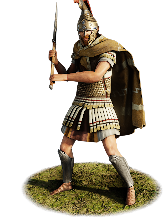
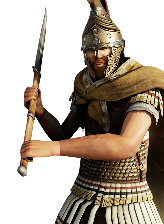
Class: light · Category: infantry · Men per unit: 40
Description
The royal guard of the Bithynian kings is made up of the descendants of the first Thracian settlers of this Anatolian region. Accordingly, most of them wear precious Thracian cloaks and fight with the impressive longsword known as the rhomphaia, which is otherwise only used in Thrace. Some of these swords are smaller and can be used one-handed, with the soldiers wearing a thureos shield in the other hand. Other romphaiai, however, are gigantic beasts, and can therefore only be used with both hands. The crested, Phrygian helmets of these Bithynian warriors come from the neighbouring Phrygians, another people who migrated from Thrace to Asia Minor in days long past. A few even have white feathers sticking out from their helmets, a sign of elite status. At the same time, most of the guards’ clothes are Greek, with a few even preferring Macedonian cloaks. Both their muscle cuirasses and iron greaves were produced in traditional Hellenic workshops, perhaps in the allied cities of Herakleia Pontike or Byzantion. Thus armed, this Thracian Infantry Guard is ready to fight and die for the king of Bithynia!
Historical background
The Bithynians (Greek: Bithynioi) once lived around the Strymon river in Thrace, before Mysians and Teukrians (perhaps Trojans) allegedly pushed them out of their ancient homeland. This, at least, is the story the Bithynians themselves told Herodotus in the late 5th century BC (Hdt. 7.75.2). Older, Bulgarian research posited that the Bithynians had lived in Paionia and were pushed out when the Paionians themselves arrived, around 700 BC (Danov, Altthrakien (1976); Mihailov, Thrace before the Persian Entry into Europe (1991)). In any case, they left Europe at some point and settled in the area later known as Bithynia, in the extreme northwest of Asia Minor. This was probably after the Phrygians had made the same journey around 900 BC, taking over vast lands across the Bosporos (Olshausen/Wittke, s.v. Phryges, Phrygia, in: DNP online). Even though there were strong Greek and Anatolian influences on both Phrygians and Bithynians, the Thracian element remained strong, especially in the Bithynian countryside (Post, Bithynian army (2022), p. 6).
There is no concrete information on a royal guard in this Bithynian kingdom, but it is conceivable that such a unit would have existed under Nikomedes I (r. 280 - ca. 255 BC) at the latest. At this point, the state had become well-established, and the Northern League safeguarded its existence. When Ziaelas, the son and successor of Nikomedes, who was also an ally of the Ptolemies, married his daughter to the Seleucid pretender Antiochos Hierax in 239 BC, he became the first Bithynian king to be recognised by the two big Hellenistic powers (Gabelko, The Dynastic History of the Hellenistic Monarchies in Asia Minor (2005), pp. 94-99). Ziaelas was followed by his son Prusias (Greek: Prousias) in 230 BC, who was keen to be seen as one of the great kings of the Greek world himself. Therefore, he made generous donations to Rhodes following the destruction of the Colossus of Rhodes through an earthquake c. 227-225 BC (Polyb. 5.90.1). A guard of Thracians armed with the most expensive Greek-style armour would definitely have existed by that point, as it would have served the aims and the ambitions of Prusias. Nikomedes had already armed the Galatians with his own equipment when he transported them to Asia Minor in 278/277 BC (Memn. 11.5), and it would be logical if Prusias did the same with his personal guard. His army, with Thureophoroi, Thureophoroi cavalry or heavy cavalry, alongside traditional Thracian infantry and skirmishers as well as a guard unit, would have been a force to be reckoned with, and, soon, he would put it to good use.
At first, Prusias went to war with his erstwhile ally Byzantion in the so-called Monopoly War in 220 BC. Using the freshly established relations with Rhodes, he forged a new coalition that broke the Northern League with Byzantion, Kios, and Herakleia when the opportunity presented itself. The Byzantines at this time were hard pressed by the Tylian Celts under King Kavaros, and accordingly raised the tolls for goods shipped through the Bosporos (Polyb. 4.46.3-4). Many unhappy traders now turned towards the mercantile republic of Rhodes to help them. When Rhodian envoys to Byzantion achieved nothing, Rhodes declared war (Polyb. 4.47.1-6). Prusias duly joined them, for he was offended by the Byzantines. They had neglected honours for his royal line, ignored his invitation to his Soteria games, and seemingly undermined his attempts at expansion by brokering between his rivals Attalos I of Pergamon and the Seleucid usurper Achaios (Polyb. 4.49.1-3). Meanwhile, Byzantine attempts to convince Attalos to support them were futile, for Attalos was hard pressed by Achaios, the ruler of much of southern Anatolia. Achaios himself, however, was happy to help, and joined the Monopoly War on the side of Byzantion (Polyb. 4.47.7-48.13). Prusias then decided to attack the Byzantines on land, while the Rhodians would lead operations at sea (Polyb. 4.49.4).
Byzantion felt so betrayed that they asked Philip V of Macedon to send Zipoites, the half-brother of Prusias’ father Ziaelas (Memn. 14.1), from his Macedonian exile to the Bosporos (Polyb. 4.50.1). Ostensibly, the plan was to kill Prusias and replace him with Zipoites (cf. Polyb. 4.50.8-9). The outraged Prusias immediately invaded the Asiatic territory of Byzantion and captured many towns including the so-called Holy Place, a strategic site on the Bosporos (Polyb. 4.50.2-4). Polybios does not mention Chalkedon, another member of the Northern League, which was probably under Byzantine control as its coins became identical in the late 3rd and 2nd century BC (see, e.g., Schönert-Heiss-1263-70; SNG BM Black Sea 82-var). Though the Rhodians had also attacked Byzantion and blocked the access to the Bosporos with a fleet at Sestos, the Byzantines held firm, possibly because Chalkedon, just opposite the Bosporos, was still under their control (cf. Polyb. 4.50.5-7). The tides only turned when the Rhodians freed Andromachos, the father of Achaios, from Alexandria: once they handed him over, Achaios accepted a ceasefire with Rhodes and Bithynia (Polyb. 4.50.10-51.6). Even better for Prusias, Zipoites suddenly died, suspiciously, just before reaching Byzantion (Polyb. 4.51.7). Ambitious to crush the Byzantines once and for all, the Bithynian king now reached out to his kinsmen and persuaded certain Thracians (perhaps the Asti or the Odrysians) to attack Byzantion on the European side (Polyb. 4.51.8). Yet, when Kavaros of Tylis began arbitrating between the warring parties, both the Rhodians and Prusias were ready to listen to his suggestions (Polyb. 4.52.1-3). On the one hand, the Byzantine concession to cancel the tolls, not least because the Tylians seemingly ended their war against them, meant that Rhodes in particular had achieved its main goal. On the other hand, Prusias had to agree to give up all fortresses, people, slaves, ships, and even missiles, timber, tiles, and stones his men had taken from the Byzantines (Polyb. 4.52.5-10). This is quite surprising, and I would suggest that Chalkedon, which Polybios does not mention once, must have held out against the Bithynian army and blocked any further advances, so that Prusias decided to take the smaller victory.
Around the same time, Attalos of Pergamon brought his “own” Galatians to Asia to combat Achaios: the Aigosages. As always, the Celts soon began pursuing their own goals and turned their eyes towards affluent Ilion, the historical successor of Troy. Once they heard about Ilion being besieged, the inhabitants of neighbouring Alexandreia in the Troad bravely raised their militia of four thousand men and broke the siege (Polyb. 5.111.1-4). The Aigosages now marched northwards to Abydos on the Dardanelles and occupied Arisba, one of its towns (Polyb. 5.111.5). From there, they plundered the surrounding countryside. Prusias did not hesitate to grasp his chance, assembled his army, and overwhelmed the Aigosages. Even their wives and children were slaughtered to the last (Polyb. 5.111.6-7). The message was clear: Bithynia protected the Greeks in the Troad, and its army was superior to any Galatian force. Philip V was convinced and seemingly offered Prusias an alliance during the First Roman-Macedonian War, in which the Bithynians fought against Pergamon (cf. Liv. 29.12.14). In 202 BC, by giving him the town of Myrleia, Philip convinced Prusias to turn against another former ally: Kios. The combined army besieged and eventually captured Kios, enslaving much of its population and renaming the city to “Prusias by the sea” (cf. Polyb. 15.21-23). Despite his alliance with its enemy, the Romans eventually acknowledged Prusias’ conquests to stop him from allying with Antiochos III in the war between Rome and the Seleucids (192-188 BC) (Polyb. 21.11).
Despite this agreement, the senate was not too happy when Prusias invaded Attalid Phrygia and occupied most of it in 190 BC. The Romans thus supported Pergamon in its war against Bithynia, while the Galatians fought on Prusias’ side. Furthermore, he was able to draw on the knowledge of Hannibal, who had been in exile with Antiochos and then Armenia before arriving in Nikomedia. Here, he helped to reorganise the troops – perhaps including the guards – and successfully led both navies and armies from 190 to 184 BC (Nepos, Hannibal, 10-11). After the Romans had defeated the Galatians, their troops left Asia, but Eumenes II of Pergamon could draw on the support of Bithynia’s former ally Herakleia Pontike, which must have been irritated after Prusias’ attacks on Byzantion and Kios. Prusias now captured Kieros, renaming it Prusias, and then occupied Tieion before enclosing Herakleia. When trying to storm the city with his best troops, he broke his leg and was thoroughly defeated, however, earning him the nickname Cholos, “the lame” (Memn. 19.1-3). Eventually, Eumenes defeated the remaining Galatians in two battles, however (IPerg 65; Segre, Due nuovi testi storici (1932)), and when the Romans offered to broker a peace should Prusias hand over Hannibal, he sacrificed the famous commander, who committed suicide (Nepos, Hannibal, 12). A year after the peace, Prusias himself died of natural causes. Almost four decades later, his son Prusias II, too, would be protected by a Thracian guard until his own death (App. Mithr. 1.6).
AThe guard unit of such a busy king would have been very important, probably saving his life several times in the campaigns against Byzantion, the sieges of Kios and Herakleia, or the battles against the Aigosages. Little concrete information on the Bithynian guard units exists, though, and thus we simply combined weapons attested in neighbouring regions and among the Thracians, like the romphaia, which would have given these warriors an edge over their enemies. Phrygian helmets are obviously from nearby Phrygia, which Prusias conquered and then had to give up again in 183 BC, while muscle cuirasses and greaves were popular among Greek elites for centuries.
Stats
| Rank in roster | ||
|---|---|---|
| Men per unit | 40 | ███······· 30% |
| Attack | 17 | █████████· 87% |
| Charge bonus | 38 | ██████████ 98% |
| Defence | 30 | ████······ 43% |
| · armour | 12 | ███████··· 69% |
| · defence skill | 16 | ███······· 28% |
| · shield | 2 | ███······· 25% |
| Morale | 15 | █████████· 91% |
| Discipline | Normal | |
| Training | Untrained | |
| Recruitment cost | 2,119 dn | █████····· 54% |
| Upkeep per turn | 776 dn | ████████·· 75% |
| Turns to recruit | 3 |
Weapons
| Primary | Secondary | Primary | Secondary | Primary | Secondary | Primary | Secondary | ||||
|---|---|---|---|---|---|---|---|---|---|---|---|
| Attack | 17 | — | Charge bonus | 38 | — | Type | melee · blade | — | Damage | slashing | — |
| Properties | Armour-piercing (counts only half the target's armour) | — |
Defence
| Primary | Secondary | Primary | Secondary | Primary | Secondary | Primary | Secondary | ||||
|---|---|---|---|---|---|---|---|---|---|---|---|
| Total | 30 | — | Armour | 12 | — | Defence skill | 16 | — | Shield | 2 | — |
Condition and terrain
| Hit points | 1 | Modifier against mounts | horse +2 · camel +2 | Ground: scrub / sand / forest / snow | 0 / -1 / -2 / -1 | Charge distance | 30 |
| Formations | Square |
Technical stats
| Time between blows (primary / secondary) | 2.5 s / — | Extra fatigue in hot climates | 1 | Collision mass per man (1.0 is normal) | 1.14 | Spacing between men: close / loose | 1 × 1.2 m / 2 × 2.4 m |
| Default ranks | 5 |
In battle: Can hide in long grass · Can sap · Frighten nearby enemy infantry · Warcry improves attack · Very good stamina
Who can recruit it
A core roster unit for 8 factions, each able to raise it anywhere they hold the right building:
Asti · Bessi · Bithynia · Cabyle · Dentheletae · Maedi · Paeonia · Triballi
Exactly what a settlement must have, route by route (2)
| Building | Also requires | Building | Also requires | ||||
|---|---|---|---|---|---|---|---|
| Direct Rule | Tier 3 Military Industrial Complex · Tier 2 Colony | Homeland | Tier 2 Military Industrial Complex |