
Thracian Shieldbearers
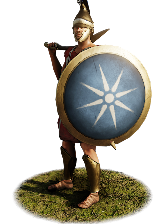
Class: light · Category: infantry · Men per unit: 40
Description
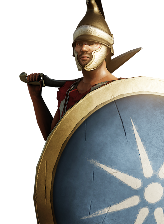
Thracian Shieldbearers are attendants to the Hellenised Thracian aristocracy, acting as nimble but heavy infantry that supports the Thracian nobles in combat. Even though they do not wear body armour, they are still relatively heavily equipped for Thracians, carrying Greek-style aspis shields and being protected by Phrygian helmets and greaves. These men are armed with machaira and xiphos swords. Their lack of armour and spears makes them vulnerable to missile and cavalry attacks. Like other Thracian infantry, they are best used aggressively rather than in defensive positions.
Historical background
Shieldbearers have a long history in Greek service, as Classical hoplites brought attendants on campaign to carry their shields. Xenophon mentions his shield-bearer (abandoning him) in the Anabasis (IV.2.20). They are also mentioned at the battle of Lechaion, where they are tasked to carry the wounded Spartans off the battlefield (Xen. Hell. IV.5.14). The shield bearers become most prominent as the Hypaspistai in the army of Aleander the Great, turning from aides into an elite unit for special missions (Lane Fox, Philip: Accession, Ambitions, and Self-Presentation (2011), p. 342). There they made up three chiliarchiai (1,000 each) or 6 lochoi (500 men each) (Arr. Anab. V.23.7; Sekunda, The Macedonian Army (2010), p. 455). They were probably lighter armed and thus contrasted with the heavier infantry of the phalanx (Arr. Anab. II.4.3; Sekunda (2010), p. 455) and may be depicted on the Alexander sarcophagus from the royal necropolis of Ayaa near Sidon (Lebanon). The use of royal hypaspistai by the diadochoi continued into the middle Hellenistic period. Philip V still had hypaspistai at Sikyon in 218 BC (Pol. V.27.3; Sekunda (2010), p. 459); or after Kynoskephalai (Pol. XVIII.33.2), in both instances indicated to be the closest attendants to the king. This is also confirmed by the Amphipolis inscription, where the quarters of the hypaspistai are to be put up in the immediate proximity of the king (Sekunda (2010), p. 459; Hatzopoulos, L’Organisation de L’Armée Macedonienne (2001), p. 57). The long rule of Macedonian elites in Thrace through Philip II, Alexander the Great, Lysimachos, and the involvement of Seleucids and Ptolemies in the area, likely Hellenised parts of the Thracian elites and military. We hear much less concrete information about them in the Hellenistic-era sources, and some may have adopted infantry guards similar to those in Macedonian service. Stoyanov asserts that the employment of Greek mercenary armies and generals like Xenophon and Iphikrates suggests an evolution of the Thracian military even before Macedonian involvement (Stoyanov, ‘Warfare’, in: A Companion to Ancient Thrace (2015), p. 437).
A potential infantry guard could be depicted on the 4th century BC Alexandrovo painting. It shows a Thracian with a blue aspis, decorated with stars, fighting a cavalryman with a sword (Webber, The Gods of Battle (2011), chapter: ‘Shields’). Two other aspis-bearers are shown in the antechamber of the Alexandrovo tomb. Those that are clothed wear the same style of attire as the Thracians in the hunting scene in another room and as the Thracians in the 3rd century BC Kazanlak tomb. Webber asserts that, since they are likely not Greeks, they may depict some sort of Thracian bodyguard of the king. Their armament of Phrygian helmets, aspis shields, swords, and greaves resembles that of the two infantry guards (presumably hypaspists) on the Alexander sarcophagus.
Another shield bearer is shown as retinue of a cavalryman on the wall painting of the North Thracian (Getic?) 3rd century BC tomb at Sveshtari (Webber (2011), chapter: shields). A few round shields have been found in Thrace (Stoyanov, ‘Warfare’, in: A Companion to Ancient Thrace (2015), pp. 429-430), an aspis shield on the Vishegrad peak, as well as a bronze rim and palmetto-decorated handgrip in a 4th century BC tomb near Topolovgrad, and a fragment of a similar rim at Sevtlen, decorated with concentric circles (Webber (2011), chapter: ‘Shields’). Though they show that the usage of such a shields in Thracian context may have been rare, it was not non-existent, and may indeed have been reserved for guard units or small infantry detachments.
This unit is further armed with xiphos swords like those found at the Zimnica necropolis, which must have had scabbards like those featured on the walls of the Alexandrovo tomb (Stoyanov (2015), p. 428). The Thracian/Phrygian helmet (or ‘tiara’ helmet: Dintsis, Hellenistische Helme (1986), pp. 50-53) was very popular in Thrace in the Classical period. Over twenty Phrygian helmets were found in Thrace (and an unknown number in private collections) and are also depicted on the wall paintings of Kazanlak and Alexandrovo tombs (Stoyanov (2015), p. 430). Greaves become common in Thrace during the 4th century BC (ibidem, p. 431). Two strategic fortifications were found in southern Thrace, probably built by Philip II (Kalyva in the southwestern Rhodope mountains and Buyuk Kale occupying the “Vishegrad” peak in the Sakar Mountains). A tumulus has been discovered in one of them near the platform of a wall, with a 4th century BC warrior grave (perhaps of an officer), which contained an aspis shield, spear, and xiphos. Whether it was a Macedonian or Thracian officer is impossible to say (Stoyanov (2015), p. 435).
Stats
| Rank in roster | ||
|---|---|---|
| Men per unit | 40 | ███······· 30% |
| Attack | 15 | ███████··· 72% |
| Charge bonus | 16 | ███████··· 69% |
| Defence | 30 | ████······ 43% |
| · armour | 3 | ██········ 21% |
| · defence skill | 22 | ██████···· 61% |
| · shield | 5 | ██████···· 57% |
| Morale | 14 | ████████·· 79% |
| Discipline | Normal | |
| Training | Untrained | |
| Recruitment cost | 1,984 dn | █████····· 49% |
| Upkeep per turn | 726 dn | ███████··· 70% |
| Turns to recruit | 2 |
Weapons
| Primary | Secondary | Primary | Secondary | Primary | Secondary | Primary | Secondary | ||||
|---|---|---|---|---|---|---|---|---|---|---|---|
| Attack | 15 | — | Charge bonus | 16 | — | Type | melee · blade | — | Damage | slashing | — |
Defence
| Primary | Secondary | Primary | Secondary | Primary | Secondary | Primary | Secondary | ||||
|---|---|---|---|---|---|---|---|---|---|---|---|
| Total | 30 | — | Armour | 3 | — | Defence skill | 22 | — | Shield | 5 | — |
Condition and terrain
| Hit points | 1 | Ground: scrub / sand / forest / snow | 0 / -1 / 0 / -1 | Charge distance | 30 | Formations | Square |
Technical stats
| Time between blows (primary / secondary) | 2.5 s / — | Extra fatigue in hot climates | 0 | Collision mass per man (1.0 is normal) | 0.98 | Spacing between men: close / loose | 1 × 1.2 m / 2 × 2.4 m |
| Default ranks | 5 |
In battle: Can hide in long grass · Can sap
Who can recruit it
A core roster unit for 4 factions, each able to raise it anywhere they hold the right building:
Asti · Cabyle · Odrysian Kingdom · Paeonia
Exactly what a settlement must have, route by route (3)
| Building | Also requires | Building | Also requires | Building | Also requires | ||
|---|---|---|---|---|---|---|---|
| Indirect Rule | Garrison Building or Tier 1 Military Industrial Complex · Tier 1 Colony | Direct Rule | Garrison Building or Tier 1 Military Industrial Complex · Tier 1 Colony | Homeland | Garrison Building or Tier 1 Military Industrial Complex |