
Athamanian Peltasts
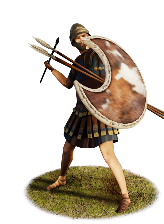
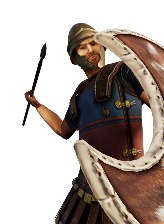
Class: missile · Category: infantry · Men per unit: 40
Description
The Athamanian Peltasts are valuable skirmishers, hailing from the mountainous border region that separates Epirus from Thessaly and the land of the Aitolians. As equipment, they carry a bundle of light javelins and a sword for use in melee, as well as a crescent-shaped pelte shield, konos or pilos type helmets, and sometimes linothorax armour. These men are sturdy fighters, and will serve anyone able to pay sufficient amounts of gold as enthusiastically as their current Epirote overlord!
Historical background
The Athamanians were a proud and once independent people in the south-eastern parts of Epirus. Their uneasy insistence on their proper Greek descent may reflect the view of others that they were barbarians (Rigsby, Asylia (1996), p. 297; see also Strab. 7.7.1). Plato is even reported to have stated that "the descendants of Athamas are Greek, of course" (Plat. Min. 315). The Athamanians, Greek or otherwise, were ruled by their own kings until the great Pyrrhos subdued them to his authority in 281 BC. They are mentioned as mercenaries at the Battle of Asculum (279 BC), serving together with similar infantry from Aitolia and Acarnania on Pyrrhos’ left wing (Diod. Hal. XX.1.3). When some Roman troops had withdrawn on a wooded hill, out of reach of the Epirote elephants, Pyrrhos sent his Athamanians after them, together with the Acarnanians and some Samnites. The Romans, however, intercepted them with their cavalry, ‘[…] and there was still greater slaughter’ (Diod. Hal. XX.3.6).
Later, the Athamanians would also fight for rather than against the Romans during the Second Roman-Macedonian War. In 197 BC the army of consul Titus Quinctius Flamininus was reinforced by 1,200 Athamanians under their king Amynander at Phtiotis. Soon thereafter, these troops contributed to Flaminius’ victory over Philip V of Macedon at the Battle of Cynoscephalae (Livy XXXIII.3.10).
While it is unclear in what style the Athamanian infantry fought, the military traditions of their broader region of origin and their ascribed position in Pyrrhos’ battle line suggest that they will likely have served as flexible javelin-throwing infantry, also known as ‘peltasts’ after their typical crescent-shaped shield, which is how we have chosen to depict them in our mod.
Stats
| Rank in roster | ||
|---|---|---|
| Men per unit | 40 | ███······· 30% |
| Attack | 13 | ██████···· 57% |
| Charge bonus | 3 | ██········ 16% |
| Defence | 29 | ████······ 40% |
| · armour | 10 | █████····· 54% |
| · defence skill | 16 | ███······· 28% |
| · shield | 3 | ████······ 37% |
| Morale | 8 | ██········ 19% |
| Discipline | Normal | |
| Training | Trained | |
| Recruitment cost | 1,268 dn | █········· 9% |
| Upkeep per turn | 464 dn | ██········ 18% |
| Turns to recruit | 3 |
Weapons
| Primary | Secondary | Primary | Secondary | Primary | Secondary | Primary | Secondary | ||||
|---|---|---|---|---|---|---|---|---|---|---|---|
| Attack | 13 | 6 | Charge bonus | 3 | 4 | Type | thrown · archery | melee · blade | Damage | piercing | piercing |
| Projectile | javelin | — | Range | 60 | — | Ammunition | 7 | — | Properties | Thrown | — |
Defence
| Primary | Secondary | Primary | Secondary | Primary | Secondary | Primary | Secondary | ||||
|---|---|---|---|---|---|---|---|---|---|---|---|
| Total | 29 | — | Armour | 10 | — | Defence skill | 16 | — | Shield | 3 | — |
Condition and terrain
| Hit points | 1 | Ground: scrub / sand / forest / snow | 8 / -1 / 8 / -1 | Charge distance | 30 | Formations | Square |
Technical stats
| Time between blows (primary / secondary) | 2.5 s / 2.5 s | Extra fatigue in hot climates | 1 | Collision mass per man (1.0 is normal) | 1.04 | Spacing between men: close / loose | 1 × 2.4 m / 1.8 × 4.32 m |
| Default ranks | 5 |
In battle: Very good stamina
Who can recruit it
A core roster unit for one faction, which can raise it anywhere it holds the right building:
Any faction holding one of the provinces below can field it.
Exactly what a settlement must have, route by route (4)
| Building | Also requires | Building | Also requires | Building | Also requires | Building | Also requires |
|---|---|---|---|---|---|---|---|
| Indirect Rule | Tier 2 Military Industrial Complex · Tier 1 Colony | Direct Rule | Tier 2 Military Industrial Complex · Tier 1 Colony | Homeland | Tier 2 Military Industrial Complex | Any settlement | Tier 2 Military Industrial Complex · Athamanian area of recruitment · Dependency or Indirect Rule · Tier 1 Colony not built |
Areas of recruitment
| Zone | Provinces | ||||||
|---|---|---|---|---|---|---|---|
| Athamanian | 0 |