
Description
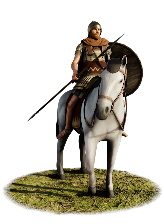
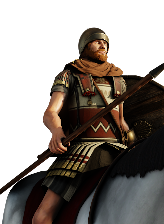
Bithynian cavalry represent a curious mix between Greek, Anatolian, Thracian, and Celtic traditions. Their clothes and colourful cloaks are a combination of Hellenic and Thracian styles, while their large, round, flat shield has no spina like the Greek aspis, and may be an Anatolian design. Most of these horsemen wear a special helmet with wide, crimped brim and highly arching bowl and peak that is a unique Bithynian invention. Some, however, prefer the Phrygian helmet or the Sidon type introduced to their region by the Ptolemies. Thracian shoulder yoke cuirasses and Greek style muscle cuirasses protect their torsos, but their combination of spear and javelin is also unusual for heavy cavalry. This makes Bithynian cavalry a particular unit with a variety of strengths. In the hands of a good commander, they can defeat most of their enemies, and decide the outcome of a tight battle.
Historical background
Under Nikomedes I (r. ca. 280-255 BC), the Kingdom of Bithynia prospered, expanded, and adopted many elements of the emerging culture of the so-called Hellenistic world. The exact development of its cavalry is difficult to trace, and horsemen are not specifically mentioned by any literary account for his reign. By the 2nd century BC, aspis shields are safely attested among Bithynian cavalry (Nefedkin, On the Origin of Greek Cavalry Shields in the Hellenistic Period (2009), p. 361). Nikomedes I already heavily featured the shield on his coins, however, in combination with the Thracian goddess Bendis, the deity of hunting and horses (RecGen1 = De Luynes 2421; RecGen 2). Since we know very little about the early Bithynian army and there are few alternatives for units, Bithynian cavalry is accordingly available from early on. That Nikomedes chose the Thracian goddess also fits the fact that his overt Hellenisation had little effect in the countryside, where most Bithynians stuck to their Thracian roots and traditions (Post, Bithynian army (2022), p. 6).
Around 250 BC, Nikomedes’ oldest son Ziaelas had won the War of the Bithynian Succession and followed his father on the throne (cf. Memn. 14.1-3). Soon after, he minted his first coins, on which small cavalry lance heads appear (e.g., Imhoof-Blumer (1898), p. 35 nr. 60 = Hoover (2012), p. 209 no. 612). Bithynian horsemen had long since enjoyed a good reputation (cf. Xen. Anab. 6.4.26), but only as light cavalry, not heavy cavalry. If the lance heads are correctly identified, however, these would be associated with heavier cavalry capable of charging an enemy. Perhaps, he had learned the advantages of having such a unit during his time in Armenia. In any case, it was likely a tribute to the contributions of his horsemen, for Ziaelas had not only won the war against his stepmother and stepsiblings, but also went to war several times during his reign as king. As Bithynia was still considered a breakaway state by the Seleucids, he at first forged an alliance with the Ptolemies (Syll.³ 456 = Welles 25 = Burstein, The Hellenistic Age (1985), no. 26). This would have been useful during the Third Syrian War, also known as the Laodikeia War, for Laodike had poisoned both her former husband, the Seleucid king Antiochos II, and Berenike, the sister of king Ptolemy III (Athen. 13.593d = Phylarchos, FGrHist 81 F24; Appian. Syr. 65.344-345; Plin. nat. hist. 7.53; Iust. 27.1.1-2). While the Ptolemaic forces swept their Seleucid enemies from the battlefields of the Eastern Mediterranean, Ziaelas deepened the existing ties between Bithynia and Kos, which was part of the Ptolemaic realm (Bagnall, The administration of the Ptolemaic possessions (1976), p. 103). In a letter to the polis of Kos, he reminds the Koans of the goodwill of his father Nikomedes, recognises the sacred asylum of the temple of Asklepios, and promises to care for the protection of all Greeks (Syll.³ 456 = Welles 25 = Burstein, The Hellenistic Age (1985), no. 26). A similar phrase is later found in a letter from Scipio Africanus to Herakleia-on-Latmos in Caria (Syll.³ 618), which implies that Ziaelas had to prove he was Hellenic, too, using the famous site of Kos to improve his reputation (Fears, The Cult of Virtues (2016), p. 868).
While Ziaelas’ army may not have actively fought in the Laodikeia War, later, eastward expansion of his kingdom is attested (Arrian, Bithyniaka, FrGrHist 156 F89b and a tropaion (victory monument) on a coin, cf. Schottky, s.v. Ziaelas, in: DNP online). Since the Galatians were his allies (Memn. 14.1-3) and Memnon, the historian of Herakleia, does not mention any involvement of the Herakleiotes, this enemy must have been the Seleucids, more precisely Seleukos II Kallinikos (“the beautiful victor”), who ruled from 246 to 226 BC. In 246 BC, Seleukos had appointed his fourteen-year-old brother Antiochos to reclaim and rule Asia west of the Tauros. The young boy took possession of vast stretches of Asia Minor and did not intend to hand these back to Seleukos, however (Iust. 27.2). When the Laodikeia War came to an end, the now 19-year old turned to Ziaelas and offered to marry his daughter. Around the same time, Seleukos wed Laodike, the sister of Mithridates II of Pontos (Porphyrios FGrH 260 F 32,8). When Ziaelas accepted the proposal, the two Seleucid monarchs had acknowledged the two ‘rebel’ kingdoms Bithynia and Pontos (Gabelko, The Dynastic History of the Hellenistic Monarchies in Asia Minor (2005), pp. 94-99). Supported by Bithynia and the Galatians, Antiochos, now known as Hierax (“the hawk”), confronted his brother in battle and defeated him at Ancyra in 239 BC (Grainger, The Rise of the Seleucid Empire (2014), p. 195). Armenian troops, too, may have been involved, as Ziaelas had spent time in exile there, and so would Antiochos Hierax in 227 BC (Schottky, Ziaelas), and Cappadocians, as Ariarathes III at times acted as an ally of Antiochos (Olbrycht, Early Arsakid Parthia (2021), p. 71). The Galatians soon turned against Antiochos, however, and he bought them off to survive (Iust. 27.2). Next, Attalos I of Pergamon declared for Seleukos and Antiochos, Ziaelas and the Galatians fought against him (Phylarchos FGrH 81 F 50), while Ziaelas also founded the new fortress towns Kressa and Zela to secure his conquests from Seleukos in the east (Steph. Byz. s.v. Kressa & s.v. Zela).
During these campaigns, Bithynian cavalry would have been most useful for both Ziaelas and Antiochos. It could not prevent the king’s death, however: ironically, the man who had gained the throne only thanks to the Galatians, was slain by the Galatians fighting on the side of Antiochos Hierax. A battle at Pergamon in 230 BC ended in defeat for the attackers, and seeing that Antiochos’ case was probably lost, the Galatians killed his loyal ally Ziaelas (Pomp. Trog. prolog. 27; Phylarchos FGrH 81 F 50). Ziaelas was followed by his son Prusias (Greek: Prousias), this time without any known bloodshed. There is a wealth of evidence for Bithynian cavalry in the time of Prusias (r. 230-182 BC) and, subsequently, in the period of his grandson Nikomedes II (r. 149-127 BC). A relief from the newly founded city of Prousa depicts a horseman with Aspis shields and what are perhaps two javelins (Nefedkin (2009), p. 361), a similar warrior, protected by a muscle cuirass, appears on a grave stele from Daskyleion, dated to the 2nd century BC (Post (2022), p. 6), while a gold stater of Nikomedes II also depicts a horseman with a flat, round shield (Nefedkin (2009), p. 361). Shoulder yoke cuirasses similar to linothorakes protect the other riders. Finally, a heavy cavalryman on the stela of Phila and her family from the mid 2nd century BC uses his long spear overarm, and a later relief from Miletopolis in nearby Mysia (1st century BC), too, portrays a rider with flat Aspis, cuirass, and spear (Nefedkin (2009), p. 361). Perhaps, even the round shield on the stele of Diliporis from the early 2nd century BC belonged to such a horseman, though it looks relatively small (Post (2022), p. 8). The Bithynian helmet on these images is a synthesis of the Boiotian helmet with its wide, crimped brim, and the late Hellenistic pilos with its highly arching bowl and peak. The motifs on the shields, meanwhile, are inspired by the aforementioned coins of Nikomedes I with Bendis (RecGen1 = De Luynes 2421; RecGen 2) and on a relief from Pergamon, shown on the marble balustrade of the Temple of Athena, which may represent captured equipment from the Bithynian enemy (you can see it in the Pergamonmuseum in Berlin, if it ever opens again). The unit is thus well-sourced and such dual-purpose, mounted contingents would have perfectly fit the multicultural nature of the Bithynian army.
Stats
| Rank in roster | ||
|---|---|---|
| Men per unit | 30 | █········· 8% |
| Attack | 11 | ███······· 34% |
| Charge bonus | 24 | ████████·· 81% |
| Defence | 29 | ████······ 40% |
| · armour | 9 | █████····· 50% |
| · defence skill | 15 | ██········ 24% |
| · shield | 5 | ██████···· 57% |
| Morale | 12 | ██████···· 57% |
| Discipline | Normal | |
| Training | Untrained | |
| Recruitment cost | 2,030 dn | █████····· 51% |
| Upkeep per turn | 817 dn | ████████·· 79% |
| Turns to recruit | 3 |
Weapons
| Primary | Secondary | Primary | Secondary | Primary | Secondary | Primary | Secondary | ||||
|---|---|---|---|---|---|---|---|---|---|---|---|
| Attack | 11 | 10 | Charge bonus | 24 | 28 | Type | thrown · archery | melee · blade | Damage | piercing | piercing |
| Projectile | javelin | — | Range | 60 | — | Ammunition | 7 | — | Properties | Thrown | — |
Defence
| Primary | Secondary | Primary | Secondary | Primary | Secondary | Primary | Secondary | ||||
|---|---|---|---|---|---|---|---|---|---|---|---|
| Total | 29 | — | Armour | 9 | — | Defence skill | 15 | — | Shield | 5 | — |
Condition and terrain
| Hit points | 1 | Mount | light horse | Ground: scrub / sand / forest / snow | 0 / -1 / -4 / -1 | Charge distance | 40 |
| Formations | Square |
Technical stats
| Time between blows (primary / secondary) | 2.5 s / 2.5 s | Extra fatigue in hot climates | 2 | Spacing between men: close / loose | 2 × 4.8 m / 3 × 7.2 m | Default ranks | 5 |
In battle: Very good stamina
Who can recruit it
A core roster unit for one faction, which can raise it anywhere it holds the right building:
Any faction holding one of the provinces below can field it.
Exactly what a settlement must have, route by route (5)
| Building | Also requires | Building | Also requires | Building | Also requires | Building | Also requires |
|---|---|---|---|---|---|---|---|
| Any settlement | Tier 2 Military Industrial Complex · Bithynian area of recruitment · Any Government (Dependency, Indirect Rule or Direct Rule) · Tier 2 Colony not built · Requires resource horses or horses supplied factionwide | Indirect Rule | Tier 2 Military Industrial Complex · Tier 1 Colony · Requires resource horses or horses supplied factionwide | Direct Rule | Tier 2 Military Industrial Complex · Tier 1 Colony · Requires resource horses or horses supplied factionwide | Homeland | Tier 2 Military Industrial Complex |
| Any settlement | Tier 2 Military Industrial Complex · Bithynian area of recruitment · Dependency or Indirect Rule · Tier 1 Colony not built |
Areas of recruitment
| Zone | Provinces | ||||||
|---|---|---|---|---|---|---|---|
| Bithynian | 0 |