
Bithynian Epibatai
Class: missile · Category: infantry · Men per unit: 40
Reforms: Unlocked by Second wave of military innovations have arrived!, Bithynian Reforms I
Description
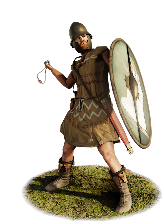
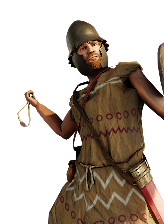
These marines fight for the kings of Bithynia in northwestern Anatolia. Since the time of Zipoites, who reigned during the early 3rd century BC, Bithynia has become a regional power, and its location on the Propontis means that it needs a fleet to uphold this position. For this purpose, the king has trained a division of soldiers that is capable of fighting ship-to-ship. They are armed with large thureos shields, various helmets (Bithynian helmets, Bithynian konos, Phrygian and Sidon/Attico-Boiotian helmets) - slings and xiphos swords, with some being brave enough to wear a muscle cuirass. The heavy armour may save them from missile fire, but it could also lead to their death by drowning. These soldiers are recruited from brave, young men, who dream of glory. If need arises, they are prepared to die for Bithynia, so that Bithynia may live!
Historical background
Little is known about the early history of Bithynia, aside from there being no navy at all. The first known Bithynian prince was a man called Doidalsos, who lived in the 5th century BC (Memn. 12.3-4). He was seemingly a friendly neighbour to the Megarian colony of Astakos on the Propontis. Astakos had been founded in 712/711 BC and was allegedly named after a descendant of Kadmos’ Spartoi, the co-founders of Thebes who grew out of dragon teeth (Memn. 12.2, Apollod. 3.4). Others in the area (possibly Thracians or Mysians) had attacked Astakos until Athens sent new settlers, and Bithynia, too, seems to have supported this re-foundation of the city (Memn. 12.3, Strab. 12.4.2C563). Many Bithynians still lived in the hills at this time and tried to make a living by occasionally raiding the towns under Persian control. In 399/398 BC, the Achaemenids even enlisted the help of the Lakedaimonian commander Derkylidas to deal with such attacks (Xen. Hell. 3.2.2-5). Doidalsos’ position may just have been that of a warlord or local prince rather than that of a ruler over all Bithynians. His dynasty, however, would remain on the Bithynian throne for centuries to come (Bevan, House of Seleucus (1902), p. 82).
Doidalsos was followed by Boteiras, his nephew or brother, who lived for 76 years (Memn. 12.4). During this period, we hear nothing of the events in Bithynia. Boteiras died in ca. 377 BC and left the kingdom to his 21-year-old son Bas (Memn. 12.4). Towards the end of Bas’ reign, Alexander invaded Asia, bound to bring down the Achaemenid Empire. The Bithynians now faced the danger of being subjugated by the Macedonians. Alexander had appointed Kalas, the son of Harpalos from the Elimiotis (in Upper Macedonia) (Arr. Anab. 1.14.3) as the governor of Hellespontine Phrygia, which bordered Bithynia (Anab. 2.4.2). He assembled a decent army including well-trained Macedonians and marched against Bithynia. Bas was well prepared, however, and proved himself a capable general when he defeated Kalas in battle (Memn. 12.4). For now, Bithynia was saved, but when Alexander died in 323 BC, his diadochi cast their hungry eyes on the lands southeast of Chalkedon.
In 327 or 326 BC, Zipoites followed Bas on the throne of Bithynia (Memn. 12.5). He initially consolidated his position before attempting a policy of expansion. In 315 BC, he besieged Astakos and Chalkedon, but the mighty diadoch Antigonos Monophthalmos sent his general Ptolemy against him - the Bithynians lost the subsequent battle (Diod. 19.60.2). Zipoites acknowledged his inferiority and accepted Ptolemy’s offer of an alliance in the name of Antigonos (Diod. 19.60.3). Zipoites now built up his power base, but the victory of the anti-Antigonid coalition in a huge battle at Ipsos in 301 BC spelt new trouble, for the diadoch Lysimachos now laid claim to Bithynia. When he invaded the country, Zipoites showed he was his father’s son: both Macedonian armies were defeated, with one of the commanders being killed and the other running for his life (Memn. 12.5). The Bithynian ruler made the best of the moment and though another attack on Chalkedon faltered (Plut. mor. 302e), Astakos was finally conquered in 297 BC (Paus. 5.12.7). After these victories, Zipoites took the title basileus and thus became king. In 281 BC, he fought on the side of Seleukos I against Lysimachos at Kurupedion and contributed to the victory and Lysimachos’ death (Schottky, s.v. Zipoites (1), in: DNP online; cf. Memn. 12.5). Now full of confidence, the aged Zipoites returned home to Bithynia and then immediately attacked Herakleia Pontike to the east. In a brutal invasion, thousands of Herakleiotes and Bithynians died and not even Seleucid reinforcements could stop Zipoites' army (Memn. 6.3, 9.5, 12.5). Though he eventually evacuated the territory of Herakleia when further Seleucid forces showed up (Memn. 9.5), he retained the Thynis and the Greek cities Kieros and Tios/Tieion, and had thus greatly expanded his realm before dying later in the year 280 BC at the age of 76 (Schottky, s.v. Zipoites). His final act was the foundation of a new city, Zipoition, named after himself, under Mount Lyparos (Memn. 12.5).
Although Astakos was destroyed in the last war with Lysimachos (Strab. 12.4.2C563) and Zipoition has never been found, Astakos had been in Bithynian hands as its first port city and Kieros and Tieion, too, possessed harbours. They would be sold back to Herakleia by Zipoites son’ Nikomedes (Memn. 9.4), but that king still held Thynia and he, too, enlarged Bithynia. Henceforth, it would always retain access to the sea. This meant that the kingdom needed a fleet to protect its coasts. However, the sources say almost nothing on any naval Bithynian activities, and even less on the soldiers aboard such a navy. Hence, our best piece of evidence is a stele from Kios, erected in the early 2nd century BC. Kios, southwest of Bithynia, had once been a flourishing, independent city and an ally of the kingdom in the Northern League when it was ruled by Nikomedes I (r. 280-ca. 255 BC) (Kaye, The Attalids of Pergamon and Anatolia (2023), p. 188). Yet, Nikomedes’ grandson, Prusias I (r. ca. 228-182 BC), betrayed and attacked Kios, conquering it with the help of the Antigonid king Philip V (r. ca. 221-179 BC) in 202/201 BC (Polyb. 15.21-23). A large part of the population was enslaved and many of Kios’ buildings destroyed, much to the anger of the Bithynians (Polyb. 15.23.10). The city was, however, rebuilt as “Prusias by the sea”, and among the edifices one would find the stele of Nikasion. While Gabelko (Tale of Two Cities (2015) passim) argues that he was a Kian marine who fought in the naval skirmish against the advancing Bithynian fleet in 202 BC, Post (The Bithynian Army in the Hellenistic Period (2022), p. 11) was convinced he was a Bithynian navy soldier. The latter seems more likely, for Polybios emphasises that most of the Kian population had been enslaved and/or carried off, and the stela was erected in the Bithynian kingdom after the defeat of Kios. But even if Nikasion had been a member of the Kian defence fleet, the erection of his monument would demonstrate he joined the Bithynian navy after the destruction of his home.
Therefore, we can now use the stele as evidence for Bithynian epibatai. Nikasion stands on the prow of a ship, looking across the sea at another galley and a slain Galatian, who is being submerged by the waves. A muscled cuirass with pteryges over a chiton and a thureos shield can easily be identified, while the type of the plumed helmet and weapons are harder to define. Nevertheless, Nikasion’s pose suggests that he was originally wielding a spear. His feet are bare, but this may be a heroic motif - surely, boots would be more practical in a fight. For helmets, we have decided to use the so-called Bithynian helmet and what we termed the Bithynian konos helmet. Both appear on various stela, but the first can be best made out on the Deydinler stele from ca. 150 BC (Post (2022), stele F) while the second is prominent on the stele of Phokritos, son of Dionysios, which was found at Kios (1st half of the 2nd century BC, Post (2022) stele K). The Bithynian variant is much more elaborate than a standard konos, with a cramp reminiscent of a Boiotian helmet shielding both neck and forehead and large cheek guards protecting, well, the cheeks. The “Bithynian helmet” is different again, and looks like a synthesis of the late Hellenistic pilos and a Boiotian helmet: a wide, crimped Boiotian brim is combined with a high, arching bowl and the peak of the late pilos. Unlike a pilos helmet, however, it has a bowl that rises to a slender peak (see Post (2022) for further discussion). Phrygian and Sidon helmets complete the headgear of our Bithynian epibatai as they were common throughout the Hellenistic world (something already noted for the Phrygian by: Samuel Rush Meyrick, A criticial inquiry into ancient armour (1842), p. xvi).
The reader may still have one question, though: why slings? According to the interpretation of Ruben Post, the Galatian enemy of Nikasion (also a marine) fights with a sling (Post (2022), p. 11) and slings - or just thrown stones - were indeed a very useful weapon in the chaotic and often obstructed combat between and on ships (De Souza, Raiders from the Sea (2017), p. 215). Unfortunately, RTW does not allow the combination of sling and spear, so the latter has been replaced with a straight xiphos sword which can be seen, e.g., on the floor stele of Mokazis from Tarsos in Bithynia (now Adliye Köy: Rumscheid/Held, Erinnerungen an Mokazis (1994)) or on the Alexandrovo tomb in Thrace, the original home of the Bithynians (Webber, Odrysian Cavalry (2003), p. 550). Finally, a muscle cuirass is a great risk on a ship in the open sea, and therefore some of our marines only wear chlamys and chiton like the other marine on the left ship on the stele of Nikasion (Post (2022), p. 11).
Stats
| Rank in roster | ||
|---|---|---|
| Men per unit | 40 | ███······· 30% |
| Attack | 7 | █········· 6% |
| Charge bonus | 10 | ████······ 35% |
| Defence | 35 | ██████···· 57% |
| · armour | 9 | █████····· 50% |
| · defence skill | 22 | ██████···· 61% |
| · shield | 4 | █████····· 48% |
| Morale | 11 | ████······ 39% |
| Discipline | Normal | |
| Training | Trained | |
| Recruitment cost | 1,973 dn | █████····· 48% |
| Upkeep per turn | 722 dn | ███████··· 69% |
| Turns to recruit | 2 |
Weapons
Its secondary attack is the stronger one: 10 against 7.
| Primary | Secondary | Primary | Secondary | Primary | Secondary | Primary | Secondary | ||||
|---|---|---|---|---|---|---|---|---|---|---|---|
| Attack | 7 | 10 | Charge bonus | 10 | 11 | Type | missile · archery | melee · blade | Damage | blunt | piercing |
| Projectile | stone | — | Range | 150 | — | Ammunition | 27 | — |
Defence
| Primary | Secondary | Primary | Secondary | Primary | Secondary | Primary | Secondary | ||||
|---|---|---|---|---|---|---|---|---|---|---|---|
| Total | 35 | — | Armour | 9 | — | Defence skill | 22 | — | Shield | 4 | — |
Condition and terrain
| Hit points | 1 | Ground: scrub / sand / forest / snow | 0 / -1 / 0 / -1 | Charge distance | 30 | Formations | Square |
Technical stats
| Time between blows (primary / secondary) | 2.5 s / 2.5 s | Extra fatigue in hot climates | 2 | Collision mass per man (1.0 is normal) | 1.13 | Spacing between men: close / loose | 1.2 × 1.4 m / 2.4 × 2.8 m |
| Default ranks | 5 |
In battle: Can sap · Very good stamina
Who can recruit it
A core roster unit for one faction, which can raise it anywhere it holds the right building:
Any faction holding one of the provinces below can field it.
Exactly what a settlement must have, route by route (4)
| Building | Also requires | Building | Also requires | Building | Also requires | Building | Also requires |
|---|---|---|---|---|---|---|---|
| Any settlement | Trade Port · Garrison Building or Tier 1 Military Industrial Complex · Second wave of military innovations have arrived! · Bithynian area of recruitment · not Phrygian area of recruitment · Any Government (Dependency, Indirect Rule or Direct Rule) · Tier 2 Colony not built | Indirect Rule | Trade Port · Garrison Building or Tier 1 Military Industrial Complex · Bithynian Reforms I · Tier 1 Colony | Direct Rule | Trade Port · Garrison Building or Tier 1 Military Industrial Complex · Bithynian Reforms I · Tier 1 Colony | Homeland | Trade Port · Garrison Building or Tier 1 Military Industrial Complex · Bithynian Reforms I |
Areas of recruitment
| Zone | Provinces | ||||||
|---|---|---|---|---|---|---|---|
| Bithynian | 0 |