
Etruscan Hoplites
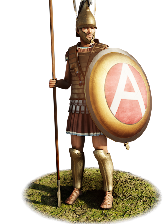
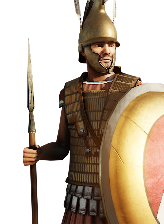
Class: spearmen · Category: infantry · Men per unit: 40
Description
"The Etruscans, who fought with round shields of bronze and in phalanx formation, impelled them to adopt similar arms." – Diodorus Siculus, Library of History (23.2.1), explaining how the early Romans adopted the Etruscan style of war to defeat them.
Armoured with richly decorated bronze panoplies, these Hoplites represent the traditionalist core of the Etruscan aristocracy. They are highly valued for their discipline and fierceness and able to hold the line in both attack and defence. While the widespread adoption of more flexible unit tactics and large oval shields (thureos or scutum) by both Romans and Celts has made the phalanx a rare sight in Central Italy, these noble champions and their retainers hold on to the traditions and equipment of their ancestors. Their greater personal wealth allows these men to afford the best protection available: linothorax, muscle, or lamellar cuirasses, scale corselets, greaves, as well as crested Attic, Chalcidian, or Etrusco-Thracian helmets. For defence they put their trust in a bronze “argive” shield (aspis), often emblazoned with their family heraldry or regional emblems, such as the surveyor's level motif “A” found on Etruscan coinage and paintings. Armed with heavy javelins, long thrusting spears (dory), and (in RIS purely decorative) xiphos swords for close-fighting or when their spear breaks, these spearmen are able to overcome any enemy infantry charge. Should a strong ruler manage to restore the power and influence of Volsinii and the Etruscan League, these proud aristocrats will stand ready to defend their people and give their life to the League whenever they are summoned to war.
Historical background
The culture of the Etruscans was profoundly transformed through centuries of interaction with the Greek world, with their military being heavily influenced by it. Taylor tells us that for the Etruscans, the “exotic Greek combat gear was a marker not only of the military dominance they exerted over their own societies but also of their international horizons and cosmopolitan sophistication” (Taylor, 'Etruscan Identity and Service in the Roman Army: 300–100 B.C.E.', in: AJA 121-2 (2017), pp. 277-278). The appearance of Etruscan warriors armed in the hoplite manner was not an indication of democratic citizen-states (poleis), but rather of a highly stratified social structure dominated by royal and aristocratic clans (gentes) and their dependent clients. In the Servian centuriate order, recorded by Dionysius of Halicarnassus (4.16.3) and Livy (1.43.4), the wealthiest class rated at 100,000 asses or 100 minae was required to furnish complete personal armour, including bronze helmets, cuirasses, greaves, swords, and heavy shields.
During the 4th and 3rd centuries BC, these aristocratic elites governed the Twelve City-States of the Etruscan League and oversaw sacred federal assemblies at the Fanum Voltumnae (Campo della Fiera near Volsinii). According to Calapà, even after the fall of the old Volsinii to M. Fulvius Flaccus in 264 BC and the Social War, the Etruscan epigraphy still "shows a certain degree of continuity in family names and a relative stability of the local elite". They preserved their social standing, wealth, and civic religious authority under Roman hegemony (Calapà, 'Sacra Volsiniensia. Civic Religion in Volsinii after the Roman Conquest', in: TRAC (2013), p. 39). So strong were their traditions that "the Etruscan League of the ‘Twelve Peoples’ of Etruria was renewed in the Early Imperial Age, probably on Augustus’ initiative: it included fifteen Etruscan cities and was clearly concerned only with religious ceremonies and spectacles" (Calapà (2013), p. 44).
Regarding Volsinii, Calapà makes it clear that "the destruction and forced refoundation of the city did not lead to the eradication of local cults". While it faced obvious changes following the conquest of the city by the Romans, "the sanctuary of Campo della Fiera was renovated after the conquest and still enjoyed popularity in the Imperial Age. The hypothesis of its identification with the fanum Voltumnae, if proved to be correct, would obviously explain the centrality of this cult place in Roman Volsinii, where the celebrations of the League of the ‘Fifteen Peoples’ still marked the cultural and religious life of the city" (Calapà (2013), p. 44). Lastly, Calapà concludes that the "prestige of Volsinii as prominent religious centre of the Etruscan League, whose sacred ceremonies were revitalized during the Imperial Age, may have contributed to the persistence and to the vitality of traditional cult places, such as the sanctuary of Nortia and possibly the fanum Voltumnae" (Calapà (2013), p. 45).
In the Mid-Republican period, while the common infantrymen increasingly adopted the standardized Italo-Roman panoply (scutum, Montefortino helmet, and gladius), the Etruscan aristocracy preserved their Hellenized hoplite equipment on costly cinerary urns and votive bronzes (Taylor (2017), p. 276). As Taylor notes, Etruscan artwork for the elite maintained an "Hellenic alterity in terms of armor and equipment. Indeed, in terms of martial aesthetics, the Etruscan elite appear far more hellenized than their Roman counterparts" (Taylor (2017), p. 287). This was a “sign of cultural aloofness and social snobbery, allowing the elites to separate themselves from both their Roman counterparts and the classes below them in their own communities’’ (Taylor (2017), p. 276). Furthermore, a beautiful 4th-century BC wall painting from the Giglioli Tomb at Tarquinia depicts all the equipment used by this unit. From heavy javelins (pila), shields with painted emblems, including the famous “A”, a himation, xiphos swords, greaves, and helmets, all represented in this unit.
One element of armour that stands out in relation to its equipment is the famous Etruscan Linothorax from the ”Mars of Todi”, a bronze statue that was excavated intact back in 1835. The statue follows the artistic standards of the Attic-Polycletian school of sculpturing (430-400 BC) and probably depicts a hoplite, performing the act of a propitiatory libation by offering a sacrifice (“patera”) just before the start of battle. It was excavated in the Umbria region (Northwest of Rome), with archaeologists believing it originated from a renowned workshop in the Etruscan city of Orvieto. Currently, the statue is being displayed at the “Museo Etrusco Gregoriano”, part of the Vatican Museums. In terms of design, the armour follows the traditional Greek-style linothorax , which consists of the “epomides” (shoulder guards), torso, and pteryges (lower wings) clearly visible. The striking feature is that the epomides and torso are covered by numerous long, narrow, rectangular lamellae which are arranged in parallel rows and overlap each other along the horizontal axis. The space between the parallel rows has been covered by a strip of circular cross-section which bears a spiral deployment, and its purpose is probably to cover the existing gap between the rows. The wings are short, double-rowed, and do not have any lamellar protection, like the rest of the armour. The cuirass is secured with five pairs of rings (attachment points for leather straps), two pairs on the upper chest and three pairs on the left underarm lateral area. The interior is lined with linen, while all the edges are covered with folded leather. The end result is a heavy cuirass that offers satisfactory protection against incoming threats such as arrows, swords, and spears. It was certainly a luxurious and expensive type of armour available only for hoplites of aristocratic background, based on the Hellenistic models and fabricated by Etruscans ('Etruscan Linothorax – "Mars of Todi"', in: Hellenic Armors’; cf. Brendel, Etruscan Art [1978]).
Stats
| Rank in roster | ||
|---|---|---|
| Men per unit | 40 | ███······· 30% |
| Attack | 16 | ████████·· 80% |
| Charge bonus | 14 | ██████···· 60% |
| Defence | 45 | █████████· 87% |
| · armour | 10 | █████····· 54% |
| · defence skill | 30 | █████████· 93% |
| · shield | 5 | ██████···· 57% |
| Morale | 12 | ██████···· 57% |
| Discipline | Normal | |
| Training | Highly trained | |
| Recruitment cost | 1,837 dn | ████······ 40% |
| Upkeep per turn | 672 dn | ██████···· 60% |
| Turns to recruit | 3 |
Weapons
| Primary | Secondary | Primary | Secondary | Primary | Secondary | Primary | Secondary | ||||
|---|---|---|---|---|---|---|---|---|---|---|---|
| Attack | 16 | 11 | Charge bonus | 14 | 16 | Type | thrown · blade | melee · blade | Damage | piercing | piercing |
| Projectile | javelin | — | Range | 50 | — | Ammunition | 2 | — | Properties | Used just before charging into combat | Light spear (braced against cavalry charges from the front) · +8 attack against cavalry |
Defence
| Primary | Secondary | Primary | Secondary | Primary | Secondary | Primary | Secondary | ||||
|---|---|---|---|---|---|---|---|---|---|---|---|
| Total | 45 | — | Armour | 10 | — | Defence skill | 30 | — | Shield | 5 | — |
Condition and terrain
| Hit points | 1 | Ground: scrub / sand / forest / snow | 0 / -1 / -1 / -1 | Charge distance | 30 | Formations | Square |
Technical stats
| Time between blows (primary / secondary) | 2.5 s / 2.5 s | Extra fatigue in hot climates | 3 | Collision mass per man (1.0 is normal) | 1.27 | Spacing between men: close / loose | 1 × 1.05 m / 2 × 2.4 m |
| Default ranks | 5 |
In battle: Can sap · Good stamina
Who can recruit it
A core roster unit for one faction, which can raise it anywhere it holds the right building:
Any faction holding one of the provinces below can field it.
Exactly what a settlement must have, route by route (3)
| Building | Also requires | Building | Also requires | Building | Also requires | ||
|---|---|---|---|---|---|---|---|
| Direct Rule | Tier 3 Military Industrial Complex · Tier 2 Colony | Homeland | Tier 2 Military Industrial Complex | Any settlement | Tier 2 Military Industrial Complex · Etruscan area of recruitment · not Faliscan area of recruitment · Dependency only · Tier 1 Colony not built |
Areas of recruitment
| Zone | Provinces | ||||||
|---|---|---|---|---|---|---|---|
| Etruscan | 0 |