
Histri Axe Cavalry
Class: missile · Category: cavalry · Men per unit: 30
Description
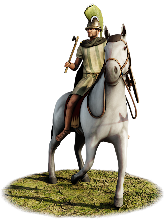
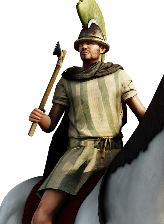
Histri Axe Cavalry are an evolution upon the typical Illyrian horseman. Although still using the javelin and axe as primary weapons, they show some development in their equipment, as they hold a small wooden shield to protect their vitals. The Histri are a little wealthier than the average Illyrian, so their heads are protected by Negau helmets, too. It is only their bodies that remain without armour, just using the short Illyrian tunic to stay light and flexible. Keep them moving, hit the enemy hard and fast, but do not dither if you want these men to survive!
Historical background
The history of the Histri is something of a mystery, and most of their recorded identity is one of opposition to Rome. The Histri dwelt in Istria, a large peninsula on the Adriatic Sea that took its name from the people who dwelled there, which is mostly in modern Croatia but also partially Italian and Slovenian. It was a fairly barren land, but had plentiful coastlines fit for hiding ships, and also had a reputation for growing some of the finest olive oil on its rocky soil (Wilkes, The Illyrians (1996), p. 185). They neighboured the Transalpine Iapodes, Liburnians, and Veneti, and were known for piracy. Their location meant that on some occasions they were considered part of Cisalpine Gaul, or Italy, and did not form part of the Roman province of Illyricum (Sasel Kos, Appian and Illyricum (2005), p. 123). This area was a melting pot for many disparate cultures and peoples, so for Greek and Roman writers it was unclear who exactly the Histri were. While most called them Illyrians, some suggested they were Veneti, or even both at the same time. Pliny the Elder (Plin. Nat. 3.6) names them alongside other Illyrian tribes when describing the coast of Magna Graecia, “the Iapodes, the Histri, and the Liburni”. Appian (Illyr. VIII. 22) concurs that they are “one of the Illyrian people”, as does Strabo: “the Istri were the first nation on the Illyrian coast” (Strab. 7.5.17). On the other hand, Livy (Liv. 10.2.4) separates the Histri from the Illyrians, listing various groups of pirates as “the Illyrians, Liburnians, and Histrians”.
Modern historian John Wilkes redefines the Histri as a Venetic people, along with the Carni, Liburnians, and Veneti (naturally) – a distinct group of Illyrians with Venetic languages (Wilkes (1996), p. 183). Much like their neighbouring Liburnians, the Histri were little affected by La Tene culture. Instead, they displayed much more influence from Greek, Hellenic, and later Roman cultures, and enjoyed a relatively prosperous society without many notable changes such as civil wars (Terzan and De Marinis, The Northern Adriatic (2018), p. 33).
The Histri had a formidable reputation in Rome as “savage tribes and notorious most of them [the Illyrians] for their piracies” (Liv. 10 2). They lived close enough to Rome that this would cause problems in the future, for when the city of Aquileia was founded, the citizens felt sufficiently threatened by the neighbouring Histrians and Illyrians to call for help from the senate. This would backfire for both the Aquileians and the Histrians, as the resident consul Cassius used it as an excuse to march through Illyria, looting all the way, in order to attack Macedon, which led to many diplomatic protests from the affected peoples (Wilkes (1996), p. 153). The Histri were frequently hostile to Rome, with Eutropius (3.7) recording Roman frustration about pirates attacking Roman grain ships. Marjeta Sasel Kos suggests that the systematic nature of Histri piracy during the First Histrian War in 221-220 BC shows a degree of centralised government that implies they were a kingdom at that time (Sasel Kos (2005), p. 273). This claim could perhaps be supported when it is considered that the Histri had developed an urbanised society with political institutions between the fourth and second centuries BC (Dzino, Illyricum in Roman Politics (2010), p. 37). The Histri fought two major wars against Rome until their eventual submission to Tuditanus in 177 BC (Sasel Kos, The Tauriscan Gold Mine (1999), p. 209), although they would later join in with the Great Illyrian Revolt. For a people living so close to Rome, it is an achievement that the Histri remained independent for so long before becoming the Tenth Region of Italy (Wilkes (1996), p. 209).
The equipment of the Histri Axe Cavalry is based on findings from tumulus, which are a form of burial mound, or barrow, prevalent in many Illyrian cultures. The findings from a complex of mounds in Romaje in modern Kosovo inspired many of our Illyrian cavalry units as within that complex, one tumulus contained multiple lances, Sibyna spears, battleaxes, and most importantly, a horse bridle to show that the owner once rode with these (Lippert, Die Illyrer: Kulture und Sprache eines alteuropaischen Volkes (2022), p. 62). Findings of armour are rare, whereas helmet findings are much more common. In one case there were 30 helmets of varying types discovered in the Dolensko region (Wilkes (1996), pp. 239-40). Archaeological findings of warriors and their equipment being buried together are an irregular occurrence, as sometimes it was taboo in Illyrian culture. Nevertheless, findings include equipment like swords, spears, shields, and helmets (Hammond, The Cambridge Ancient History: Illyrians and North-west Greeks (1994), pp. 425, 428). So, in the end, we settled on a unit with Illyrian Negau helmets, javelins, axes, and shields, but without armour, as seems to have been common during RIS’ timeframe in this region.
Stats
| Rank in roster | ||
|---|---|---|
| Men per unit | 30 | █········· 8% |
| Attack | 10 | ██········ 19% |
| Charge bonus | 18 | ███████··· 72% |
| Defence | 16 | █········· 10% |
| · armour | 2 | █········· 13% |
| · defence skill | 14 | ██········ 17% |
| · shield | 0 | █········· 0% |
| Morale | 9 | ███······· 26% |
| Discipline | Normal | |
| Training | Untrained | |
| Recruitment cost | 1,485 dn | ██········ 16% |
| Upkeep per turn | 598 dn | ████······ 40% |
| Turns to recruit | 2 |
Weapons
| Primary | Secondary | Primary | Secondary | Primary | Secondary | Primary | Secondary | ||||
|---|---|---|---|---|---|---|---|---|---|---|---|
| Attack | 10 | 6 | Charge bonus | 18 | 25 | Type | thrown · archery | melee · blade | Damage | piercing | slashing |
| Projectile | javelin | — | Range | 60 | — | Ammunition | 7 | — | Properties | Thrown | Armour-piercing (counts only half the target's armour) |
Defence
| Primary | Secondary | Primary | Secondary | Primary | Secondary | Primary | Secondary | ||||
|---|---|---|---|---|---|---|---|---|---|---|---|
| Total | 16 | — | Armour | 2 | — | Defence skill | 14 | — | Shield | 0 | — |
Condition and terrain
| Hit points | 1 | Mount | light horse | Ground: scrub / sand / forest / snow | 0 / 0 / -3 / 0 | Charge distance | 40 |
| Formations | Square |
Technical stats
| Time between blows (primary / secondary) | 2.5 s / 2.5 s | Extra fatigue in hot climates | 0 | Spacing between men: close / loose | 2 × 4.8 m / 3.6 × 6.72 m | Default ranks | 5 |
In battle: Can form Cantabrian circle · Very good stamina
Who can recruit it
A core roster unit for one faction, which can raise it anywhere it holds the right building:
Any faction holding one of the provinces below can field it.
Exactly what a settlement must have, route by route (4)
| Building | Also requires | Building | Also requires | Building | Also requires | Building | Also requires |
|---|---|---|---|---|---|---|---|
| Any settlement | Garrison Building or Tier 1 Military Industrial Complex · Histrian area of recruitment · Any Government (Dependency, Indirect Rule or Direct Rule) · Tier 2 Colony not built | Indirect Rule | Garrison Building or Tier 1 Military Industrial Complex · Tier 1 Colony | Direct Rule | Garrison Building or Tier 1 Military Industrial Complex · Tier 1 Colony | Homeland | Garrison Building or Tier 1 Military Industrial Complex |
Areas of recruitment
| Zone | Provinces | ||||||
|---|---|---|---|---|---|---|---|
| Histrian | 0 |