
Iapodian Elite Spearmen
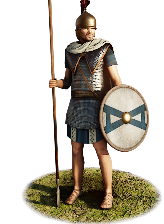
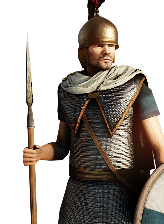
Class: spearmen · Category: infantry · Men per unit: 40
Description
“The Iapodes on the far side of the Alps, a powerful and savage people, had within a period of about twenty years twice repulsed Roman attacks, raided Aquileia, and plundered the Roman colony of Tergestum.” – Appian, The Illyrica (XVIII. 52).
Iapodian Elite Spearmen are staunchly proud and independent warriors. They wield long Sibyna spears with great skill, round shields that are often coated in leather, and gut foes who get too close with their Thracian style sica daggers if their shield wall is broken. They are vested with linen or chainmail armour, and their accoutrements include Celtic style chain belts along with Smarjeta and Negau helmets. These Iapodes are a steadfast and lethal force that is to be reckoned with.
Historical background
The Iapodes lived and radiated outward from the region behind the western Croatian Velebit mountain range. In Lika, they also ranged to the middle reaches of the Kolpa river and the upper parts of the river Una. In the heights of their expansion, the Iapodes even managed to control some of the Kvarner coast around Senj (Terzan and De Marinis, The Northern Adriatic (2018), p. 33). The impact of Iapodian occupation of the coastal region around Tarsatica is evidenced by a variety of archaeological sites, ranging from the end of the third to early second century BC and other, nearby littoral areas from Rijeka to Jablanac, which even show further Iapodian activity throughout the Iron Age. Only in the end of the second or dawn of the first century BC did the Iapodes lose control of this vital area to the Liburnians, a circumstance that could mostly have been due to heavy attrition caused by warring with the Romans (Sasel Kos, Appian and Illyricum (2005), pp. 104-5).
There are significant archaeological findings in the old Iapodian territories, including large cemeteries with both flat and tumulus style graves. These were often found near settlements and helped uncover many different examples of what Iapode elites were buried with and give a somewhat mixed picture of the extent to which the Iapodes were influenced by the Celtic La Tene culture. Grave findings have made clear that the Iapodes had strong commercial connections all the way to the Baltic, with a large upper class consuming these fairly rare imported goods, embellishing their jewellery with amber and bronze. Interestingly enough, despite having the capability to access distant trade networks, most of the material goods found in cemeteries show that the Iapodes were generally self-reliant with what they made. They seldom copied the styles of other peoples, with Celtic styles being fairly rare and La Tene cultural motifs only generally being found in Iapodian brooches (Terzan and De Marinis (2018), p. 34). The lack of significant La Tene cultural findings in Iapodian territory creates a somewhat contrasting image of the Iapodes when compared against Strabo’s (Book VI, XI) statement that the Iapodes were “a nation now mixed with the Illyrians, and Kelts”. Daniel Dzino suggests that although Iapodes had the Illyrian cultural habits of being tattooed, they were also seen wearing Celtic armour and shields, which would have seemed reason enough for Strabo to claim that the Iapodes were a mixture of both cultures (Dzino, The Celts In Illyricum (2008), p. 57). Furthermore, Sasel Kos theorises that the reason that the Celtic influence has been mostly superficial in Iapodian archaeological findings was possibly due the Celts not settling south of Sava, a mountainous hinterland region of the Iapodes (Sasel Kos (2005), p. 220). Indeed, rather contrary to this idea of Iapodian Celticness, the Iapodes maintained a fairly autarkic and autonomous culture that lived on until their eventual defeat and subjugation by Rome in 33 BC (Terzan and De Marinis (2018), p. 35).
Iapodian Elite Spearmen’s equipment and combat style are based upon archaeological evidence and attested to in written sources. Appian (Illyr. XX 56) describes a battle where the Iapodes ambushed Roman soldiers and “stabbed them with long spears”. Appian’s emphasis on long spears was perhaps the most poignant part, as it could be interpreted that the Iapodes’ Sibyna spear was at the more extreme range of spear length when compared to what other Illyrians fielded, as the average Sibyna spear measured between 2-2.5 metres. The spearheads themselves had a rhombic shape and varied in length, with Iron Age examples in Croatia, Serbia, and Slovenia of spearheads ranging from a 20-35cm, with some extreme examples measuring up to 40-50cm (Terzan and De Marinis (2018), p. 81). The knives themselves are of a fairly ubiquitous Thracian or Dacian style, and are representative of the Iapodes’ traditional use of their own derivative of the sica. These have been found throughout their territorial stomping grounds from the southeast of the Alps up to Pannonia, dating before the late La Tene period. Using single edged, bladed daggers or swords was in fact quite common throughout the Central Balkans during the early Iron Age, so it is extremely likely that the Iapodian Elite Spearmen would have used this and other similarly recurved blades (Terzan and De Marinis (2018), pp. 37-38). These Elite Spearmen, therefore, represent a fairly ‘timeless’ fighting warrior of the Iapodes from the time before the subsequent developments of the late La Tene period.
Stats
| Rank in roster | ||
|---|---|---|
| Men per unit | 40 | ███······· 30% |
| Attack | 12 | █████····· 48% |
| Charge bonus | 16 | ███████··· 69% |
| Defence | 48 | █████████· 93% |
| · armour | 6 | ████······ 38% |
| · defence skill | 39 | ██████████ 100% |
| · shield | 3 | ████······ 37% |
| Morale | 14 | ████████·· 79% |
| Discipline | Normal | |
| Training | Untrained | |
| Recruitment cost | 2,209 dn | ██████···· 57% |
| Upkeep per turn | 808 dn | ████████·· 78% |
| Turns to recruit | 4 |
Weapons
| Primary | Secondary | Primary | Secondary | Primary | Secondary | Primary | Secondary | ||||
|---|---|---|---|---|---|---|---|---|---|---|---|
| Attack | 12 | — | Charge bonus | 16 | — | Type | melee · blade | — | Damage | piercing | — |
| Properties | Light spear (braced against cavalry charges from the front) · +8 attack against cavalry | — |
Defence
| Primary | Secondary | Primary | Secondary | Primary | Secondary | Primary | Secondary | ||||
|---|---|---|---|---|---|---|---|---|---|---|---|
| Total | 48 | — | Armour | 6 | — | Defence skill | 39 | — | Shield | 3 | — |
Condition and terrain
| Hit points | 1 | Ground: scrub / sand / forest / snow | -1 / -1 / -2 / -1 | Charge distance | 30 | Formations | Square |
Technical stats
| Time between blows (primary / secondary) | 2.5 s / — | Extra fatigue in hot climates | 0 | Collision mass per man (1.0 is normal) | 0.99 | Spacing between men: close / loose | 1 × 1.2 m / 2 × 2.4 m |
| Default ranks | 5 |
In battle: Can hide in long grass · Can sap · Very good stamina
Who can recruit it
A core roster unit for one faction, which can raise it anywhere it holds the right building:
Any faction holding one of the provinces below can field it.
Exactly what a settlement must have, route by route (4)
| Building | Also requires | Building | Also requires | Building | Also requires | Building | Also requires |
|---|---|---|---|---|---|---|---|
| Any settlement | Tier 3 Military Industrial Complex · Iapodian area of recruitment · Any Government (Dependency, Indirect Rule or Direct Rule) · Tier 2 Colony not built | Direct Rule | Tier 3 Military Industrial Complex · Tier 2 Colony | Homeland | Tier 2 Military Industrial Complex | Any settlement | Tier 2 Military Industrial Complex · Iapodian area of recruitment · Dependency only · Tier 1 Colony not built |
Areas of recruitment
| Zone | Provinces | ||||||
|---|---|---|---|---|---|---|---|
| Iapodian | 0 |