
Iapodian Swordsmen
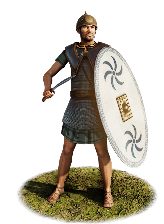
Class: light · Category: infantry · Men per unit: 40
Reforms: Unlocked by Military innovations have arrived!, Iapodian Swordsmen Reform
Description
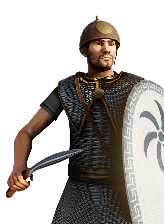
Iapodian Swordsmen are cunning and robust warriors, capable of skirmishing in the Illyrian style but also in forming a virtually unbreakable shield wall. Should the battle call for it, they will not hesitate to use their oblong, wooden shields covered with leather to that purpose. They are armed with javelins and a uniquely Illyrian angled Pritoka-Bela Cerkev type long knife, useful not only as a tool, but also for carving through or even stabbing enemies. Their armour is formidable, with many of these men donning Celtic mail, along with bronze or iron helmets of either the Montefortino or Smarjeta types. Even the Romans under Augustus feared trying to break these scary, tattooed men!
Historical background
The recorded history of the Iapodes and their territory is a fairly long one for an Illyrian tribe. The earliest preserved mention of them can be found in fragments of Hecataeus of Miletus from the late 6th to early 5th century BC. This fragment states: “Two cities: one in Italy and the other in Illyria. As Hecataeus (writes). The ethnic is Iapyx, Iapigios, and Iapygia”, and was cited by Stephanus of Byzantium when he discussed the Iapgyria having a city in Italy and Illyria in his Lexicon Ethnica (Huseinovic, The land of the “Illyrian” Iapodes (2022), p. 157). The Iapodes, much like other Illyrian groups, were no strangers to war with Rome, having had a mutually hostile first-contact experience due to Gaius Cassius Longinus attacking them rather petulantly after failing to defeat Macedon before signing peace treaty in 171 BC and Rome sending them reparations for such conniving and spiteful behaviour. The Iapodes later bore the brunt of an indecisive campaign by Gaius Sempronius Tuditanus in 129 BC (Huseinovic (2022), p. 163), which was possibly conducted with the motive to halt their seaward expansion into Liburnian territory (Dzino, Illyricum in Roman Politics (2010), p. 70).
Appian notes that at the time of Octavian’s campaign from 35 BC – 33 BC, the Iapodes were residing “inside the Alps and on the other side of the Alps” (Ill. 3. 4. 16; 27, 18 - 21), referring to what we now know as the Transalpine and Cisalpine Iapodes. This is a wording that is still under some discussion, as it is unclear whether it was just a geographical or also a political division (Dzino, The people who are Illyrians and Celts (2008), p. 421). Cassius Dio (21. 49. 35 – 38) also, albeit in passing, revealed an interesting development upon Appian, that the Iapodes “dwelling not very far from the sea” gave little resistance against Octavian compared to the fortified settlement of Metulum. This would suggest the territory of the Iapodes was still significant in size and breadth, spanning more than just the area between mountain ranges by 35 BC.
Matters between the Iapodes and their evil Roman neighbours truly came to a head when Octavian (the later Emperor Augustus) declared war upon many Illyrian groups at the same time, including the regional heavyweights the Delmatae and the Iapodes, along with others, such as the Salassi, Segestani, and Pannonians. Several Alpine tribes of Iapodes, the Arupini, Avendeatae, and Moentini surrendered at the onset. But the Transalpine Iapodes fought hard and proved to be one of Octavian’s most dangerous enemies. They gathered forces at their fortified capital, Metulum, smashing the initial Roman attack and even wounding Octavian when he had to rally the disheartened attackers and personally led an assault on the city (Sasel Kos, Octavian’s Illyrian War (2018), p. 42). This showed that they were more than capable of adapting to use different military technology when the need forced them. Even after the war they were held in some regard by Strabo (Geographika, VII, 5, 4): “They are indeed a war-mad people, but they have been utterly worn out by Augustus. Their cities are Metulum, Arupini, Monetium, and Vendo. Their lands are poor, the people living for the most part on spelt and millet. Their armour is Celtic, and they are tattooed like the rest of the Illyrians and the Thracians.”
Iapodian Swordsmen represent the combination of several distinct military innovations, both Celtic and homegrown. While the Iapodes were tenacious defenders of their own ways and traditions, they were also not afraid to incorporate new things (Huseinovic, p. 178). Appian (Ill. 19) attests to “3000 well-armed and warlike Iapodian warriors” during the siege of Metulum, where the ferocious fighting saw the Romans lose heart after a defeat, and needing to be led by Octavian himself to achieve victory. Furthermore, these warriors were just from Metullum alone, not even counting the other forces the Iapodes could deploy (Dzino (2010), p. 109). The Iapodian’s skill at war and their resourcefulness was further highlighted at Metulum when they repurposed captured siege equipment and “fired from the wall upon the [Roman] soldiers with military devices, seized in the war which had been fought there by Decimus Brutus against Antony and Augustus” (Illyr. 19.54). The Iapodes were found to have adopted a variety of shields on different occasions, including the round, aspis (like hoplites) and possibly the Celtic inspired oval shield (Raunig, Umjetnost i religija prahistorijskih Japoda (2004), p. 254). In RIS, these Iapodian Swordsmen correspondingly mostly favour the oval shield, along with some more rectangular designs.
The armament and equipment of the Iapodian Swordsmen is inspired by several material findings to show the evolution in their warmaking. Spears were common weapons for the Iapodes and javelins equally so. Often, swords were used as sidearms rather than the primary offensive weapon, and Branka Raunig states that spears and helmets dominate many artistic depictions of the Iapodes. Indeed, even the oldest depictions show up to twenty helmets with pointed crosses upon them (Raunig (2004), pp. 45-6, 253). Archaeological findings in the Croatian village of Jezerine have shown that later Iapodian elites were buried with angular long knives of the Pritoka-Bela Cerkev type (Drnic (2018), p. 73), a custom generally not practiced in earlier Iapodian grave-good findings, as it was considered a taboo (Terzan and De Marinis (2018), p. 34). The reversal of the Iapodan taboo against grave good burials is possibly a grudgingly slow but eventual acceptance of La Tene style burial rites in elite culture in both the later Iron Age and late phase of the La Tene period, although it does not necessarily mean there was a mass assimilation of all Celtic values and material. The knives themselves are the subject of academic debate, as some scholars like M. Karwowski contend that the Pritoka-Bela Cerkev knives in the Pannonian area were possibly a development from the Thraco-Dacian sica, rather than the result of imported La Tene culture (Drnic (2018), p. 73). Indeed, it appears that small, single-edged blades (somewhat similar in shape and combat function to the falcata or mahaira) on daggers and swords were a traditional weapon in the territory of the southeastern Alps, southern Pannonia, and the central Balkans, and as far as the eastern Adriatic coast, since the early Iron Age.
Furthermore, the Pritoka-Bela Cerkev knife can also be found in archaeological digs west of Croatian-Serbian Danube region valley, whereas Thracian-made or derivative versions of the sica are not. This could be for a multitude of reasons but one of the most compelling is that the Iapodes simply chose to wield the bigger, multifunctional Pritoka-Bela Cerkev knife because it was a larger weapon at 35-55cm, could be used in daily life as a tool, and was not required for cavalry use (Drnic (2018), pp. 74-7). When the evidence is taken together, this goes to show that the Iapodes generally did not have to rely on imported weaponry and they had their own preferences of what was the most efficient choice of armament, but still occasionally displayed the odd item not of their own manufacture. Their helmets are fairly eclectic, and they are equipped with bronze and iron helmets of the Smarjeta type (Stipcevic (1977), p. 177) along with the Montefortino helmets that were brought by the Celts and later likewise adopted by the thieving Romans. In addition, due to the influence of La-Tene and the Scordisci, many Illyrians also began to adopt chainmail, thus some of the Iadpodian Swordsmen don a mail shirt, too, once again drawing on Strabo’s assertion of the Iapodes wearing Celtic armour.
Stats
| Rank in roster | ||
|---|---|---|
| Men per unit | 40 | ███······· 30% |
| Attack | 16 | ████████·· 80% |
| Charge bonus | 15 | ██████···· 64% |
| Defence | 38 | ███████··· 68% |
| · armour | 6 | ████······ 38% |
| · defence skill | 27 | █████████· 85% |
| · shield | 5 | ██████···· 57% |
| Morale | 12 | ██████···· 57% |
| Discipline | Normal | |
| Training | Untrained | |
| Recruitment cost | 1,878 dn | ████······ 43% |
| Upkeep per turn | 687 dn | ██████···· 64% |
| Turns to recruit | 3 |
Weapons
| Primary | Secondary | Primary | Secondary | Primary | Secondary | Primary | Secondary | ||||
|---|---|---|---|---|---|---|---|---|---|---|---|
| Attack | 16 | 9 | Charge bonus | 15 | 16 | Type | thrown · blade | melee · blade | Damage | piercing | slashing |
| Projectile | javelin | — | Range | 50 | — | Ammunition | 2 | — | Properties | Used just before charging into combat | Armour-piercing (counts only half the target's armour) |
Defence
| Primary | Secondary | Primary | Secondary | Primary | Secondary | Primary | Secondary | ||||
|---|---|---|---|---|---|---|---|---|---|---|---|
| Total | 38 | — | Armour | 6 | — | Defence skill | 27 | — | Shield | 5 | — |
Condition and terrain
| Hit points | 1 | Ground: scrub / sand / forest / snow | 0 / -1 / 0 / -1 | Charge distance | 30 | Formations | Square |
Technical stats
| Time between blows (primary / secondary) | 2.5 s / 2.5 s | Extra fatigue in hot climates | 1 | Collision mass per man (1.0 is normal) | 1.03 | Spacing between men: close / loose | 1 × 1.2 m / 2 × 2.4 m |
| Default ranks | 5 |
In battle: Can hide in long grass · Can sap · Very good stamina
Who can recruit it
A core roster unit for one faction, which can raise it anywhere it holds the right building:
Any faction holding one of the provinces below can field it.
Exactly what a settlement must have, route by route (5)
| Building | Also requires | Building | Also requires | Building | Also requires | Building | Also requires |
|---|---|---|---|---|---|---|---|
| Any settlement | Tier 2 Military Industrial Complex · Military innovations have arrived! · Iapodian area of recruitment · Any Government (Dependency, Indirect Rule or Direct Rule) · Tier 2 Colony not built | Indirect Rule | Tier 2 Military Industrial Complex · Iapodian Swordsmen Reform · Tier 1 Colony | Direct Rule | Tier 2 Military Industrial Complex · Iapodian Swordsmen Reform · Tier 1 Colony | Homeland | Tier 2 Military Industrial Complex · Iapodian Swordsmen Reform |
| Any settlement | Tier 2 Military Industrial Complex · Military innovations have arrived! · Iapodian area of recruitment · Dependency or Indirect Rule · Tier 1 Colony not built |
Areas of recruitment
| Zone | Provinces | ||||||
|---|---|---|---|---|---|---|---|
| Iapodian | 0 |