
Illyrian Axe Cavalry
Class: missile · Category: cavalry · Men per unit: 30
Description
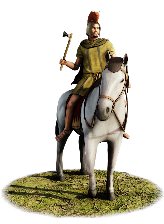
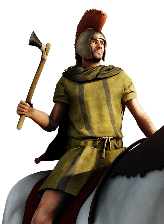
Illyrian Axe Cavalry provide versatile javelin and axe support to flank and pursue the enemy. They have no armour, except from a few Negau helmets to at least keep their heads safe. Use them as a flexible reserve to exploit gaps in the enemy line and to turn on exposed flanks.
Historical background
The word ‘Illyrian’ is often used as a blanket term, slapped onto a geographic area and applied to a huge variety of peoples within it, which caused problems understanding them both in the past and today (Dzino, Contesting Identities of pre-Roman Illyricum (2012), p. 70). Initial conceptions of the Illyrians came to us from the Greeks, who used the term to refer to the indigenous people of the south-eastern Adriatic coast and those who lived on the Macedonian borders. These ideas and stereotypes were later expanded on by the Romans to cover an even greater area (Dzino, (2012), p. 72). The issue of understanding who exactly an Illyrian is, is made more difficult as the Romans themselves were unsure as to exactly how big Illyria was and therefore did not know to what extent they could even apply the term until they fully conquered and Romanised it all. Herodian declares that Illyria is a thin province that barely separates Italy from Germany (6.7.4), and uses the terms Illyria and Pannonia separately (2.9.1), but refers to both together as Illyricum, too (2.9.9). Zosimus uses Illyricum regularly and seems to define its identity by where it is not, noting it as a region separate to Thracia, Moesia, and Dacia (2.33.2), Noricum (2.48.2), Dalmatia (2.14.1), and like Herodian both uses Pannonia separately (46.1) and combined with Illyricum, too (4.17.1-2). Only by the 4th century AD does Rufius Festus have a clearer Roman concept of Illyricum as a full Roman region with 18 provinces (8.3) that ranges from the Adriatic Sea (7.1), the Sava region and Second Pannonia (7.5), and to Valeria between the Danube and Drave (8.1). Many ancient authors discussing Illyria had limited sources, knowledge, and understanding of Illyria, which is why defining it was so troublesome for them and continues to be so even for us (Gracanin, Illyricum of the 2nd and 3rd centuries and in the works of Latin and Greek Historians (2006), p. 290).
Illyrian cavalry appears on occasion in ancient sources, and would see great use and praise when recruited as part of the Roman military. In 272 AD, Dalmatian cavalry proved pivotal in helping Aurelian to defeat Zenobia of the Palmyrene Empire in Syria (Zosimos, 1.52.3). They appeared once again in the Historia Augusta, with their bravery being lauded when fighting for Emperor Claudius II (Vita Claudii, 11.9). We also find evidence of cavalry and their armament in grave findings, such as a tumulus complex in Romaje in modern Kosov, which contained multiple lances and spears, alongside axes and even a horse bridle together (Lippert, Die Illyrer: Kulture und Sprache eines alteuropaischen Volkes (2022), p. 62). This combination of battle-axes, javelins, and horse equipment gave enough evidence to decide to include an Illyrian Axe Cavalry unit in RIS that uses all of these findings together. Their equipment is otherwise fairly light, as these men only wear helmets and do not use shields. The Illyrians generally preferred to remain fairly lightly clothed, and, in most cases, their cavalry seems to have been no exception. Findings of armour are rare, whereas helmet finds are much more common. In one case, 30 helmets of varying types were discovered in the Dolensko region (Wilkes, The Illyrians (1996), pp. 239-40). This is possibly an intentional choice, as it must be born in mind that Illyria in many areas has rugged territory with mountains, dense hill ranges, and thick oak forests, all of which would be rather difficult to traverse if encumbered in heavy armour. Of course, many parts of Illyria were also rather impoverished, so it could also be the case that armour was too expensive for your average Illyrian cavalryman.
Light armour would also be a benefit for skirmishing and irregular warfare, which was something the Illyrians were renowned to be competent in (Stefanovski, Representation of Warriorhood (2023), p. 193). Illyrian horsemen were often a band of warriors, who were oath bound or had other sacred ties to local strongmen or elites (Dzino (2012), p. 73). Thucydides (Thuc. 4.126.) complains about the Illyrians’ dislike of formations being at odds with their terrifying appearance: “The spectacle of their numbers is terrible, their cries are intolerable, and the brandishing of their spears in the air has a menacing effect. But in action they are not the men they look, if their opponents will only stand their ground; for they have no regular order, and therefore are not ashamed of leaving any post in which they are hard pressed; to fly and to advance being alike honourable, no imputation can be thrown on their courage. When every man is his own master in battle he will readily find a decent excuse for saving himself.” Why stick around to get hit when you do not have to?
Stats
| Rank in roster | ||
|---|---|---|
| Men per unit | 30 | █········· 8% |
| Attack | 10 | ██········ 19% |
| Charge bonus | 18 | ███████··· 72% |
| Defence | 17 | █········· 13% |
| · armour | 3 | ██········ 21% |
| · defence skill | 14 | ██········ 18% |
| · shield | 0 | █········· 0% |
| Morale | 9 | ███······· 26% |
| Discipline | Normal | |
| Training | Untrained | |
| Recruitment cost | 1,503 dn | ██········ 17% |
| Upkeep per turn | 605 dn | ████······ 43% |
| Turns to recruit | 2 |
Weapons
| Primary | Secondary | Primary | Secondary | Primary | Secondary | Primary | Secondary | ||||
|---|---|---|---|---|---|---|---|---|---|---|---|
| Attack | 10 | 6 | Charge bonus | 18 | 25 | Type | thrown · archery | melee · blade | Damage | piercing | slashing |
| Projectile | javelin | — | Range | 60 | — | Ammunition | 7 | — | Properties | Thrown | Armour-piercing (counts only half the target's armour) |
Defence
| Primary | Secondary | Primary | Secondary | Primary | Secondary | Primary | Secondary | ||||
|---|---|---|---|---|---|---|---|---|---|---|---|
| Total | 17 | — | Armour | 3 | — | Defence skill | 14 | — | Shield | 0 | — |
Condition and terrain
| Hit points | 1 | Mount | light horse | Ground: scrub / sand / forest / snow | 0 / 0 / -3 / 0 | Charge distance | 40 |
| Formations | Square |
Technical stats
| Time between blows (primary / secondary) | 2.5 s / 2.5 s | Extra fatigue in hot climates | 0 | Spacing between men: close / loose | 2 × 4.8 m / 3.6 × 6.72 m | Default ranks | 5 |
In battle: Can form Cantabrian circle · Very good stamina
Who can recruit it
A core roster unit for 3 factions, each able to raise it anywhere they hold the right building:
Daesitiates · Iapodes · Liburni
Any faction holding one of the provinces below can field it.
Exactly what a settlement must have, route by route (4)
| Building | Also requires | Building | Also requires | Building | Also requires | Building | Also requires |
|---|---|---|---|---|---|---|---|
| Any settlement | Garrison Building or Tier 1 Military Industrial Complex · Northern Illyrian area of recruitment · not Histrian area of recruitment · not Pannonian area of recruitment · not Liburnian area of recruitment · not Dalmatian area of recruitment · not Autariataian area of recruitment · Any Government (Dependency, Indirect Rule or Direct Rule) · Tier 2 Colony not built | Indirect Rule | Garrison Building or Tier 1 Military Industrial Complex · Tier 1 Colony | Direct Rule | Garrison Building or Tier 1 Military Industrial Complex · Tier 1 Colony | Homeland | Garrison Building or Tier 1 Military Industrial Complex |
Areas of recruitment
| Zone | Provinces | ||||||
|---|---|---|---|---|---|---|---|
| Northern illyrian | 0 |