
Italiote Hoplites
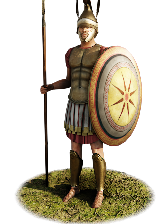
Class: spearmen · Category: infantry · Men per unit: 40
Description
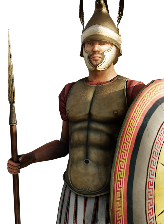
Italiote Hoplites represent the levies fielded by the various Greek cities in Southern Italy. These soldiers have confronted each other in battle as much as the surrounding native Italic tribes, which is reflected by their habit of pre-empting melee with a volley of javelins. On their heads they wear an Italic version of the Attic helmet type, as well as pilos, Italo-Corinthian, or Phrygian helmets. Their upper bodies are protected by linothorakes, muscle cuirasses, or the local style of pectoral-cuirasses called “kardiophylakes”. The Italiote Hoplites still bear the iconic aspis shields, typical for Greek hoplites, and along with their javelins, carry spears and xiphos swords into battle.
Historical background
When Rome entered the South Italian political theatre at the end of the 4th and beginning of the 3rd century BC, it arrived in a region that had already been deeply involved with the major players of the Mediterranean world over the preceding centuries. If the campaign of RIS were set to start only a 100 years earlier, all Italiote cities would be well-deserving of their own faction and fully fledged rosters. It is not without reason that this region was called Megale Hellas, or Magna Graecia: Greater Greece.
Greek communities began to appear on the Italian peninsula in the 8th century BC, starting with Kyme and Pithekoussai in Campania, founded by Euboians around 750-725 BC. Between 725 and 700 BC Sybaris and Kroton were established by the Peloponnesian Achaians, Taras by the Spartans (c. 706 BC), and Rhegion by the Chalkidians (Fischer-Hansen, Nielsen, and Ampolo, Italia and Kampania (2004), p. 251). In the next century, Lokroi Epizephyrioi was created by the Lokrians, around 660 BC the city of Siris perhaps by the Kolophonians, and ca. 630 BC Metapontion by the Achaians, following an invitation from Sybaris. The last significant one was Thourioi in the later 440s BC, founded as part of a panhellenic expedition led by Athens (Fischer-Hansen, Nielsen, and Ampolo (2004), p. 251). Further minor colonies followed: Hipponion and Medma were established by Lokroi, Kaulonia and Terina by Kroton, Neapolis by Kyme, Laos and Poseidonia by Sybaris, and, lastly, Herakleia in 433/32 BC by both Taras and Thourioi, replacing Siris (Fischer-Hansen, Nielsen, and Ampolo (2004), p. 252).
All of these city states were embroiled in various complicated conflicts with one another, the native Italic tribes, or with greater powers outside of Magna Graecia, such as Syracuse, Carthage, Epeiros, and of course Rome. It is as part of these conflicts that we learn about these cities fielding their own militia armies. In 473 BC, Taras had issues with the native Iapygians, and in an event that Herodotos called “the greatest slaughter of Hellenes that is known to us”, a joint Tarantine-Rhegian army was destroyed by the Iapygians, though only the losses of Rhegion – around 3,000 men – are mentioned (Hdt. 7.170; Diod. 11.52). In the 6th century BC, an alliance of Lokroi and Rhegion defeated Kroton at the battle of Sagra, allegedly confronting 130,000 Krotoniates (Strab. 6.1.10). Around 510 BC, Sybaris, apparently with 300,000 men levied from 4 tribes and 25 subject cities, was in turn defeated by Kroton (Strab. 6.1.13; Diod. 10.23.1). The numbers become more believable as we enter the Classical Period. During the Peloponnesian War (431-404 BC), Thourioi granted Athens reinforcements of 700 hoplites and 300 akontistai for its Sicilian expedition in 413 BC (Thuk. 7.35). In 399 BC, the Rhegians fielded 6,000 infantry, 600 cavalry, and 50 triremes against Dionysios I of Syracuse (r. 405-367 BC; Diod. 14.40.3).
In the recurring conflicts between Syracuse and the Italiote cities, Dionysios allied with the Italic Leukanoi tribe, which invaded the land of Thourioi. The latter asked her allies for support, as the cities had an agreement to help each other in case of a Leukanian attack, or the generals would be put to death (14.101.1). Thourioi did not wait for the allies, however, and marched against the Leukanians with more than 14,000 infantry and 1,000 cavalry. The latter retreated, baiting the Thourians into becoming over-eager and entering Leukanian territory, capturing the prosperous city of Laos. Near some hills, the Thourian army was then surrounded by the superior Leukanian army of 30,000 infantry and 4,000 cavalry (101.4), and more than 10,000 Greeks fell in the course of the ensuing battle (14.102).
As some major powers emerged and held sway over other cities, e.g. Taras, Syracuse, and Rome, such independent armies became fewer and fewer, and cities became increasingly reliant on allies or mercenaries to complement their native forces. In 303 BC, the Tarentines were at war with Leukania (Lucania) and Rome, asking Kleonymous of Sparta to help them. He enrolled 5,000 mercenaries at Tainaron, sailed to Taras, enrolled 5,000 more soldiers there, as well as 20,000 citizens fighting as infantry and 2,000 cavalry. Additionally, he also won the support of most Italiotes and the Messapians (Diod. 20.104.1-3). This led to the Leukanians establishing friendship with Taras. When Metaponton did not join him, Kleonymous persuaded the Leukanians to attack the Metapontines, intimidating them with a simultaneous attack. After the Pyrrhic War (281-275 BC), Rome assumed control over Magna Graecia, where they mainly relied on the Italiote coastal cities to provide them with ships and crews. Occasionally, though, we do also hear of citizen soldiers in this period. During the Second Punic War (218-201 BC), for example, the Roman praefect of Thourioi relied on the local militia, which he had trained and armed himself, to hold the city (Liv. 25.15), even though it ended up betraying the Romans and switching sides to Hannibal.
These Italiote Hoplites are armed with militaria common for Southern Italy. Their armament at the time of the 4th-3rd centuries BC was more traditional than on the Greek mainland. Greek muscle cuirasses are found quite often, provenanced near the Greek cities of Taras and Metaponton at the sites of Conversano (Tomb 10, 325-300 BC, in: Bari inv.20893-4, also contained greaves, javelins, and spears), Ginosa (Tomb 13.I.1935, 480-450 BC, in: Taranto inv.73003-73004, also contained greaves), Metaponto (400-300 BC, in: Basel inv.Ka223; three javelins/spears from tomb 17/71 (500-490 BC), four from tomb 18 (320-280 BC), and San Giorgio Lucano (350-300 BC, also with a short straight sword with the same dating). Pseudo-Corinthian helmets were found at Pomarico (Type III, The British Museum, Inv. No. 2832. 1856.12-26.669, 5th-4th c. BC, near ancient Metapontum), two from Taranto (undated) and four from Rutigliano near Taranto (Tomb 3 and graves 11, 19, 77). During the siege of Taras (209 BC), we see Tarentine citizen soldiers hurl their javelins at the Romans in the battle on the forum (Liv. 27.16). Even though their fighting experience was not as good as it once used to be, they were still ready to take up arms in defence of their city.
Stats
| Rank in roster | ||
|---|---|---|
| Men per unit | 40 | ███······· 30% |
| Attack | 14 | ███████··· 65% |
| Charge bonus | 11 | ████······ 38% |
| Defence | 41 | ████████·· 76% |
| · armour | 10 | █████····· 54% |
| · defence skill | 26 | ████████·· 78% |
| · shield | 5 | ██████···· 57% |
| Morale | 10 | ███······· 29% |
| Discipline | Low | |
| Training | Highly trained | |
| Recruitment cost | 1,679 dn | ███······· 31% |
| Upkeep per turn | 615 dn | █████····· 46% |
| Turns to recruit | 2 |
Weapons
| Primary | Secondary | Primary | Secondary | Primary | Secondary | Primary | Secondary | ||||
|---|---|---|---|---|---|---|---|---|---|---|---|
| Attack | 14 | 9 | Charge bonus | 11 | 13 | Type | thrown · blade | melee · blade | Damage | piercing | piercing |
| Projectile | javelin | — | Range | 50 | — | Ammunition | 2 | — | Properties | Used just before charging into combat | Light spear (braced against cavalry charges from the front) · +8 attack against cavalry |
Defence
| Primary | Secondary | Primary | Secondary | Primary | Secondary | Primary | Secondary | ||||
|---|---|---|---|---|---|---|---|---|---|---|---|
| Total | 41 | — | Armour | 10 | — | Defence skill | 26 | — | Shield | 5 | — |
Condition and terrain
| Hit points | 1 | Ground: scrub / sand / forest / snow | 0 / -1 / -1 / -1 | Charge distance | 30 | Formations | Square |
Technical stats
| Time between blows (primary / secondary) | 2.5 s / 2.5 s | Extra fatigue in hot climates | 2 | Collision mass per man (1.0 is normal) | 1.19 | Spacing between men: close / loose | 1 × 1.05 m / 2 × 2.4 m |
| Default ranks | 5 |
In battle: Can sap · Very good stamina
Who can recruit it
A core roster unit for one faction, which can raise it anywhere it holds the right building:
Any faction holding one of the provinces below can field it.
Exactly what a settlement must have, route by route (4)
| Building | Also requires | Building | Also requires | Building | Also requires | Building | Also requires |
|---|---|---|---|---|---|---|---|
| Any settlement | Garrison Building or Tier 1 Military Industrial Complex · Italiote area of recruitment · Any Government (Dependency, Indirect Rule or Direct Rule) · Tier 2 Colony not built | Indirect Rule | Garrison Building or Tier 1 Military Industrial Complex · Tier 1 Colony | Direct Rule | Garrison Building or Tier 1 Military Industrial Complex · Tier 1 Colony | Homeland | Garrison Building or Tier 1 Military Industrial Complex |
Areas of recruitment
| Zone | Provinces | ||||||
|---|---|---|---|---|---|---|---|
| Italiote | 0 |