
Kietaian Hillmen
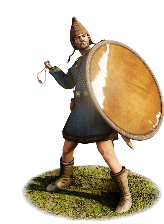
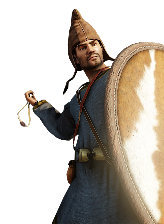
Class: missile · Category: infantry · Men per unit: 40
Description
The Kietai or Cietae are a fiercely independent tribe that lives in a mountain range so inaccessible that they do not even have a settlement in RIS – nor is there any street view or images on Google today for their home region. As such, they are brutal men, who never give up a fight. Armed with slings for ranged combat and curved machaira swords for melee, the Kietaians are aggressive warriors who can hurt the enemy’s flanks. Phrygian caps or woven Cilician helmets cover their heads, with some even being able to afford crested Attic helmets. In their light Cilician garments with long sleeves and firm belts as well as their sturdy boots, they can move swiftly across the battlefield. When defending, Cilician oxhide shields of various shapes and colours can effectively block missiles, and perhaps even swords or spears. The Kietai have never been subjugated, and they will give their last drop of blood to ensure that this never changes!
Historical background
''Shortly afterwards, the tribes of wild Cilicians, known under the name of Cietae (Kietai), who had already broken the peace on many occasions, now formed a camp, under the leadership of Troxobor, on their precipitous hills; and, descending to the coast or the cities, ventured to attack the peasants and townspeople, and, very frequently, the merchants and shipmasters. The city of Anemurium (Anemourion) was invested; and a troop of horse sent to its relief from Syria under the prefect Curtius Severus was put to flight, as the rough ground in the vicinity, though suited to an infantry engagement, did not admit of cavalry fighting.'' – (Tacitus, Annals, 12.55)
The Kietai (Greek), Cietae, or Clitae (Latin) were a Cilician ethnos we mainly know about from the Annals of the Roman historian Tacitus, composed at the end of the 1st century AD. They dwelled in a part of Kilikia Tracheia ("rough Cilicia") known as the Kietis, which was located in the hills and mountains along the Kalykadnos river (now the Göksu) and split into three parts: the Kennatis, the Lakanitis, and the Lalassis (Ptol. 5.7.3, 6). The Kietai were probably Cilicians, but related to the Isaurians (Friedrich Hild, s.v. Anemurion: in DNP online). We hear nothing about them before the Roman period, but Cilicia, and in particular the aptly named ‘rough’ part, had been split between brigand chiefs, powerful priests, the satraps of large empires (Achaemenids, Seleucids, Ptolemies), and pirate lords since at least the 4th century BC (Tempesta, Central and Local Powers in Hellenistic Rough Cilicia (2013), pp. 27-28). In the borderlands between Seleucid and Ptolemaic zones of influence in eastern Tracheia, the high priests of Olba or Olbe, from the family of the Teucrids, were the only accepted authority (Tempesta (2013), p. 32). The Kietis, too, was dotted with small sanctuaries dedicated to the god of Olbe, whom the Greeks represented as Zeus (Strab. 14.5.10C672; Tempesta (2013), p. 35). Though Olbe’s power grew throughout the Hellenistic period, it never attempted to subjugate the mountains, as is implied by Strabo himself, who speaks of ''tyrants (...) and pirates'' residing there. The Cilician pirates originated in the Tracheia, and one does not need much imagination to suggest there were Kietai among them.
Even after the defeat of the pirates in 66 BC, Rome did not dare to go anywhere near the literal rough parts of southeastern Anatolia. The temple-state of Olbe lived on, sometimes with their own client-kings loyal to Rome (sometimes not so loyal), sometimes as part of bigger kingdoms allied to Rome, later as a special area surrounded by a Roman province (Friedrich Hild, s.v. Olba, in: DNP online). Much of the rest was governed by client kings, the Tarkondimotids, but also – or, at times – by the kings of Cappadocia, Commagene, and Pontos (Cass. Dio. 59.8.2; Ish-Shalom, Provincial Monarchs as an Eastern Arcanum Imperii (2021), p. 157, 158, and 171-172; Facella, La Dinastia degli Orontidi nella Commagene Ellenistico-Romana (2006), p. 317). In this context, it is not surprising that the Kietai are not mentioned before the first century AD, nor that they would have retained their independence from foreign powers for so long. Apparently, they had originally also lived in the lowlands, but when they became part of the kingdom of Archelaos of Cappadocia, the Kietai took umbrage at the Hellenising and Roman influences, specifically the regular paying of tributes (Tac. Ann. 6.41). Therefore, they migrated to the inaccessible tops of the Tauros mountains.
From their new home, the Kietai undertook regular raids into the plains and plundered the towns and farms under the control of Archelaos. When royal Cappadocian forces were sent against them, the Cilicians prevailed (Tac. Ann. 6.41). After the annexation of Cappadocia in 17 AD, the problem remained, and the responsibility to solve it eventually fell to Lucius Vitellius, the Roman governor of Syria, who was the father of the later emperor Vitellius and commanded the largest Roman army in the east (Keppie, Legions and Veterans (2000), p. 186). In 36 AD, Vitellius dispatched a legion with 4,000 men and a sizable force of picked auxiliaries under the legate Marcus Trebellius. On learning of the Roman advance, the Kietai occupied two hills called Kadra and Davara, and waited for the enemy to attack (Tac. Ann. 6.41). Trebellius, however, saw that the Cietae were ill-supplied, and encircled their position. When some of them sallied forth, they were defeated by the Romans, and the rest eventually surrendered because they were starving (Tac. Ann. 6.41).
With brigands like the Kietai, one can never be sure they are beaten, and so it proved. In 52 AD, with the nearby parts of Cilicia now under the rule of Antiochos IV of Kommagene (r. 38-72 AD; Borgia, The Rule of Antiochus IV of Commagene in Cilicia [2004]), the Kietai had regained enough strength to terrorise the people in the plains and on the coasts again. We read about it in the quote above: a man called Troxobor organised their warriors and convinced them to undertake regular attacks, even on ships and harbours. A fortified camp in the mountains served as the base for this army (Tac. Ann. 12.55). And yet, it must have been a major shock for Antiochos and the Romans when a major Kietan force appeared before the wealthy port city of Anemourion and besieged it. Once again, the army in Syria had to intervene, and a Roman cavalry force under the prefect Curtius Severus arrived to attack the Cilicians. Apparently, they once again took positions on hilltops, but in contrast to Trebellius, Severus tried to dislodge the Kietai with a charge. Attacking uphill against an enemy who knows the terrain better is a difficult task, and in fact the Roman horsemen were repelled and routed (Tac. Ann. 12.55). After the failure of his Roman allies, Antiochos resorted to diplomacy. Using his wealth, he sowed discord between the various groups of brigands and warriors. Soon enough, they turned against each other, and the chiefs responsible for the attacks, including Troxobor, were handed over to the king. Antiochos had them executed and pardoned the rest, thus winning their sympathy and loyalty (Tac. Ann. 12.55).
The only thing Tacitus tells us about the fighting style of the Kietai is that they fought on foot, and thus the equipment of the Kietai hillmen in RIS is an educated guess. The clothes are typically Cilician (Hdt. 7.91.1), and the long sleeves make sense for mountain peoples. Woven helmets stem from nearby Cappadocia (Hdt. 7.72.1) and suit the Kietai who had migrated to the highest of the Tauros mountains on the border between Cappadocia and Cilicia (Tac. Ann. 6.41), and who had formerly lived under the rule of Archelaos of Cappadocia (Tac. Ann. 6.41). Herodotus describes Cilicians in his time with oxhide shields (Hdt. 7.91.1) and round, pelte-style shields appear on coins from the 4th century BC (Nephelis, Cilicia, AE 18, Imhoof Monn. Gr. 51; Prowe III 1226). Finally, two coins from Tarsos portray Attic helmets (SNG BN 258 ff = SNG Levante 78 f; SNG BN 251 = SNG Levante 71).
Stats
| Rank in roster | ||
|---|---|---|
| Men per unit | 40 | ███······· 30% |
| Attack | 7 | █········· 6% |
| Charge bonus | 1 | █········· 4% |
| Defence | 14 | █········· 6% |
| · armour | 2 | █········· 13% |
| · defence skill | 10 | █········· 5% |
| · shield | 2 | ███······· 25% |
| Morale | 7 | █········· 10% |
| Discipline | Low | |
| Training | Untrained | |
| Recruitment cost | 1,318 dn | █········· 11% |
| Upkeep per turn | 482 dn | ██········ 19% |
| Turns to recruit | 2 |
Weapons
| Primary | Secondary | Primary | Secondary | Primary | Secondary | Primary | Secondary | ||||
|---|---|---|---|---|---|---|---|---|---|---|---|
| Attack | 7 | 6 | Charge bonus | 1 | 3 | Type | missile · archery | melee · blade | Damage | blunt | slashing |
| Projectile | stone | — | Range | 150 | — | Ammunition | 35 | — |
Defence
| Primary | Secondary | Primary | Secondary | Primary | Secondary | Primary | Secondary | ||||
|---|---|---|---|---|---|---|---|---|---|---|---|
| Total | 14 | — | Armour | 2 | — | Defence skill | 10 | — | Shield | 2 | — |
Condition and terrain
| Hit points | 1 | Ground: scrub / sand / forest / snow | 0 / 0 / 0 / 0 | Charge distance | 30 | Formations | Square |
Technical stats
| Time between blows (primary / secondary) | 2.5 s / 2.5 s | Extra fatigue in hot climates | 0 | Collision mass per man (1.0 is normal) | 0.84 | Spacing between men: close / loose | 1.2 × 2.8 m / 2.16 × 5.04 m |
| Default ranks | 5 |
In battle: Very good stamina
Who can recruit it
A core roster unit for one faction, which can raise it anywhere it holds the right building:
Any faction holding one of the provinces below can field it.
Exactly what a settlement must have, route by route (4)
| Building | Also requires | Building | Also requires | Building | Also requires | Building | Also requires |
|---|---|---|---|---|---|---|---|
| Any settlement | Garrison Building or Tier 1 Military Industrial Complex · Cilician area of recruitment · Any Government (Dependency, Indirect Rule or Direct Rule) · Tier 2 Colony not built | Indirect Rule | Garrison Building or Tier 1 Military Industrial Complex · Tier 1 Colony | Direct Rule | Garrison Building or Tier 1 Military Industrial Complex · Tier 1 Colony | Homeland | Garrison Building or Tier 1 Military Industrial Complex |
Areas of recruitment
| Zone | Provinces | ||||||
|---|---|---|---|---|---|---|---|
| Cilician | 0 |