
Labeataean Light Infantry
Class: light · Category: infantry · Men per unit: 60
Description
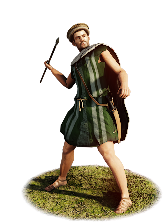
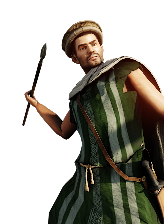
Capable raiders both on land and at sea, these Labeataean Light Infantry fight in the Illyrian style, preferring loose formations and skirmishing tactics. They are light, as their name indicates, because they wear no armour, only tunics, cloaks, and hats. Their weapons are long Pecine knives and a handful of javelins each, so should strike wherever the enemy is weakest or its formations are disorganised.
Historical background
The Labeataean Kingdom, later known as the Illyrian Kingdom after 218 BC, reached the height of its power during the reigns of King Skerdilaidas (c. 218-206 BC) and King Gentius (181-168 BC). The realm emerged from the many smaller Illyrian tribes who inhabited the shores of Lake Labeatis, modern Lake Skhodra, which is likely what gave this kingdom its name. The Labatae are mentioned by Pliny (NH, 3.144) as one of the Illyrian tribes in this area: “it contained the Labeatae, Senedi, Rudini Sasaei, Grabaei, properly called Illyrians, and Taulantii and Pyraei”. This region was often a battleground, both figuratively and literally, between the Ardiaioi and the Labeatae, with the Ardiaioi initially being the ascendent power with a proper kingdom of their own (Dzino, ‘Illyrians’ in ancient ethnographic discourse (2014), p. 47). This situation was to change after the defeat of the Ardiaioi and their king, Demetrios of Pharos, by the Romans. It was then that Skerdilaidas, the Illyrian commander of Teuta and Demetrios, made the most of the Ardiaioi’s fractured power and took control of the Labeataean Kingdom to become the foremost Illyrian power in the area. The ethnic identity of Skerdilaidas seems to be of Labeatae origin, since Livy (43,19,3) states that his grandson Genthios was a Labeataean (Sasel Kos, From Agron to Genthius. Large Scale Piracy in the Adriatic (2002), p. 147).
With the ascension of Skerdilaidas to the throne, the Labatae now ruled over a territory stretching from the Dalmatian coast to Lissos and had their capital at Skodra near Lake Labeatis. Although the Ardiaean elites were allowed to maintain control of their territory around the Boka kotorska (Bay of Kotor), they did so as a confederated people under the ruling umbrella of the Labeataeans and their king (Borsic, Dzino, and Radic Rossi, Liburnians and Illyrian Lembs (2021), p. 17). King Skerdilaidas had to balance relations with Rome and Macedon. In theory, he was a Macedonian ally and assisted with attacking the Aetolians in 219 BC, although even that did not amount to much in reality, as local Illyrian dynasts disrupted his efforts of solidifying his rule. Bad blood was already simmering in the alliance as the displaced ruler of the Ardiaea Kingdom, Demetrios of Pharos, was given shelter in the Macedonian court, despite Roman demands for his arrest. One of the terms for Skerdilaidas’ assistance against the Aetolian League was a subsidy of 20 talents a year. When the greedy King Philip V of Macedon would not give him his rightful share of the booty from a mutual campaign or his tribute, Skerdilaidas decided that enough was enough, forsook their alliance, and went off on the offensive (Dzino, Illyricum in Roman Politics, 229 BC–AD 68 (2010), p. 53). The Labeataeans had already sent 15 lembi (small Illyrian ships) to collect the tribute, so these ended up raiding south of Kerkyra, killing two of Philip’s Corinthian friends in the process, then engaged in piracy of shipping in the south Peloponnese near Cape Maleas (Polyb. 5.95.1-4, 101.1-2). This was done in conjunction with an overland invasion of Macedonian holdings in Illyria. The Labeataeans took several strongholds in Dassaretis, before their momentum saw them overrunning several districts on the frontiers of the Macedonian kingdom itself.
The Labeataean navy was not strong enough to contain the Macedonians on its own, but the threat of a Roman naval squadron kept their retaliation plans confined, and even foiled an invasion scheme as the Romans came to know of a secret pact between Carthage and Macedon to carve up Roman territory (Dzino (2010), p. 54). When the Antigonid army successfully counterattacked, Skerdilaidas sought support of Rome, Aitolia and, finally, his erstwhile enemy Dardania. At the time the Romans were themselves being invaded by Hannibal from the Alps, so the Macedonians were quite sanguine of their chances of success. However, the Labeataean Kingdom’s joint campaigns alongside other Illyrians and Rome eventually led to the reconquest of some southern Illyrian holdings, and the territory of the kingdom steadily expanded under his son Pleuratos and his grandson Genthios. It would remain a fairly stable but small kingdom for nearly a century afterwards (Wilkes, The Illyrians (1996), pp. 164-8) After Skerdialidas, Pleuratos then Genthios increasingly centralised the kingdom at the expense of the local elites, with Genthios famously minting coins of his own (Dzino (2010), pp. 54-5). This act shows a high degree of organisation and political sophistication, further emphasising that the various peoples were indeed becoming one kingdom (Dzino (2014), p. 57).
The equipment of the Labeataean Light Infantry is pretty similar to other Illyrian skirmisher units and uses the same historical basis. The main difference in how they are represented are their uniquely Labeataean Kausia hats. This design is based upon one of the coins minted by King Genthios. On the coin, Genthios himself is depicted wearing a quite distinctive hat, with what appears to be two layers of brims. This unusual and iconic Kausia hat is represented in RIS, too. Otherwise, the equipment of the Light Infantry is standard enough, they use short pecine knives and javelins, like most other Illyrian infantry, and wear no armour, just a short tunic.
Stats
| Rank in roster | ||
|---|---|---|
| Men per unit | 60 | █████████· 87% |
| Attack | 8 | █········· 9% |
| Charge bonus | 3 | ██········ 16% |
| Defence | 21 | ██········ 21% |
| · armour | 1 | █········· 0% |
| · defence skill | 20 | █████····· 48% |
| · shield | 0 | █········· 0% |
| Morale | 7 | █········· 10% |
| Discipline | Low | |
| Training | Untrained | |
| Recruitment cost | 1,489 dn | ██········ 16% |
| Upkeep per turn | 545 dn | ███······· 28% |
| Turns to recruit | 2 |
Weapons
| Primary | Secondary | Primary | Secondary | Primary | Secondary | Primary | Secondary | ||||
|---|---|---|---|---|---|---|---|---|---|---|---|
| Attack | 8 | 3 | Charge bonus | 3 | 3 | Type | thrown · blade | melee · simple | Damage | piercing | piercing |
| Projectile | javelin | — | Range | 50 | — | Ammunition | 4 | — | Properties | Used just before charging into combat · thrown | — |
Defence
| Primary | Secondary | Primary | Secondary | Primary | Secondary | Primary | Secondary | ||||
|---|---|---|---|---|---|---|---|---|---|---|---|
| Total | 21 | — | Armour | 1 | — | Defence skill | 20 | — | Shield | 0 | — |
Condition and terrain
| Hit points | 1 | Ground: scrub / sand / forest / snow | 0 / 0 / 0 / 0 | Charge distance | 30 | Formations | Square |
Technical stats
| Time between blows (primary / secondary) | 2.5 s / 2.5 s | Extra fatigue in hot climates | 0 | Collision mass per man (1.0 is normal) | 0.82 | Spacing between men: close / loose | 1 × 1.2 m / 2 × 2.4 m |
| Default ranks | 5 |
In battle: Can hide in long grass · Can sap · Very good stamina
Who can recruit it
A core roster unit for one faction, which can raise it anywhere it holds the right building:
Any faction holding one of the provinces below can field it.
Exactly what a settlement must have, route by route (4)
| Building | Also requires | Building | Also requires | Building | Also requires | Building | Also requires |
|---|---|---|---|---|---|---|---|
| Any settlement | Garrison Building or Tier 1 Military Industrial Complex · Labeataean area of recruitment · Any Government (Dependency, Indirect Rule or Direct Rule) · Tier 2 Colony not built | Indirect Rule | Garrison Building or Tier 1 Military Industrial Complex · Tier 1 Colony | Direct Rule | Garrison Building or Tier 1 Military Industrial Complex · Tier 1 Colony | Homeland | Garrison Building or Tier 1 Military Industrial Complex |
Areas of recruitment
| Zone | Provinces | ||||||
|---|---|---|---|---|---|---|---|
| Labeataean | 0 |