
Lyttian Hetairoi
Class: heavy · Category: cavalry · Men per unit: 30
Description
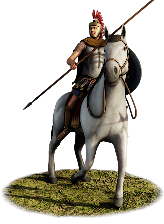
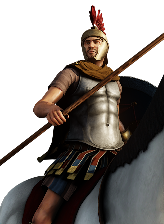
The hetairoi of Lyttos are an elite within the society of the Doric city in the interior of eastern Crete. Like the Spartiates, they spend much time preparing for war and share common meals (syssitia). Uncharacteristically for Greek cavalry in the Classic and Early Hellenistic period, the noblemen of Crete carried Aspis shields when fighting on horseback. Finely crafted bronze muscle cuirasses, greaves, and Boiotian or crested Attic helmets offer them great protection. Armed with javelins and lances, they are a deadly all-round heavy cavalry unit whose elite status is marked by glowing red cloaks. Despite their elevated social and military position and obvious wealth, they fight for the most democratic state of Crete, and will guard it against its Knossian and Gortynian rivals with their lives.
Historical background
Lyttos was, if we believe the 2nd century BC historian Polybios of Megalopolis (Polyb. 4.54.6), the oldest city on Crete. Even more ancient than Knossos, it was founded sometime in the 2nd millennium BC under the name Lyktos, and it appears as Rikata, a trading port of the Keftiu (Kretes, Cretans), in the Place List of pharaoh Amenophis III (ca. 1388-1351 BC). The archaic poet Hesiod even asserted Zeus was born in Lyttos (Hes. Theog. 477). From early on, Lyktos (later Lyttos) had a close connection to Sparta, which was allegedly its mother city (Polyb. 4.54.6, Aristot. Pol. 1271b28). In the Trojan War, its men accordingly followed Lakedaimon’s call and bravely fought shoulder to shoulder with their cousins (Hom. Il. 2.647; 17.611). Is such a Spartan colonisation origin story plausible? The historian Ephoros of Kyme (ca. 400-330 BC) seems to imply that the Dorian Greeks only started founding their cities on Crete around 1000 BC (Strab.10.4.15C479 = FGrHist 70 F149) and there are no safe traces for Lakonian emigration to Crete. In the end, it does not matter, however, since the citizens of both cities and, with them, most ancients seem to have believed the story and acted accordingly. The historian and geographer Strabo of Amaseia (ca. 63 BC-25 AD) again quotes Ephoros (F 149) when telling us that the Cretans had their own constitutions, but the legendary Lykourgos of Sparta perfected them – this was also true for Lyttos, where Lykourgos was held in great esteem (Strab. 10.4.17-18C481). Lyktos was originally founded on a spectacular ridge in the interior of central eastern Crete, as the author of this text saw with his own eyes. The large sea port of Chersonesos – now a popular beach resort for British tourists – was annexed and its citizenry included in an enlarged Lyttian state (Chaniotis, Angelos, Die Verträge zwischen kretischen Poleis (1996), p. 431). An alliance with Lindos on Rhodes around 412 BC assured external acknowledgement and support (Inscr. Lindos II.13).
Much of Lyttos’ domain had been cut out of the possessions of the half-mythical Minos of Knossos, and even though almost a millennium had passed, the Knossians had not forgotten. As anyone who has visited the mountainous interior of the island can attest, time often stands still on Crete and some of its towns seem frozen in time, back then just like now. This is certainly true for the hard feelings between Knossos and Lyttos, and in 344 BC, Knossos spent all its money on a mercenary army to finally have their revenge. Led by the Phokian Phalaikos and reinforced by Knossian troops, this force surprised the Lyttians and managed to storm their city (Diod. 16.62.2-3). The desperate Lyttians appealed to their Lakedaimonian relatives for help, and when their envoys reached Lakonia, they found the Spartans assembling an army to help another polis related to them by blood, Taras (Tarentum). The Lyttian ambassadors managed to convince the Lakedaimonians that their case was more urgent, and King Archidamos III (ca. 400-338 BC) led an expedition to Crete which ended in a quick victory – Lyttos was saved (Diod. 16.62.4).
Subsequently, the Lyttians quickly recovered, and in the early 3rd century BC they extended their influence through alliances with Malla (IC I XIX 1 & 3) and Praisos (IC III VI 11 & 12). In 260 BC, a treaty of friendship and mutual assistance with Miletos, the "capital" of Ionia, at that time under Ptolemaic authority, followed (StV 3, 482). Even more impressive were alliances first with Antiochos I and then Antiochos II, rulers of the mighty Seleucid Empire (StV 3, 486). Such elaborate diplomacy was necessary to protect Lyttos’ position and safeguard it against Knossian and Gortynian expansionism. While Gortyn and Knossos often quarrelled with each other, too, this changed after the mid 3rd century when more and more poleis on Crete fell under the control of the two powers who increasingly acted in unison (Polyb. 4.53.4). Lyttos was the only major city that resisted this development, and when its alliances with Miletos and the Seleucids ended in the years prior to 220 BC, Gortyn and Knossos decided it was time to bring Lyttos into line as well.
The so-called Lyttian War was one of the most brutal conflicts of the Hellenistic period. Almost every Cretan polis had been forced into the Knosso-Gortynian alliance and declared war on Lyttos in 221/220 BC. Yet, when the Lyttians initially managed to avoid defeat in the field, the grand alliance showed first cracks. After a matter of weeks or months, Polyrrhenia, Keraia, Lappa, Horion and Arkadia ceased their support for the Knossian army and, not long after, they officially left the coalition (Polyb. 4.53.5). While the Knossians made some progress on their campaign, the Gortynians, too, began to hesitate, for the younger citizens of the polis had expressed their sympathies for Lyttos at an assembly. When their elder compatriots reminded them that they had promised to support their ally Knossos, a stasi (a state of civil war) broke out, though there was initially no fighting (Polyb. 4.53.6). Once the news reached Knossos, their officials were shocked and reacted by immediately dispatching a messenger to the Aitolian League, their ally in mainland Greece. The Aitolians duly transported 1,000 fresh soldiers to Crete, in return for which the Knossians would later assist Aitolia with archers (Polyb. 4.55.5). But the Knossian army also still contained allied troops from Crete: their most passionate ally was Dreros, located in the northeast of the island. The Drerians were arch enemies of Lyttos and Dreros’ ephebes, the sons of the citizens, had to swear an oath to be enemies of the Lyttians forever:
‘I swear by Hestia, who is in the magistrates' hall, and by Zeus, the patron of the assembly, and by Zeus of the Tallaian Mountains, and by Apollo Delphinios, and by Athena (...), Artemis (...) and by Ares, and by Aphrodite, and by Hermes, and by the Sun, and by Britomarpis (a daughter of Zeus on Crete), and by Phoinix, and by Amphione (probably another daughter of Zeus), and by Earth, and by the Sky, and by the male and female heroes, and by the water sources, and by the rivers, and by all the gods and goddesses; truly, I will never be benevolent towards the Lyttians, in no way and through no pretension, neither by day nor by night; and I will try, to the best of my capacity, to harm the city of the Lyttians. (...) And I will be friendly towards the Drerians and the Knossians.’ – (I. Cret. I IX 1)
The text, preserved in an inscription, testifies to the rivalries and hatred between the Cretan poleis. This oath specifically may well have been taken in 220 BC, when the Knossians could not afford to lose another ally and thus asked the Drerians or coerced them into publicly declaring their loyalty (Chaniotis, War in the Hellenistic World (2005), p. 47). Reinforced by Drerians and Aitolians, the Knossian army now marched from the Lyttian chora (territory) southwest to Gortyn, met with the troops of the Gortynian elders, and attacked the city. The allies seized the citadel and exiled or executed the leaders of the young men (Polyb. 4.53.6). This was a huge victory for Knossos, and when the Lyttians tried to seize the chance by sending their whole force into Knossian territory, the Knossians immediately marched to Lyttos, which was almost completely bereft of defenders. The Knossians boldly attacked the walls and stormed them at first attempt, routing the Lyttian troops. Only women and children remained, and the Knossians took them back to their city, while setting Lyttos on fire (Polyb. 4.54.1-2). When the Lyttian field army finally returned, a tragic and awful scene took place, described by Polybios in the following words:
‘When the Lyttians came back to their city from the expedition and saw what had happened, they were so much affected that none of them had the heart even to enter his native town, but one and all after marching round it and many times bewailing and lamenting the fate of their country and themselves, turned their backs on it and retired to Lappa. The Lappaians received them with the utmost kindness and cordiality; and thus having become in one day cityless aliens instead of citizens they went on fighting against Knossos with the other allies. Thus was Lyttos, a colony of the Spartans and allied to them by blood, the most ancient city in Crete, and ever, as all acknowledged, the breeding-place of her bravest men, utterly and unexpectedly made away with.’ – (Polyb. 4.54.3-6)
The destruction of Lyttos was a watershed moment in the history of Crete. Even today, every Cretan knows of this triumph or tragedy – whoever you side with – and the author of these lines saw the ashes of Lyttos in the Archaeological Museum of Heraklion, which itself is located not far from the site of ancient Knossos. The burnt cereals and grain seeds from a storage house are silent witnesses to the purposeful and thorough destruction of Lyttos’ buildings, which was emphasised by Polybios (4.54.2). Yet, the war did not end here. The Lappaians, who had welcomed the Lyttian men, now organised a conference with them and the Polyrrhenians and debated their options. They realised that the Aitolians, who were supporting Knossos, were the enemies of the Achaian League and of Philip V, the mighty Antigonid king of Macedon, and decided to open negotiations with these two powers. To their delight, the Achaians and Macedonians agreed to ship 400 Illyrian mercenaries, 200 Achaians and 100 Phokians to Polyrrhenia (Polyb. 4.55.1-2). Reinforced by these experienced men and the Lyttians, the Polyrrhenians and Lappaians now proceeded to besiege Eleutheria, Kydonia and Aptera. Unable to support each other, all three poleis quickly agreed to desert the Knossian coalition (Polyb. 4.55.4). Those of the young men of Gortyn who had either been exiled or fled the city, now seized Phaistos with its important harbour, a well fortified, very ancient town in the territory of Gortyn, the home of the mysterious Phaistos disc, which has never been deciphered. The merchants of Gortyn, too, favoured the Lyttians and held the harbours Lebena and Matalon against the Knossians and older Gortynians. Continuous skirmishes dominated the area, with neither side being able to win the upper hand (Polyb. 4.55.6, Chaniotis, Das antike Kreta (2004), p. 82). The Achaian League seems to have sent more soldiers soon after, for Arcadians on the side of Lyttos appear in the course of the war, among them Philopoimen, the later leader of the Koinon (Plut. Philopoimen 7.1-2, Plut. Aratos 50.5).
Not much is known about the end of the Lyttian War, but it seems to have petered out around 219 BC (Sonnabend, Holger, s.v. Lyttos, in: DNP online). Low-scale warfare continued until 216 BC, when Philip V used his influence and authority to declare Crete a Macedonian protectorate and effect overall peace (cf. Polyb. 7.14.4). The anti-Knossian coalition seems to have largely prevailed, and Gortyn soon resumed its attempts from earlier in the century to lead a Cretan League, so the polis must have overcome its stasis (Chaniotis (2004), p. 81-82). This state of peace only lasted for eleven years, however, when the Cretan War (205-200 BC) between Macedon and Rhodes and their respective allies broke out. The Lyttians, who were still living with the Lappaians, though they may have received back their children and women by this point, remained neutral, just like Lappa. They were already trying to rebuild their old domain, however: Chersonesos, the former harbour of Lyttos, which had remained a dependent ally, was now renamed Lyttos pros Thalassai, Lyttos by the Sea (IC1, 19.2 ll.8-10, cf. Viviers, La Cite 1994, 252-259). Not long after, probably in 204 or 203 BC, the Lyttians undertook a brutal expedition of their ow. Dreros, its sworn enemy, was surprised, encircled, and eventually sacked. The victors, whose settlement had been burned by the Knossians, now razed Dreros to the ground, whose citizens had been determined to kill all Lyttians (Chaniotis (2005), p. 47). The territory of Dreros was annexed and Lyttos reinstated as a major regional power. Finally, the city was rebuilt, probably on the same or a nearby hill where the old Akropolis had stood (Driessen, Destruction (2013), p. 287). Later, a close alliance was forged with Olous (Kritzas, Anathimatiki (2011), p. 44) and in 184 BC, Lyttos was one of the Cretan cities who signed an alliance with Eumenes II of Pergamon in which it offered to send mercenaries to the Attalids (SIG 627). Lyttos thus remained an important centre on Crete, and even after the Roman conquest in 67 BC (Liv. per. 99), it retained its new, mighty walls which the Romans had not overcome, and its significance on the island (Sonnabend, Lyttos).
Lyttos’ proclaimed kinship with Sparta was an important factor in the city’s history, culture and society. Like the famous Spartiates, the male, adult citizens of Lyttos ate together in public halls at so-called syssitia (Athen. 4.143A-D= FGrHist 458 F2). Dosiadas of Kydonia, who is now a character in the RIS campaign for the Kydonia faction, composed a history of Crete up to his own time in the mid 3rd century BC and described the Lyttian syssitia for us. He calls the community of men andreia (literally: manliness) and its members hetairoi (Athen. 4.143A-D= FGrHist 458 F2). Yet, in difference to Lakedaimon, Lyttos was a democracy (source: Jorellaf’s interpretation of Polyb. 4.54, the citizens being away with the army). Thus, more men than in Sparta will have participated in the common meals, though it is impossible to say how open the syssitia really were. The tradition itself is doubtlessly aristocratic, so we may have to envisage an elite circle like the Homoioi, but one that was significantly wider (cf. Willetts, Aristocratic Society in Ancient Crete (1955), p. 183). The hetaireiai were the central units of social life and rivalled with each other in hunting, feasting, and educating their sons. There would thus have been different military regiments of hetaireia, too (Seelentag, Abschluß der Ephebie (2009), p. 156). We also know that most Cretan cities had helot-like serfs, and the democratic constitution of Lyttos does not rule out that they, too, had subjugated the pre-Greek population of the island. After all, Strabo (12.3.4C542) describes the so-called Minoans as the dependent farmers of Crete. The name suggests a connection with the Minoans and thus the Eteokretans who had dominated Crete before the arrival of the Ionians (Hom. Od. 19.172-179). The poet and mercenary Hybrias the Kretan (6th century BC) referred to himself as the master of a mnoia, but emphasises they never used arms, so their subjugation may have been peaceful (Ath. XV 695 no. 25; Schofield, Kretan cult and customs (2011), p. 156). In any case, if there were Minoans, foreigners and citizens outside the syssitia, the Hetairoi of Lyttos will have formed a confident elite that steered the course of the polis. We have thus armed them after the example of the Lyttian and Gortynian Hippeis: a stele from the shrine of Glaukos and Kounabi in Eltyna (between Knossos and Gortyn, but nearer to Knossos) from the 3rd or 2nd century BC, which is now in the Archaeological Museum of Heraklion, depicts a rider with Boiotian helmet, two javelins, quilted tunic, rimmed Aspis and spear. Greaves and bronze cuirasses were added to show that the members of the Hetairoi would be able to afford the best equipment available. The Hetairoi are thus Lyttos’ best unit in RIS.
Stats
| Rank in roster | ||
|---|---|---|
| Men per unit | 30 | █········· 8% |
| Attack | 17 | █████████· 87% |
| Charge bonus | 29 | █████████· 88% |
| Defence | 38 | ███████··· 68% |
| · armour | 15 | ████████·· 82% |
| · defence skill | 18 | ████······ 38% |
| · shield | 5 | ██████···· 57% |
| Morale | 15 | █████████· 91% |
| Discipline | Normal | |
| Training | Highly trained | |
| Recruitment cost | 3,071 dn | █████████· 86% |
| Upkeep per turn | 1,236 dn | ██████████ 96% |
| Turns to recruit | 4 |
Weapons
| Primary | Secondary | Primary | Secondary | Primary | Secondary | Primary | Secondary | ||||
|---|---|---|---|---|---|---|---|---|---|---|---|
| Attack | 17 | 13 | Charge bonus | 29 | 34 | Type | thrown · blade | melee · blade | Damage | piercing | piercing |
| Projectile | javelin | — | Range | 50 | — | Ammunition | 2 | — |
Defence
| Primary | Secondary | Primary | Secondary | Primary | Secondary | Primary | Secondary | ||||
|---|---|---|---|---|---|---|---|---|---|---|---|
| Total | 38 | — | Armour | 15 | — | Defence skill | 18 | — | Shield | 5 | — |
Condition and terrain
| Hit points | 1 | Mount | heavy horse | Ground: scrub / sand / forest / snow | -2 / -2 / -6 / -2 | Charge distance | 40 |
| Formations | Square · Wedge |
Technical stats
| Time between blows (primary / secondary) | 2.5 s / 2.5 s | Extra fatigue in hot climates | 5 | Spacing between men: close / loose | 2 × 4.8 m / 3 × 7.2 m | Default ranks | 5 |
In battle: Powerful charge
Who can recruit it
A core roster unit for one faction, which can raise it anywhere it holds the right building:
Any faction holding one of the provinces below can field it.
Exactly what a settlement must have, route by route (4)
| Building | Also requires | Building | Also requires | Building | Also requires | Building | Also requires |
|---|---|---|---|---|---|---|---|
| Any settlement | Tier 3 Military Industrial Complex · Lyttian area of recruitment · Any Government (Dependency, Indirect Rule or Direct Rule) · Tier 2 Colony not built · Requires resource horses or horses supplied factionwide | Direct Rule | Tier 3 Military Industrial Complex · Tier 2 Colony · Requires resource horses or horses supplied factionwide | Homeland | Tier 2 Military Industrial Complex | Any settlement | Tier 2 Military Industrial Complex · Lyttian area of recruitment · Dependency only · Tier 1 Colony not built |
Areas of recruitment
| Zone | Provinces | ||||||
|---|---|---|---|---|---|---|---|
| Lyttian | 0 |