
Mysian Thureophoroi
Class: spearmen · Category: infantry · Men per unit: 40
Reforms: Unlocked by Second wave of military innovations have arrived!, Pergamene Military Reforms
Description
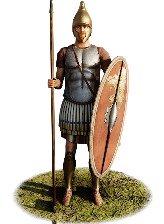
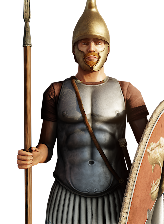
Mysian Thureophoroi are potent infantry, known for their versatility and ferocious charge. They wield the same spear and shield as ‘normal’ Thureophoroi, but are slightly more skilled in charging and attacking. Their shields, bronze helmets, and strong muscle cuirasses give these men some durability when engaged in a melee. As this unit is more aggressive than normal Thureophoroi, it has lower defensive skills. Mysian Thureophoroi are thus best used to flank the opposing battle line and rout the enemy with a devastating charge. If the charge does not work directly, though, they can hold themselves together fairly well in a prolonged melee.
Historical background
The ancient city of Pergamon lay in the southwest of a landscape called Mysia, named after the Thracians that settled Northwestern Anatolia in the 12th century BC. Many Mysians lived piously in the highlands and were vegetarians because they believed that the consumption of meat was a sin: “(...) in accordance with their religion they abstain from eating any living thing, and therefore from their flocks as well; and they use as food honey and milk and cheese, living a peaceable life” (Strab. VII, 3, 3). While the Mysians had the utmost respect for life and nature, they were simultaneously fierce warriors. Homer called them 'hand-to-hand-fighters' (Hom. Il. 13, 5) and Strabo said he did so 'because they were indomitable, as is the case with all brave warriors' (Strab. VII, 3, 3, C296). That is the reason we gave this unit a considerably higher charge bonus than regular Thureophoroi.
This unit is modelled after a Mysian Thureophoros depicted on the funerary stele found in Yiğitler (130 km or 80,7 miles to the east of ancient Pergamon, modern day Demirci district), from the late 2nd century BC (Ma, ‘The Attalids’, in: Thonemann (ed.), Attalid Asia Minor: Money, International Relations, and the State (2013), p. 66). The stele shows a family, including a man wearing a muscle cuirass with a chlamys and accompanied by an aide carrying a thureos shield decorated with a winged thunderbolt (Mysian settlements were often dedicated to Zeus). The shield was probably adopted after military contacts with Gauls, particularly the invasions of Thrace and Greece around 280 BC. This shield type is lighter than the aspis shield carried by traditional hoplites, because the wood was covered with leather instead of bronze. The shield, usually painted white, can be recognised by a hard wooden shield boss and spine (Head, Armies of the Macedonian and Punic Wars (1982), p. 115).
The Mysian Thureophoroi’s muscle cuirass is of particular interest. The emergence of unarmoured Thureophoroi during the early third century was followed by the later recognition that these troops, acting more like heavy peltasts, were at a disadvantage when closing in with more heavily equipped enemy infantry (Plut. Phil. 9.1). Over time, therefore, they started to be equipped with body armour (first linothorax and muscle cuirasses, later Celtic mail shirts) and became part of the main battleline as circumstances dictated (Head (1982), p. 115).
While the stele does not show a helmet, we know about the Mysians’ favourite headgear. Herodotus (VII, 74, 1) noted that they went to war wearing 'their native helmets'. This has been interpreted as referring to helmets similar to the Phrygian design, originating in neighbouring Phrygia, that provide shade for the eyes. Therefore, some of the men are provided with these bronze helmets. Others wear the Chalcidian helmet, a helmet popular among Thracian nobles that had existed since Classical Period. Most soldiers wear a common conical Macedonian Konos.
In the Hellenistic period, Mysia was mostly under the control of the Attalid dynasty, which resided in Pergamon. After Philetairos (343-263 BC) became lord of Pergamon in the early 3rd century BC, he needed an army to defend the city and hired Mysians from the adjacent towns and mountains. These mercenaries later became a permanent part of the Pergamene army, fighting as javelinmen, archers, infantry, and even cavalry (Ma (2013), pp. 65-69; Du Plessis, Seleucid Army (2022), p. 166). Fighting as Thureophoros was a good pick for a well-rounded mercenary. By the late 3rd and 2nd centuries BC, most Mysians were levies or military colonists, though some continued to serve as mercenaries. In an inscription dating to the late 240s BC, King Eumenes I (r. 263-241 BC), the younger brother of Philetairos, differentiates between three classes of soldiers in the Attalid army: "unpaid" soldiers, regularly paid soldiers, and "soldiers decorated with crowns", probably the guard regiments (OGIS 266.13-16,57). They were eventually settled as katoikoi in strategical locations in an area called Mysia Abbaeitis. These were part of the settlement of Mysians during the years after the Galatian war (168–165 BC), in the frontier zone between Mysia, Lydia, and Phrygia. These military communities were placed in strategic sites, living off produce in the countryside, and received Greek equipment as they Hellenised (Ma (2013), pp. 65-69). The funerary stele found in Yiğitler was from such a Mysian settled in Mysia Abbeaitis. The depicted family scene is a good example of the Hellenization of the Mysians.
Mysian mercenaries were also hired by the Antigonid and Seleucid kings (see description: Mysian Archers). The Hellenistic world was a world of mercenaries, and Mysians probably appeared in many armies of the Eastern Mediterranean. In 133 BC, the area became part of the Roman Asia province as stated in the last will of King Attalos III. The Mysians, however, feared the loss of their privileges and backed Aristonikos, the illegitimate son of Eumenes II, as Eumenes III (IGRR IV 154). This revolt was, however, put down in 129 BC, ending the Mysians’ role as important mercenaries.
Stats
| Rank in roster | ||
|---|---|---|
| Men per unit | 40 | ███······· 30% |
| Attack | 15 | ███████··· 72% |
| Charge bonus | 9 | ███······· 33% |
| Defence | 38 | ███████··· 68% |
| · armour | 11 | ██████···· 64% |
| · defence skill | 22 | ██████···· 61% |
| · shield | 5 | ██████···· 57% |
| Morale | 11 | ████······ 39% |
| Discipline | Normal | |
| Training | Untrained | |
| Recruitment cost | 1,794 dn | ████······ 37% |
| Upkeep per turn | 657 dn | ██████···· 55% |
| Turns to recruit | 2 |
Weapons
| Primary | Secondary | Primary | Secondary | Primary | Secondary | Primary | Secondary | ||||
|---|---|---|---|---|---|---|---|---|---|---|---|
| Attack | 15 | 12 | Charge bonus | 9 | 12 | Type | thrown · blade | melee · blade | Damage | piercing | piercing |
| Projectile | javelin | — | Range | 50 | — | Ammunition | 2 | — | Properties | Used just before charging into combat | Light spear (braced against cavalry charges from the front) · +8 attack against cavalry |
Defence
| Primary | Secondary | Primary | Secondary | Primary | Secondary | Primary | Secondary | ||||
|---|---|---|---|---|---|---|---|---|---|---|---|
| Total | 38 | — | Armour | 11 | — | Defence skill | 22 | — | Shield | 5 | — |
Condition and terrain
| Hit points | 1 | Ground: scrub / sand / forest / snow | 0 / -1 / -1 / -1 | Charge distance | 30 | Formations | Square |
Technical stats
| Time between blows (primary / secondary) | 2.5 s / 2.5 s | Extra fatigue in hot climates | 3 | Collision mass per man (1.0 is normal) | 1.27 | Spacing between men: close / loose | 1 × 1.2 m / 2 × 2.4 m |
| Default ranks | 5 |
In battle: Can sap · Very good stamina
Who can recruit it
A core roster unit for one faction, which can raise it anywhere it holds the right building:
Any faction holding one of the provinces below can field it.
Exactly what a settlement must have, route by route (4)
| Building | Also requires | Building | Also requires | Building | Also requires | Building | Also requires |
|---|---|---|---|---|---|---|---|
| Any settlement | Garrison Building or Tier 1 Military Industrial Complex · Second wave of military innovations have arrived! · Mysian area of recruitment · Any Government (Dependency, Indirect Rule or Direct Rule) · Tier 2 Colony not built | Indirect Rule | Garrison Building or Tier 1 Military Industrial Complex · Pergamene Military Reforms · Tier 1 Colony | Direct Rule | Garrison Building or Tier 1 Military Industrial Complex · Pergamene Military Reforms · Tier 1 Colony | Homeland | Garrison Building or Tier 1 Military Industrial Complex · Pergamene Military Reforms |
Areas of recruitment
| Zone | Provinces | ||||||
|---|---|---|---|---|---|---|---|
| Mysian | 0 |