
Description
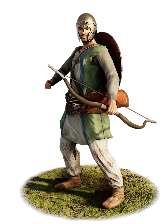
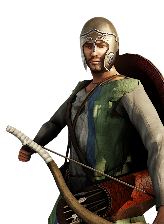
These archers are citizens of Olbia, a proud Greek city on the shores of the Black Sea. After centuries of contact with the Scythians, they have learned a thing or two from their nomadic neighbours. Archery is more popular among them than among most Greeks, and thus the Olbiopolites are one of few poleis who specialise in it, using Scythian composite bows and gorytoi. While they still wear the Hellenic chiton (tunic), some have adopted ‘barbarian’ trousers, while these sport Scythian decorations. Even their tunics have long sleeves, as the winters around Olbia can be long and harsh. Their brazen Chalcidian helmets are popular both in Greece and Scythia these days, while the xiphos sword and the round aspis shield stem from old Greek traditions. When shooting their bows, the Olbiopolite archers sling their shields on their backs and wear their swords in scabbards around their hips. Even though they wear no body armour, they are much better protected than other bowmen. Combining the advantages of Hellenic and Scythian warfare, the archers of Olbia are lethal and effective.
Historical background
The city of Olbia was founded on the junction of the rivers Borysthenes (Dniepr) and Hypanis (Bug) by Milesian colonists in the late 7th century BC (Ps.-Skymn. 804-809). From its foundation, it was also known as Borysthenes due to the nearby river (Hdt. 4.24, 78.3, 5; Ps.-Scymn. 806). Initially, relations with the neighbouring Scythians were amiable, but they soon worsened. Archaeological research attests attacks and fights around the city and nearby Berezan, an even older trade emporion that had fallen under Olbia’s sway (Boardman, Olbia and Berezan (1998), p. 203; Braund, Greater Olbia (2007), pp. 44-45). Eventually, the royal Scythians became ‘protectors’ of Olbia in the early 5th century BC (Hdt. 4.78.3-4). Yet, this was not a one-sided conquest: Olbia’s wealth and its urban culture appealed to some among the Scythian elite, and king Skyles (ca. mid-5th century BC) spent much of his time in the city, adopting Greek dress, buying a house in Olbia, and marrying a Borysthenian woman (Hdt. 4.78.3-5). For some, Skyles’ behaviour passed a line when he had himself initiated into the rites of the Bacchic Dionysos, the god of wine and excessive partying. The Scythians were averse to the cult, and when they heard that their own king had become a follower of Dionysos, and, even worse, that the Olbians made fun of him, they rebelled (Hdt. 4.79.1-80.1). Skyles eventually had to flee to Thrace, but the Thracian king Sitalkes betrayed and killed him (Hdt. 4.80.2-5).
These events did not curb the exchange between Scythians and Olbiopolites. Greek imports were found upstream as far north as Kyiv (cf. Braund (2007), pp. 58-59), a Hellenistic Scythian king of Neapolis on Crimea showed in his epitaph that he had read Homer (Zaytsev, The Scythian Neapolis [2004]), and the Archaic poet Alkaios of Lesbos called Achilles “lord of Scythia” (Alkaios, fr. 354, Campbell) – for the Scythians venerated him in an area called The Racecourse of Achilles, and much beyond (Braund (2007), p. 51). Yet, the rural settlements of the Greeks stopped expanding and growing after ca. 475 BC – perhaps related to the death of Skyles, or another, unknown clash between natives and newcomers (Braund (2007), p. 63). Around the same time, one Leoxos was buried in Olbia, and his gravestone tells us he was killed in battle (IOSPE i² 270). In any case, Olbia itself generally flourished and, safe behind its large stone walls and with a sizable fleet at its disposal (cf. IOSPE i² 325), it did not have to fear direct Scythian attacks or even interventions (Braund (2007), p. 73). At the end of the 5th century BC, Olbiopolite farmers once again claimed new frontiers, and Greek agrarian activity intensified (Braund (2007), p. 64). Around this time, merchants even reached the area of the River Don (Medvedev, Ol’viyskiye torgovye puti i stepen’ dostovernosti etnogeograficheskikh dannykh Gerodota (1997), pp. 24-28). Scythian kings came and went, and their relations with Olbia were sometimes closer, sometimes looser, but the Scythian protectorate was mostly not to the disadvantage of the Olbiopolites (Braund (2007), p. 75). Olbia’s history therefore befits its name, which means “the happy (city)” (Petersen, Cultural Interactions on the Pontic Shores (2010), p. 99, n. 70).
Olbia was a wondrous place, a middle ground between Greeks and Scythians, land and sea, Black Sea and Eurasian steppe. Immigrants from northern Greece, Ionia, and Thrace (Braund (2007), p. 44) shaped the city as much as the neighbouring Scythians, the region’s many waterways (reflected in the religious cults: Braund (2007), p. 76), or the polis’ democratic constitution (Braund (2007), p. 75). Several Olbiopolite families even had some family members with Greek and others with Scythian names (SEG 1990, 631). In this context, it surely comes as no surprise that the soldiers, too, were the product of both Hellenic and Scythian influences. Specifically prominent in Olbia’s army were bowmen: in the training of the ephebes, which took place in a gymnasion like in other Greek cities (IOSPE i² 40), archery was emphasised as the most important activity (IOSPE i² 195). In the latter inscription, dated to the fourth century BC, the elite athlete Anaxagoras, son of Demagoras, claims to have shot an arrow 283 orgies – around 520m (!). The current world record is 330m, achieved by Tyler Toney (USA) in Texas in 1987 (Guiness World Records, s.v. farthest archery target hit [male]). This, however, refers to an actual hit, which Anaxagoras does not specify, so his wonder shot over 520m is possible and shows the athleticism of ancient sportsmen and warriors. A 10cm long Scythian bow found in a child grave attests the popularity of archery in Olbia, and so do the many arrowheads and sometimes even parts of gorytoi in graves (Liashenko, The Protection of the Happy City (2023), p. 47).
Archers probably played a significant part in the defence of Olbia’s walls, farmsteads, forts, and harbours. They feature regularly on the city’s coins and Vladimir Stolba suggested they would have played a starring role when Olbia defeated an expeditionary corps under the Macedonian general Zopyrion, sent by Alexander the Great to subjugate the region in 331 BC (Stolba, ‘Archers’ of the Blessed City [2015]). The overall equipment of Olbia’s bowmen may have consisted of Greek chiton (albeit with long sleeves due to the climate) and chlamys, Chalcidian helmets – which were found in Olbia and also used by Scythians –, a large aspis on the back, also after archaeological finds (Liashenko (2023), p. 47), Scythian bows, and xiphos swords, after more finds (Liashenko (2023), p. 48). The Olbiopolite archers wear their gorytos on the left and their xiphos on the right, after the Scythian, not the Greek custom (as visible, e.g., on the 4th century BC Kul-Oba vessel: Loades, Scythian archery (2021), p. 260). They are arguably some of the best foot archers in the Hellenistic world, and their deadly arrows guarantee Olbia’s autonomy.
Stats
| Rank in roster | ||
|---|---|---|
| Men per unit | 40 | ███······· 30% |
| Attack | 11 | ███······· 34% |
| Charge bonus | 3 | ██········ 16% |
| Defence | 22 | ██········ 23% |
| · armour | 3 | ██········ 21% |
| · defence skill | 14 | ██········ 18% |
| · shield | 5 | ██████···· 57% |
| Morale | 8 | ██········ 19% |
| Discipline | Normal | |
| Training | Trained | |
| Recruitment cost | 1,658 dn | ███······· 28% |
| Upkeep per turn | 607 dn | ████······ 43% |
| Turns to recruit | 3 |
Weapons
| Primary | Secondary | Primary | Secondary | Primary | Secondary | Primary | Secondary | ||||
|---|---|---|---|---|---|---|---|---|---|---|---|
| Attack | 11 | 6 | Charge bonus | 3 | 5 | Type | missile · archery | melee · blade | Damage | piercing | piercing |
| Projectile | arrow | — | Range | 170 | — | Ammunition | 30 | — |
Defence
| Primary | Secondary | Primary | Secondary | Primary | Secondary | Primary | Secondary | ||||
|---|---|---|---|---|---|---|---|---|---|---|---|
| Total | 22 | — | Armour | 3 | — | Defence skill | 14 | — | Shield | 5 | — |
Condition and terrain
| Hit points | 1 | Ground: scrub / sand / forest / snow | 0 / 0 / 0 / 0 | Charge distance | 30 | Formations | Square |
Technical stats
| Time between blows (primary / secondary) | 2.5 s / 2.5 s | Extra fatigue in hot climates | 0 | Collision mass per man (1.0 is normal) | 0.95 | Spacing between men: close / loose | 1.1 × 2.6 m / 1.98 × 4.68 m |
| Default ranks | 5 |
In battle: Can hide in long grass · Very good stamina
Who can recruit it
A core roster unit for one faction, which can raise it anywhere it holds the right building:
Any faction holding one of the provinces below can field it.
Exactly what a settlement must have, route by route (5)
| Building | Also requires | Building | Also requires | Building | Also requires | Building | Also requires |
|---|---|---|---|---|---|---|---|
| Any settlement | Tier 2 Military Industrial Complex · in a Olbian region · Any Government (Dependency, Indirect Rule or Direct Rule) · Tier 2 Colony not built | Indirect Rule | Tier 2 Military Industrial Complex · Tier 1 Colony | Direct Rule | Tier 2 Military Industrial Complex · Tier 1 Colony | Homeland | Tier 2 Military Industrial Complex |
| Any settlement | Tier 2 Military Industrial Complex · in a Olbian region · Dependency or Indirect Rule · Tier 1 Colony not built |
Areas of recruitment
| Zone | Provinces | ||||||
|---|---|---|---|---|---|---|---|
| Olbian homeland | 0 |