
Olbiopolite Hoplites
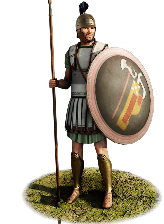
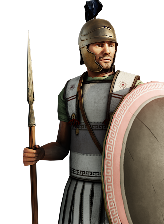
Class: spearmen · Category: infantry · Men per unit: 40
Description
These hoplites hail from Olbia, a flourishing Greek city on the Borysthenes and Hypanis rivers in southern Scythia. Centuries of life in the world of the steppes has shaped the Olbiopolites, and thus some of these hoplites wear Scythian clothes, including trousers and Phrygian hats, while others wear linothorax cuirasses with Iranian-style plates to protect their chests. All of these hoplites carry short, almost triangular daggers from Scythia. This type is known as akinakes and is of high symbolic value in the societies of the Eurasian steppe. At the same time, the round aspis shields and dory spears as well as other parts of their varied equipment (Greek tunics, muscle cuirasses, boots, sandals, greaves) are typically Greek. Since hoplites arm themselves, richer citizens are clad in shining metal armour, while the poorest men go to war with nothing more than spear, shield, and hat. Most of the Olbiopolite Hoplites have helmets, however, and these encompass Chalcidian, Thracian, Thraco-Attic, and pilos types. Those who can afford them wear decorated helmets with colourful crests or plumes. Thus armed, they are the backbone of the Olbiopolite army and will protect the city and its territories against any invaders or raiders.
Historical background
As a colony of Miletos, Olbia was as much a Greek polis as its mother city. Its citizens demanded political rights, and in turn they would defend Olbia’s walls and borders as hoplites. This was true from the Archaic period, when the heavily armoured spearman was born, all the way to the time of Alexander and his successors. Since the early 5th century BC, Olbia was, however, forced to accept the dominion of the royal kings of Scythia (Hdt. 4.78.3-4). Since the Ionian polis was wealthy, heavily fortified, and possessed a navy, this only slightly restricted the movement and activities of the Olbiopolites. By the mid-5th century BC, agents of the Persian Empire were mingling in north Pontic affairs alongside the Scythians (Porucznik, Heuresibios Son of Syriskos (2018), pp. 406-407). The patchy evidence implies they may have brought about the establishment of a tyranny in the formerly aristocratic polis (Porucznik (2018), p. 408). This period did not last long, however, as by around 400 BC, the Olbipolites introduced the cult of Zeus Eleutherios (“the liberator”) and changed their political system to a moderate democracy (IOlb. 71 = IGDOlbia 11, cf. Porucznik (2018), p. 404).
Was this a native rebellion against Persian and possibly Scythian oppression, led by the heroic Heuresibios, son of Syriskos? Not quite. It seems that yet another external power was behind this change: Athens. Already in 425/424 BC, a decree mentions Olbia on a list of tribute paying members of the Delian League during the Peloponnesian War (ATL I 157). Democratic Athens might well have manipulated Olbiopolite affairs in its favour, undermining the pro-Achaemenid tyranny to effect a democratic revolution (Porucznik (2018), p. 403). In any case, Olbia now remained democratic and free from Achaemenid or royal Scythian influence – further Athenian interference cannot be ruled out. There is always a bigger fish, as a wise man once said, and a few decades later all three of the factions vying for control over Olbia were overshadowed by the new kid on the bloc: Alexander the Great. In 331 BC, Olbia was attacked by Macedonians under the command of one Zopyrion and had to raise all of its army, including some freed slaves. Together, they eventually staved off the siege with great losses and, perhaps, the help of some neighbouring Scythians and Getae (Macr. Sat. 1.11.33; Minns, Scythians and Greeks (1913/2011), p. 459).
Citizen troops will have played an important role in this campaign and the general defence of Olbia. A long-forgotten 4th century BC relief shows an aspis and a muscle cuirass at the top of a scene depicting a religious procession (Uvarov, Research on the Antiquities of Southern Russia and the Black Sea Shores (1851), table. XIII; cf. Vinogradov/Schaub, Forgotten Olbian Relief [2021]). The rarity of Greek weapon finds in archaeological sites (mostly machaira swords, alongside one significant fragment of a round shield) is rather due to them not being thrown away but re-used by other soldiers. Those which were found had often been deposited in sanctuaries (Rusyaeva/Nazarov, Shield Fragment (1995), p. 256). Furthermore, a number of graffiti from the harbours of Berezan and Bejkush in the Chora (territory) of Olbia, dating to the Archaic and Classical period, show Hoplites (Bujskikh, Issledovanija (1987), p. 312). While archers are well attested (IOSPE i² 195; Rusyaeva/Nazarov (1996), p. 256), Olbia does not seem to have trained a sizeable cavalry force, suggesting that Hoplites would have been the main part of its army, alongside the bowmen (Rusyaeva/Nazarov (1996), pp. 257-258).
The existing evidence led us to design the following equipment for the Olbiopolite hoplites: dory spears (used by all hoplites) and Scythian akinakes or machairai for melee, Greek tunics, the odd trouser to display Scythian influence, a few greaves for the richer citizens (cf. Jacobson, The Art of the Scythians (2022) p. 129), sandals or boots, and some body armour. The latter consists either of the usual Greek linothorakes, reinforced by Irano-Scythian scales (cf. Jacobson (2022), p. 129), or good old Hellenic muscle cuirasses. Finally, the helmets are a mix of Chalcidian, Thracian, and Thraco-Attic types (cf. Baumer, The History of Central Asia (2018), p. 245), combined with pilos and Phrygian hats. The Olbiopolite hoplites thus reflect the exchange with the world of the steppes, but they remain Greek citizen warriors, ready to defend their “happy city”.
Stats
| Rank in roster | ||
|---|---|---|
| Men per unit | 40 | ███······· 30% |
| Attack | 9 | █········· 13% |
| Charge bonus | 13 | █████····· 52% |
| Defence | 37 | ██████···· 64% |
| · armour | 6 | ████······ 38% |
| · defence skill | 26 | ████████·· 78% |
| · shield | 5 | ██████···· 57% |
| Morale | 10 | ███······· 29% |
| Discipline | Low | |
| Training | Highly trained | |
| Recruitment cost | 1,551 dn | ██········ 20% |
| Upkeep per turn | 568 dn | ███······· 33% |
| Turns to recruit | 2 |
Weapons
| Primary | Secondary | Primary | Secondary | Primary | Secondary | Primary | Secondary | ||||
|---|---|---|---|---|---|---|---|---|---|---|---|
| Attack | 9 | — | Charge bonus | 13 | — | Type | melee · blade | — | Damage | piercing | — |
| Properties | Light spear (braced against cavalry charges from the front) · +8 attack against cavalry | — |
Defence
| Primary | Secondary | Primary | Secondary | Primary | Secondary | Primary | Secondary | ||||
|---|---|---|---|---|---|---|---|---|---|---|---|
| Total | 37 | — | Armour | 6 | — | Defence skill | 26 | — | Shield | 5 | — |
Condition and terrain
| Hit points | 1 | Ground: scrub / sand / forest / snow | -1 / -1 / -4 / -1 | Charge distance | 30 | Formations | Square |
Technical stats
| Time between blows (primary / secondary) | 2.5 s / — | Extra fatigue in hot climates | 1 | Collision mass per man (1.0 is normal) | 1.06 | Spacing between men: close / loose | 1 × 1.05 m / 2 × 2.4 m |
| Default ranks | 5 |
In battle: Can hide in long grass · Can sap · Very good stamina
Who can recruit it
A core roster unit for one faction, which can raise it anywhere it holds the right building:
Any faction holding one of the provinces below can field it.
Exactly what a settlement must have, route by route (4)
| Building | Also requires | Building | Also requires | Building | Also requires | Building | Also requires |
|---|---|---|---|---|---|---|---|
| Any settlement | Garrison Building or Tier 1 Military Industrial Complex · in a Olbian region · Any Government (Dependency, Indirect Rule or Direct Rule) · Tier 2 Colony not built | Indirect Rule | Garrison Building or Tier 1 Military Industrial Complex · Tier 1 Colony | Direct Rule | Garrison Building or Tier 1 Military Industrial Complex · Tier 1 Colony | Homeland | Garrison Building or Tier 1 Military Industrial Complex |
Areas of recruitment
| Zone | Provinces | ||||||
|---|---|---|---|---|---|---|---|
| Olbian homeland | 0 |