
Prienian Epilektoi
Class: spearmen · Category: infantry · Men per unit: 40
Description
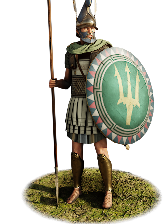
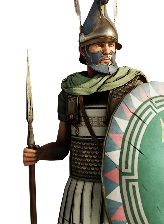
These warriors are the elite force of the Ionian city of Priene, its Epilektoi. They are armed like the Hoplites of old, and yet fight for a democracy of the future, where everyone is considered (theoretically) equal. With their stable aspis shields, deadly dory spears, and xiphos swords as well as reliable greaves, crested Attic, Pilos and Phrygian helmets and beautiful metal muscle cuirasses, they have already defeated the terrible Galatians. Who would dare to challenge these men?
Historical background
Priene was founded by Carians on the northern shores of the Latmian Gulf in times immemorial (Paus. 7.2.10). In the 8th century BC, Theban and Ionian settlers arrived and transformed it into a Greek city that quickly joined the prestigious Ionian League (Rumscheid, Frank, s.v. Priene, DNP Online 2006). Ionia was the thriving birthland of the Greek mind, of philosophy, mathematics, physics, and astronomy. Bias of Priene (ca. 590-530 BC) was counted among the Seven Sages. By his lifetime, Priene had gained control over the Panionion, the central sanctuary of the Ionian League, and it controlled much land beyond the city walls, in the fertile valley of the Maeander as well as on the other side of the Mykale mountains, which towered above the city. The northern stretch of land encompassed the Panionion, the Carian fortress Karion and the booming market town Dryoussa and a most productive farmland, which Herodotus praised as one of the most verdant districts in the world (Hdt. 1.142). Unsurprisingly, Priene's control over this land was contested by other powers, namely Samos, who declared war on the Prienians when they first took a hold in the area. The war only ended after almost two centuries and lengthy negotiations (Plut. Moralia 296A = Aristot. Constitution of the Samians F576 Rose; CIG 2254). Only a few decades later, in the mid-6th century BC, Priene fell under Lydian authority, before Kroisos was defeated by Kyros the Great and Ionia became part of the Persian Empire. From 499 to 494 BC, Priene participated in the Ionian Revolt, which was eventually put down by Artaphernes and Megabates, the brother and cousin of king Dareios, respectively. After the failure of the revolt, the blooming city was severely punished and lost much of its former wealth and importance (cf. Hdt. 6.8.1; 6.14–20). As a member of Athens’ Delian League, it was even fought over by its old enemies Miletos and Samos in 441/440 BC (Thuc. 1.115.2).
After a dark century, Priene began to recover in the 4th century BC. In 373 BC, the Panionion was restored to its ancient glory, and a law was passed to reserve the priestly offices for citizens of Priene (Diod. 15.49, Strab. 8.7.2C384). More radical measures were necessary, however: the Maeander River (Greek: Maiandros) had silted the Latmian Gulf – in the course of only 400 years, some 200 km² of sea had become land. This meant that Priene had lost its position as an important port on the Ionian coast and thus a major source of income (cf. Quint. Smyrn. Troy 10.145; Magie, Roman Rule in Asia Minor (2015), p. 78). In the mid-4th century BC, the Prienians decided that enough was enough: they moved their whole city to the southern side of the Mykale mountains, just beneath the Teloneia, with a mighty acropolis sitting high above the new city. Priene was rebuilt according to the Hippodamian city plan, an idea devised by Hippodamos of Miletos (ca. 500-408 BC). An orthogonal grid of streets was grouped around the Agora and the sanctuaries, including a stunning temple of Athena designed by the star architect Pytheos that was begun with the support of Mausolos, satrap of Caria, and finished with the help of Alexander the Great (Vitr.1.1.12; cf. Ault, Haus und Stadt im klassischen Griechenland (2017), p. 43). To supply the urban centre with water, clay tubes were built from sources in the northeast all the way to Priene, while street canals served as sewers (Crouch, Priene’s Streets and Water Supply (1996); Hoepfner/Schwandner, Haus und Stadt (1995), pp. 188-225). Many of the new buildings were made of marble to impress visitors (Rumscheid, Priene (1999), fig. 5). In the 2nd century BC, a Prytaneion for the city’s government was added, and king Orophernes of Cappadocia or one of his descendants sponsored a great hall at the northern side of the city centre as well as a market gate (Von Kienlien, Agora von Priene, 1998/1999).
The renewed polis had its autonomy confirmed by Alexander (GHI 86b = IPriene² 1, Badian, Alexander the Great and the Greeks in Asia (1966), pp. 47-48) and continued to be governed by a radical democracy in which foreigners, women and slaves had far more rights than elsewhere (I.Priene 5.1-2, Rubinstein, Ionia (2004), p. 1092; Gray, Beyond the Classical Polis (2022), p. 212). In 283/282 BC, Lysimachos had to arbitrate in another conflict between Priene and Samos to avoid a major war (IPriene 37). Other, greater threats were on the horizons: Lysimachos was killed in battle at Kurupedion by Seleukos I in 281 BC, and when the Prienians failed to congratulate the victor, they were quickly forced under Seleucid power (Lund, Lysimachus (2002), p. 207). Yet, Seleukos was killed by Ptolemy Keraunos soon after, who in turn was slain by the Galatians. Having wrought havoc to Greece and Macedon, the ‘barbarians’ were invited by the Northern League, an anti-Seleucid coalition led by Bithynia, Herakleia Pontike and Byzantion, to come to Asia in 279 BC (Memnon F 11.1–3). Though Priene remained in the Seleucid sphere, thanks to the activity of its diplomat Larichos (OGIS 215 = IPriene 57–59), the new Seleucid king, Antiochos I, was far away, Ptolemaios II was busy in Egypt, and the mighty cities of Ephesos, Pergamon and Miletos hid behind their walls when the Northern League leaned back and unleashed the horde on Asia Minor. While villages were burned down, peasants and their families killed and sanctuaries pillaged, only one faction was brave enough to confront the invaders on the battlefield: Priene (OGIS 765 = IPriene 17, ll. 1–16). Sotas, son of Lykos, one of the most renowned citizens of the city, assembled the Epilektoi, the cream of the cavalry (the Hippotrophoi, literally "horse breeders") and all volunteers from the countryside, which had already suffered from raids, and at first evacuated the farms to move all citizens behind the safe walls of Priene (IPriene 17, ll. 16–24). He then occupied all elevations in the Polis' chora (territory) and whenever Galatians were sighted, he sent out a part of his force to attack them, thus saving many barnyards and most of the peasants who had remained on the fields. When news of his successes reached the city, most of the remaining citizens took up arms and Sotas was able to form a sizeable army. When a greater Galatian force arrived, the Prienians emerged victorious (OGIS 765 = IPriene 17, ll. 25– 37). Frustrated by their losses and defeats, the Galatians moved on to the south and east, continuing to plunder until Tlos in Lycia became the second city to take the fight to them and defeat them - the end of the great Galatian raids of the early 270s (SEG 54.1442).
While the Swiss archaeologist Erich Kistler (Funktionalisierte Keltenbilder (2009), p. 33) rightly pointed out that the Galatians were not given enough food and money by the Northern League to take care of their families and were thus forced to take whatever they could lay their hands on, the Prienians contributed much to the image of the terror of the north. The inscription on the fine marble stele the Prienians later erected for Sotas speaks of "paranomia", sins against both mankind and the gods (IPriene 17, ll. 10–11) and portrays the Galatians as bloodthirsty monsters. The Epilektoi had played a starring role in the city’s defence: according to lines 18–19 in the inscription, "mistophoroi ton politon pezous”, "paid citizen foot soldiers" fought in his army (cf. Burstein, Ipsos (1985), p. 23). Furthermore, in the inscription I.Priene 22 (ca. 262 BC), Nymphon, son of Protarchos is praised for guarding the citadel, probably the Akropolis – these troops may have been Epilektoi, too. Since they were professionals, in difference to the majority of the citizen army, it would make sense to emphasise that they were paid troops. They would have been financed by public taxes and served as the standing army of Priene, together with the Hippotrophoi (John Ma, Fighting poleis of the hellenistic world (2009), p. 344).
Professional warriors are always better than volunteers, not only because they can train daily, but also because they will usually already have experienced war and battle. In RIS, the Prienian Epilektoi are given typical hoplite equipment such as the dory, the spear, a rimmed, round aspis shield, a xiphos sword for melee, greaves, and bronze muscle cuirasses. A selection of helmets typical for the period and region complete their panoply: crested Pilos, Attic, and Phrygian types. In fact, the marble stele with the Sotas inscription depicts a crested (Thraco-)Attic helmet and a rimmed aspis at the top, confirming our assumptions.
Stats
| Rank in roster | ||
|---|---|---|
| Men per unit | 40 | ███······· 30% |
| Attack | 11 | ███······· 34% |
| Charge bonus | 16 | ███████··· 69% |
| Defence | 50 | █████████· 94% |
| · armour | 12 | ███████··· 69% |
| · defence skill | 33 | ██████████ 97% |
| · shield | 5 | ██████···· 57% |
| Morale | 12 | ██████···· 57% |
| Discipline | Normal | |
| Training | Highly trained | |
| Recruitment cost | 2,123 dn | ██████···· 55% |
| Upkeep per turn | 777 dn | ████████·· 75% |
| Turns to recruit | 4 |
Weapons
| Primary | Secondary | Primary | Secondary | Primary | Secondary | Primary | Secondary | ||||
|---|---|---|---|---|---|---|---|---|---|---|---|
| Attack | 11 | — | Charge bonus | 16 | — | Type | melee · blade | — | Damage | piercing | — |
| Properties | Light spear (braced against cavalry charges from the front) · +8 attack against cavalry | — |
Defence
| Primary | Secondary | Primary | Secondary | Primary | Secondary | Primary | Secondary | ||||
|---|---|---|---|---|---|---|---|---|---|---|---|
| Total | 50 | — | Armour | 12 | — | Defence skill | 33 | — | Shield | 5 | — |
Condition and terrain
| Hit points | 1 | Ground: scrub / sand / forest / snow | -1 / -1 / -4 / -1 | Charge distance | 30 | Formations | Square |
Technical stats
| Time between blows (primary / secondary) | 2.5 s / — | Extra fatigue in hot climates | 3 | Collision mass per man (1.0 is normal) | 1.26 | Spacing between men: close / loose | 1 × 1.05 m / 2 × 2.4 m |
| Default ranks | 5 |
In battle: Can sap · Very good stamina
Who can recruit it
A core roster unit for one faction, which can raise it anywhere it holds the right building:
Any faction holding one of the provinces below can field it.
Exactly what a settlement must have, route by route (4)
| Building | Also requires | Building | Also requires | Building | Also requires | Building | Also requires |
|---|---|---|---|---|---|---|---|
| Any settlement | Tier 3 Military Industrial Complex · Prienian area of recruitment · Any Government (Dependency, Indirect Rule or Direct Rule) · Tier 2 Colony not built | Direct Rule | Tier 3 Military Industrial Complex · Tier 2 Colony | Homeland | Tier 2 Military Industrial Complex | Any settlement | Tier 2 Military Industrial Complex · Prienian area of recruitment · Dependency only · Tier 1 Colony not built |
Areas of recruitment
| Zone | Provinces | ||||||
|---|---|---|---|---|---|---|---|
| Prienian | 0 |