
Scytho-Bosporan Archers
Class: missile · Category: infantry · Men per unit: 40
Description
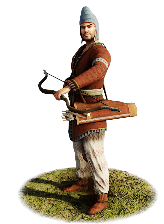
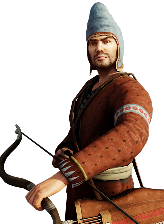
Ahhh, the bow. A tool, a weapon, a thing that kills, a thing that brings life. It helps the Scythians to obtain food, it is their status symbol, and it protects them in raids or war. The elaborate composite bow of the steppe can pierce an object, animal, or man from afar, and nothing can match it here. When you possess a lethal bow and a practical gorytos, you do not need armour or a shield. Should these men be forced into melee, they can rely on their short spears with large heads that smash bones and, well, heads. Tunics with long sleeves held together by simple belts, traditional trousers, and boots suffice to guard the Scythians who live around the Kimmerian Bosporos against the merciless wind and the cold of the night. Some wear headbands or Scythian caps, and every man carries a sword, either Scythian (akinakes) or Greek (machaira, xiphos), to display their wealth, or to simply show off a weapon they bought from Hellenic traders or took from the cold, dead bodies of their enemies. But in truth, the bow is all you need. Having been trained at archery since childhood, these Scytho-Bosporan bowmen can kill virtually anything from long range.
Historical background
Scythians formed an important part of Bosporan history. From the earliest days of Greek settlement on the northern shores of the Black Sea, they were neighbours, enemies, allies, and subjects. Already by the time of Leukon I (r. 389-349 BC) – perhaps the greatest of all Bosporan rulers – Scythian warriors had become a regular part of Bosporan armies (Polyaen. 6.9.4). The Bithyno-Macedonian lawyer Polyainos (2nd century AD) tells us that the archon stationed Scythian bowmen behind his Greek hoplites so they could shoot them if they tried to run away. This indicates that Leukon trusted his Scythian soldiers more than the Greeks, perhaps because they were paid mercenaries instead of a citizen levy from half-autonomous poleis. Several decades later, Leukon’s grandsons Satyros II and Eumelos fought each other for the Bosporan throne. At the largest battle of the war, near the river Thatis in the Sindike, both armies were largely made up of allies from the steppes: Satyros commanded 2,000 Greek mercenaries, 2,000 Thracian mercenaries, 22,000 Scythian footmen, and 10,000 Scythian horsemen. On the other side, Eumelos was supported by Aripharnes, king of the Sarmatian Siraces, who brought 22,000 infantry and 20,000 cavalry to the battlefield (Diod. 20.22.4). Not only did Scythians and Sarmatians contribute large numbers to each force, the percentage of Scythian infantry is also remarkably high.
A rich vase from a Scythian royal barrow at Kul-Oba near Pantikapaion, dated to the 4th century BC, features very detailed images of local soldiers (Gajkudevič, Bosporanisches Reich (1971), p. 145 & fig. 11). They wear headbands or pointy caps, Scythian long-sleeved tunics, belts, trousers, and boots as well as spears and/or bows. The only detail we did not add to this unit are the shields, for it represents the lower strata of Scytho-Bosporan society and the Bosporans have other, better protected archers at their disposal. In any case, a golden applique from the same burial depicts two archers without shields who wear the same clothes and use the same composite bows (BM 1909,0617.2, Catalogue of the Jewellery, Greek, Etruscan, and Roman, in the Departments of Antiquities, British Museum [2106.d]). Greek equipment, like the straight xiphos and the curved machaira swords reflect the influence of their Bosporan overlords (cf. Mielczarek, Bosporan Army (1999), pp. 46-47), while the akinakes was the traditional dagger or short sword of the Scythians (Ginters, Das Schwert der Skythen und Sarmaten in Südrussland (1928), pp. 21-23; 77-79).
Stats
| Rank in roster | ||
|---|---|---|
| Men per unit | 40 | ███······· 30% |
| Attack | 10 | ██········ 19% |
| Charge bonus | 5 | ███······· 26% |
| Defence | 29 | ████······ 40% |
| · armour | 3 | ██········ 21% |
| · defence skill | 26 | ████████·· 78% |
| · shield | 0 | █········· 0% |
| Morale | 9 | ███······· 26% |
| Discipline | Normal | |
| Training | Trained | |
| Recruitment cost | 1,560 dn | ██········ 21% |
| Upkeep per turn | 542 dn | ███······· 26% |
| Turns to recruit | 2 |
Weapons
| Primary | Secondary | Primary | Secondary | Primary | Secondary | Primary | Secondary | ||||
|---|---|---|---|---|---|---|---|---|---|---|---|
| Attack | 10 | 7 | Charge bonus | 5 | 5 | Type | missile · archery | melee · blade | Damage | piercing | piercing |
| Projectile | arrow | — | Range | 170 | — | Ammunition | 30 | — |
Defence
| Primary | Secondary | Primary | Secondary | Primary | Secondary | Primary | Secondary | ||||
|---|---|---|---|---|---|---|---|---|---|---|---|
| Total | 29 | — | Armour | 3 | — | Defence skill | 26 | — | Shield | 0 | — |
Condition and terrain
| Hit points | 1 | Modifier against mounts | horse +1 · chariot +1 · camel +1 | Ground: scrub / sand / forest / snow | 0 / 0 / 0 / 0 | Charge distance | 30 |
| Formations | Square |
Technical stats
| Time between blows (primary / secondary) | 2.5 s / 2.5 s | Extra fatigue in hot climates | 0 | Collision mass per man (1.0 is normal) | 0.84 | Spacing between men: close / loose | 1.1 × 1.3 m / 2.2 × 2.6 m |
| Default ranks | 5 |
In battle: Can hide in long grass · Can sap · Very good stamina
Who can recruit it
A core roster unit for one faction, which can raise it anywhere it holds the right building:
Any faction holding one of the provinces below can field it.
Exactly what a settlement must have, route by route (4)
| Building | Also requires | Building | Also requires | Building | Also requires | Building | Also requires |
|---|---|---|---|---|---|---|---|
| Any settlement | Garrison Building or Tier 1 Military Industrial Complex · Scytho-Bosporan area of recruitment · Any Government (Dependency, Indirect Rule or Direct Rule) · Tier 2 Colony not built | Indirect Rule | Garrison Building or Tier 1 Military Industrial Complex · Tier 1 Colony | Direct Rule | Garrison Building or Tier 1 Military Industrial Complex · Tier 1 Colony | Homeland | Garrison Building or Tier 1 Military Industrial Complex |
Areas of recruitment
| Zone | Provinces | ||||||
|---|---|---|---|---|---|---|---|
| Scytho-bosporan | 0 |