
Sindian Mounted Archers
Class: missile · Category: cavalry · Men per unit: 32
Description
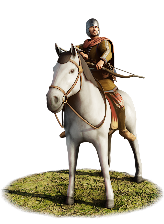
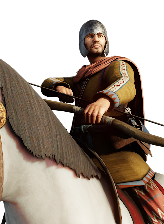
In the lands beyond the Black Sea, only two things matter: the bow and the horse. Every boy learns how to ride and how to shoot arrows from a young age, and this constant training and practice produces excellent warriors. The Sindians, who live on the eastern coast of Lake Maiotis (Sea of Azov), are no exception. Accordingly, they use the advanced composite bow of the steppe, and they possess a quick and agile force of light cavalry. In a gorytos on their hip, they always carry a huge reservoir of arrows around. Their thick tunics with long sleeves, as well as their flying cloaks, trousers, and woollen caps all keep them warm during the harsh winters of the Sindike. While many horse archers keep their equipment light, wearing no body armour or shields, quite a few of them were able to afford konos, Pseudo-Illyrian, or Pseudo-Chalcidian helmets with cheek guards, or even a linothorax or Scythian-style scale tunic. Occasionally, greaves can be seen protecting their legs, and the small, round Greek pelte shield has found some popularity. Short swords are their weapon of choice for melee, either the curved Greek machaira or the straight Scythian akinakes. While deadly, they are not the most efficient weapons when fighting from horseback, and a clear weakness when facing heavier horse- or footmen. These Sindian horse archers should thus ideally be kept outside of the enemy’s range. Sindian belts and typical Scythian boots complete their equipment.
Historical background
The ancient Greeks called the strait between the Black Sea and the Sea of Azov the Kimmerian Bosporos. The Ionian settlers, who arrived on these shores mostly from Miletos in the late 6th and early 5th century BC, named their land and later their kingdom after the strait. On the eastern side of the Bosporos, they founded a major city in Phanagoreia, alongside a string of smaller towns (Strab. 7.4.4C309–310). These lands were not uninhabited: Greek sources call the peninsula now known as Taman “Sindike”, and the Sindians were the native population (Ps.-Scyl. 2.72). In the early 4th century BC, about a century before the start of the RIS campaign, the area was annexed by the Bosporan ruler Leukon I (see description: Sindian Infantry). Its inhabitants now became subjects of Leukon and his successors, and many of them had to serve in the Bosporan army when war reared its ugly head.n
While no literary description of Sindian warriors exists, there is plenty of material evidence. A famous limestone statue from the Kuban wears a Sindian cap and Sindian clothes with long sleeves and trousers (Medvedeva/Musin, The Imperial Archaeological Commission (1859–1917) (2019), p. 477). He is armed with a bow and a gorytos, and perhaps akinakes. His tunic could also be interpreted as a linothorax (as the wise Jorellaf suggested). In nearby Elizavetovskoe, an ancient settlement has been unearthed by archaeologists in an area that may have been Siracian, Maiotian or Sindian. The burials contain spears, swords, arrowheads, a muscle cuirass with a gorgon, scale armour and a shield covered with iron stripes (Shilov, Novye dannye ob Elizavetinskom gorodiŝe po raskopkam [1952]; Anfimov, Meotskij mogilʹnik I–II vv. n. è. bliz stanicy Elizavetinskoj [1984]). In nearby Scythian lands, scale armour shirts were sometimes made from rawhide (Mielczarek (1999), p. 53, n. 204). A similar collection was found in the tumuli from Semibratnee, a modern town located 30 km from Gorgippia, the capital of the Sindian kingdom. It contains typically Scytho-Sindian items, while others reflect interactions with the Hellenic world and Persia. Among these are shoulder straps on scale armour, Medusa decorations on cuirasses, Greek plate greaves for the legs, and both machaira and xiphos swords (Goronćarowskij, Sindian Arms and Armour of the 5h-4th centuries BC [2016]). Aside from these, bows and gorytoi in the graves of nobles demonstrate that horse archers formed the main part of the Sindian cavalry both in the time before and after the integration into the Bosporan Arche (Goronćarowskij [2016]).
Machaira and akinakes swords were also found in impressive quantities at the Soviet farmstead of Rassvet in 1958 (Krushkol, Description of burial associations (2010), fig. 197.142.1; Novichikhin, Grave goods from the Rassvet necropolis (2010), p. 225). Machaira swords were also common among the Greek soldiers of the Bosporan army and were most likely first introduced in the Sindike by Bosporan Greeks (Goronćarowskij [2016]). After the annexation of the Sindian realm, they would have probably found even more widespread use in this region. Helmet finds are usually later, indicating that not everyone used them yet in the 4th or early 3rd century BC. So-called Pseudo-Illyrian and Pseudo-Chalcidian helmets with cheek guards as well as types similar to the konos and pilos dominate the archaeological record from the 3rd to 1st century BC (Symonenko, Sarmatian age helmets (2015), p. 296). Finally, the pelte shields of some of the horse archers are inspired by a terracotta figure of a rider with a roundshield found in a Bosporan burial (Agrafonov/Spiridonova/Tchekanova, Severnoye Prichernomor'yev antichnuyu epokhu: arkheologiya i mifologiya (2006), fig. 14.8).
Accordingly, the Sindian horse archers have a few helmets, linothorakes, and scale cuirasses, while some only bear caps and long-sleeved tunics. Trousers, belts, and boots are based on the limestone statue and nearby Scythian evidence, while bow, gorytos, akinakes, and machaira are the logical choice after our overview of the archaeological research. The pelte shields are only used by some riders since their depiction is uncommon, but it provides the Sindian horse archers with some additional protection against enemy missile fire.
Stats
| Rank in roster | ||
|---|---|---|
| Men per unit | 32 | ██········ 23% |
| Attack | 11 | ███······· 34% |
| Charge bonus | 15 | ██████···· 64% |
| Defence | 20 | ██········ 19% |
| · armour | 7 | ████······ 42% |
| · defence skill | 13 | █········· 13% |
| · shield | 0 | █········· 0% |
| Morale | 9 | ███······· 26% |
| Discipline | Normal | |
| Training | Trained | |
| Recruitment cost | 1,951 dn | █████····· 47% |
| Upkeep per turn | 746 dn | ███████··· 73% |
| Turns to recruit | 2 |
Weapons
| Primary | Secondary | Primary | Secondary | Primary | Secondary | Primary | Secondary | ||||
|---|---|---|---|---|---|---|---|---|---|---|---|
| Attack | 11 | 6 | Charge bonus | 15 | 22 | Type | missile · archery | melee · blade | Damage | piercing | slashing |
| Projectile | arrow | — | Range | 170 | — | Ammunition | 30 | — | Properties | — | Armour-piercing (counts only half the target's armour) |
Defence
| Primary | Secondary | Primary | Secondary | Primary | Secondary | Primary | Secondary | ||||
|---|---|---|---|---|---|---|---|---|---|---|---|
| Total | 20 | — | Armour | 7 | — | Defence skill | 13 | — | Shield | 0 | — |
Condition and terrain
| Hit points | 1 | Mount | medium horse | Ground: scrub / sand / forest / snow | -1 / 0 / -4 / 0 | Charge distance | 40 |
| Formations | Square |
Technical stats
| Time between blows (primary / secondary) | 2.5 s / 2.5 s | Extra fatigue in hot climates | 1 | Spacing between men: close / loose | 2.2 × 5.2 m / 3.96 × 7.28 m | Default ranks | 5 |
In battle: Can form Cantabrian circle · Very good stamina
Who can recruit it
A core roster unit for one faction, which can raise it anywhere it holds the right building:
Any faction holding one of the provinces below can field it.
Exactly what a settlement must have, route by route (5)
| Building | Also requires | Building | Also requires | Building | Also requires | Building | Also requires |
|---|---|---|---|---|---|---|---|
| Any settlement | Tier 2 Military Industrial Complex · Sindian area of recruitment · Any Government (Dependency, Indirect Rule or Direct Rule) · Tier 2 Colony not built · Requires resource horses or horses supplied factionwide | Indirect Rule | Tier 2 Military Industrial Complex · Tier 1 Colony · Requires resource horses or horses supplied factionwide | Direct Rule | Tier 2 Military Industrial Complex · Tier 1 Colony · Requires resource horses or horses supplied factionwide | Homeland | Tier 2 Military Industrial Complex |
| Any settlement | Tier 2 Military Industrial Complex · Sindian area of recruitment · Dependency or Indirect Rule · Tier 1 Colony not built |
Areas of recruitment
| Zone | Provinces | ||||||
|---|---|---|---|---|---|---|---|
| Sindian | 0 |