
Southern Illyrian Axemen
Class: light · Category: infantry · Men per unit: 40
Description
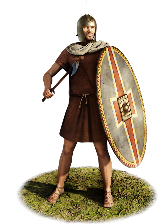
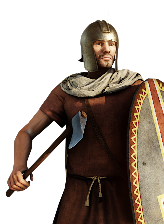
Southern Illyrian Axemen are nimble, lethal raiders who are sufficiently armed to fight other infantry toe to toe thanks to their axes, javelins, Illyrian helmets, and long thureos shields. However, these men lack body armour, preferring to wear just a traditional Illyrian short tunic to stay mobile and capable of skirmishing. They can perform both combat roles capably and make a solid, dependable mainline unit.
Historical background
By 270 BC, Southern Illyrian identity and even the communities themselves became a battleground between Greek-style Mediterranean models of culture and society, and that of the Celtic-derived La Tene culture, both of which were rather incompatible with one another (Dzino, Contesting Identities of Pre-Roman Illyricum (2012), p. 70). The Illyrian identity itself was not readily defined. Prior to the Roman conquest, it mostly just referred to the Greek idea of the indigenous peoples living throughout the south-eastern Adriatic and on the Macedonian borders (Dzino (2012), p. 72). The Romans, too, contributed to this phenomenon by labelling the area and people as Illyrian, pushing a socially cohesive identity onto the various peoples of the entire region/later province and thus creating a sense of common identity where none had existed before (Mihajlovic, Tracing ethnicity backwards. The case of the “Central Balkan Tribes” (2014), p. 103).
The axe has a long history in Illyria, throughout the region. When it comes to burials, generally it was not a common habit for Illyrians to intern their dead with weaponry, except in certain cases for elites, even before the La Tene culture arrived. There have been discoveries of individual graves with spears from Krizna gora from the eighth to seventh centuries BC, and a few graves with axes and spears from Most na Soci from the sixth to fifth centuries BC (Terzan and De Marinis, The Northern Adriatic (2018), p. 30). In this unit’s case, it is the axes that interest us most. A Vace metal plaque discovered in Slovenia and dated to somewhere around 400 BC shows Illyrian axemen with axes, javelins, Celtic-style thureos shields, Greco-Illyrian-style helmets, but they lack armour (as is common with most Illyrians), only wearing a short tunic. This is supported by archaeological findings from nearby Gorica in western Slovenia from the 6th century BC, which also indicate that at that time, warriors were wearing helmets of a Greco-Illyrian style, indicating growing power and prosperity (Wilkes, The Illyrians (1996), p. 51).
As for the thureos shield, we know that the Southern Illyrians would have been familiar with Celtic warfare and equipment too, as by the 4th century BC, Celts had been settled in Pannonia for some time, and had both warred with and against each other (Wilkes (1996), p. 138). In one particularly entertaining case, detailed by Theopompus (quoted by Athenaeus 10.60), the Celts’ knowledge of the Illyrians’ love of drinking and feasting led to them using laxatives to poison the Illyrians (likely Ardiaei) to such an extent that “many were caught by the Celts and killed, whilst others cast themselves into the river from unbearable pain”. The Dardanians, on the other hand, were confident enough in their ability to defeat the Celts, as they had suffered little from the Celtic migration in 279-80 BC and even offered (although they were rejected) 20,000 men at arms to Ptolemy Keraunos of Macedon. When the Celtic Scordisci had been defeated in Greece at Delphi in 279 BC, they were once again engaged by the Dardanians during their retreat (Wilkes (1996), pp. 144-149) and would require nearly half a century to recover, settling near the Danube (Lazic, The Celts and the Scordisci within the Territory of Serbia (2017), p. 79). Furthermore, the Delmatae’s adoption of thureos shields is directly emphasised by the Romans on their Tilurium Tropaion (a Roman victory trophy from the 2nd decade of the 1st century BC). The stone carving displays a Dalmatian warrior with a Linothorax with round metal breastplate, thureos, javelins, spear, Shmarjet, and Illyrian helmet. All this evidence from different Southern Illyrian peoples taken together, we used the thureos, javelins, and Illyrian-style helmet alongside an Illyrian axe and short tunic to represent a unit of warriors capable of raiding and hard fighting, but not necessarily representing a warrior elite.
Stats
| Rank in roster | ||
|---|---|---|
| Men per unit | 40 | ███······· 30% |
| Attack | 15 | ███████··· 72% |
| Charge bonus | 13 | █████····· 52% |
| Defence | 32 | █████····· 49% |
| · armour | 3 | ██········ 21% |
| · defence skill | 25 | ███████··· 74% |
| · shield | 4 | █████····· 48% |
| Morale | 11 | ████······ 39% |
| Discipline | Normal | |
| Training | Untrained | |
| Recruitment cost | 1,680 dn | ███······· 31% |
| Upkeep per turn | 615 dn | █████····· 46% |
| Turns to recruit | 2 |
Weapons
| Primary | Secondary | Primary | Secondary | Primary | Secondary | Primary | Secondary | ||||
|---|---|---|---|---|---|---|---|---|---|---|---|
| Attack | 15 | 9 | Charge bonus | 13 | 21 | Type | thrown · blade | melee · blade | Damage | piercing | slashing |
| Projectile | javelin | — | Range | 50 | — | Ammunition | 2 | — | Properties | Used just before charging into combat | Armour-piercing (counts only half the target's armour) |
Defence
| Primary | Secondary | Primary | Secondary | Primary | Secondary | Primary | Secondary | ||||
|---|---|---|---|---|---|---|---|---|---|---|---|
| Total | 32 | — | Armour | 3 | — | Defence skill | 25 | — | Shield | 4 | — |
Condition and terrain
| Hit points | 1 | Ground: scrub / sand / forest / snow | 0 / 0 / 0 / 0 | Charge distance | 30 | Formations | Square |
Technical stats
| Time between blows (primary / secondary) | 2.5 s / 2.5 s | Extra fatigue in hot climates | 0 | Collision mass per man (1.0 is normal) | 0.91 | Spacing between men: close / loose | 1 × 1.2 m / 2 × 2.4 m |
| Default ranks | 5 |
In battle: Can hide in long grass · Can sap · Very good stamina
Who can recruit it
A core roster unit for 6 factions, each able to raise it anywhere they hold the right building:
Ardiaei · Dardania · Delmatae · Illyrian Kingdom · Labeatae · Liburni
Any faction holding one of the provinces below can field it.
Exactly what a settlement must have, route by route (4)
| Building | Also requires | Building | Also requires | Building | Also requires | Building | Also requires |
|---|---|---|---|---|---|---|---|
| Any settlement | Garrison Building or Tier 1 Military Industrial Complex · Southern Illyrian area of recruitment · not Penestan area of recruitment · Any Government (Dependency, Indirect Rule or Direct Rule) · Tier 2 Colony not built | Indirect Rule | Garrison Building or Tier 1 Military Industrial Complex · Tier 1 Colony | Direct Rule | Garrison Building or Tier 1 Military Industrial Complex · Tier 1 Colony | Homeland | Garrison Building or Tier 1 Military Industrial Complex |
Areas of recruitment
| Zone | Provinces | ||||||
|---|---|---|---|---|---|---|---|
| Southern illyrian | 0 |