
Taurian Archers
Class: missile · Category: infantry · Men per unit: 40
Description
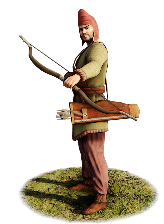
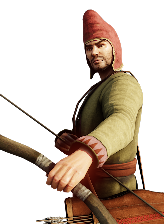
In the shadow of the Taurian mountains, grim men hunt brutal beasts with lethal bows. And if a stranger provokes them, he, too, may become their prey. The mysterious Taurians excel at archery, utilising Scythian composite bows that provide great range and penetration power. Their long-sleeved tunics, broad headbands, pointy caps, trousers, and boots similarly reflect the influence of their nomadic neighbours. And yet, most Taurians live from agriculture and trade with the Greeks of the Kimmerian Bosporos, Chersonesos, and Olbia. When forced to defend their homes, these Taurians will take up bow and spear. Greek and Scythian swords are only seen as symbols of prestige among them, and shields or helmets deemed unnecessary.
Historical background
“Lord Phoibos, here I am come, and here will die,
Unless thou save me, as thou hast betrayed.”
And, lo, from out that dark and golden shade
A voice : “Go, seek the Taurian citadel
Seize there the carven Artemis
that fell
From heaven, and stablish it on Attic soil.
So comes thy freedom.”
– Orestes, in: Euripides, Iphigenia in Tauris, vv. 977-983.
These words of the great tragedian Euripides, who was born at Salamis on Cyprus but spent most of his life in Athens, give us a glimpse into the Greek views on the Taurian peninsula (Chersonesos Taurike) in the 5th century BC. As the place where Orestes will find his sister Iphigenia, it is central to the tragedy, and the audience learns that the native Taurians sacrifice humans to their version of Artemis. Herodotus, the first Greek historian, confirms this account, adding that the Taurians cut off the heads of their enemies and place them on poles. He concludes: “The Tauroi live by plundering and war” (Hdt. 4.103.3). Even though there is no indication that the Greek settlers and the Taurian natives lived in a state of ever-present war, the latter are still represented as brutal barbarians. Archaeology helps us to look beyond this image, for sites of the so-called Kizil-Koba culture from the area around the Crimean mountains illustrate daily life in that region from the 9th to 3rd century BC.
Among the Kizil-Koba findings, bronze arrowheads are common, indicating that many Taurians hunted and fought as archers (Leskov, The Maikop treasure (2008), p. 230). Similarly important would have been javelins, as they were among the neighbouring Scythians and the Bosporan Greeks. Since Pseudo-Apollodoros and Strabo probably attest to increasing Scythian influences over time (Ps.-Apoll. Ep. 6.26; Strab. 7.4.5C311), and since many Taurians lived under the rule of the Bosporan Greeks, their respective fighting styles would have left a mark on the Taurians. In fact, some of them had already lived on the Kimmerian Bosporos in the 5th century BC. One grave stela from Pantikapaion was erected by a Taurian called Tychon, who had moved to the capital of the Bosporan Kingdom as a mercenary or merchant (Treister, Archaic Pantikapaion (2007), p. 575).
Therefore, the Taurian archers in RIS are armed with Scythian composite bows and short spears with large heads. Our bowmen wear Scythian tunics with long sleeves, pointy Scythian caps or headbands, simple belts, trousers, and boots after the fashion of the steppe. All of these can be found on the 4th century Kul-Oba vase and the Solokha comb from the lower Dniepr area (Heinen, Antike am Rand der Steppe (2006), p. 25; Gajkudevič, Bosporanisches Reich (1971), p. 145 & fig. 11). The curved machaira, the most popular sword in the royal Bosporan army (Mielczarek, Bosporan Army (1999), pp. 46-47), is worn as a decorative item by some of these soldiers. Finally, shields are only seen as a hindrance by these men – they prefer to rely on their agility and swift pace, instead.
Stats
| Rank in roster | ||
|---|---|---|
| Men per unit | 40 | ███······· 30% |
| Attack | 9 | █········· 13% |
| Charge bonus | 4 | ██········ 21% |
| Defence | 27 | ███······· 34% |
| · armour | 3 | ██········ 21% |
| · defence skill | 24 | ███████··· 68% |
| · shield | 0 | █········· 0% |
| Morale | 7 | █········· 10% |
| Discipline | Normal | |
| Training | Untrained | |
| Recruitment cost | 1,292 dn | █········· 10% |
| Upkeep per turn | 449 dn | ██········ 17% |
| Turns to recruit | 2 |
Weapons
| Primary | Secondary | Primary | Secondary | Primary | Secondary | Primary | Secondary | ||||
|---|---|---|---|---|---|---|---|---|---|---|---|
| Attack | 9 | 5 | Charge bonus | 4 | 4 | Type | missile · archery | melee · blade | Damage | piercing | piercing |
| Projectile | arrow | — | Range | 170 | — | Ammunition | 30 | — |
Defence
| Primary | Secondary | Primary | Secondary | Primary | Secondary | Primary | Secondary | ||||
|---|---|---|---|---|---|---|---|---|---|---|---|
| Total | 27 | — | Armour | 3 | — | Defence skill | 24 | — | Shield | 0 | — |
Condition and terrain
| Hit points | 1 | Modifier against mounts | horse +3 · chariot +3 · camel +3 | Ground: scrub / sand / forest / snow | 0 / 0 / -2 / 0 | Charge distance | 30 |
| Formations | Square |
Technical stats
| Time between blows (primary / secondary) | 2.5 s / 2.5 s | Extra fatigue in hot climates | 0 | Collision mass per man (1.0 is normal) | 0.84 | Spacing between men: close / loose | 1.1 × 1.3 m / 2.2 × 2.6 m |
| Default ranks | 5 |
In battle: Can hide in long grass · Can sap · Very good stamina
Who can recruit it
A core roster unit for one faction, which can raise it anywhere it holds the right building:
Any faction holding one of the provinces below can field it.
Exactly what a settlement must have, route by route (4)
| Building | Also requires | Building | Also requires | Building | Also requires | Building | Also requires |
|---|---|---|---|---|---|---|---|
| Any settlement | Garrison Building or Tier 1 Military Industrial Complex · Taurian area of recruitment · Any Government (Dependency, Indirect Rule or Direct Rule) · Tier 2 Colony not built | Indirect Rule | Garrison Building or Tier 1 Military Industrial Complex · Tier 1 Colony | Direct Rule | Garrison Building or Tier 1 Military Industrial Complex · Tier 1 Colony | Homeland | Garrison Building or Tier 1 Military Industrial Complex |
Areas of recruitment
| Zone | Provinces | ||||||
|---|---|---|---|---|---|---|---|
| Taurian | 0 |