
Taurian Pirates
Class: light · Category: infantry · Men per unit: 40
Description
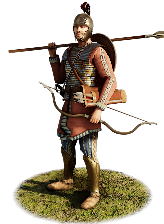
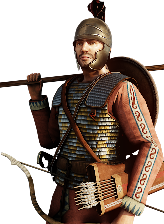
At the end of the world, a green peninsula rises out of the wine-red sea. On its stormy coasts, the wild Taurians sacrifice humans to the virgin goddess. Some of them even dare to sail the seas, where they challenge Lord Poseidon himself. While they wear the clothes of their Scythian neighbours and attack their enemies from afar with composite bows typical of the steppes, these pirates have acquired various types of Greek and Anatolian helmets, as well as an even wider array of cuirasses to protect their torsos. Some have also obtained greaves for their legs, and while they usually fight with short, Scythian style spears, they wear swords of the akinakes, xiphos, or machaira types that show off what these men have taken from their dead foes. Finally, both round Hellenic pelte and Scythian square shields allow them to block missiles or blows. Thus armed, the Taurian pirates are a deadly infantry unit, capable of holding their own both in ranged combat and in melee.
Historical background
Aye, tell thy tale. Our Tauric seas stretch far,
Where no man may escape my wand of war.
– Thoas, king of the Taurians (in: Euripides, Iphigenia in Tauris, vv. 1323-1324)
As these lines by king Thoas in Euripides' tragedy show, the Greeks knew that the native inhabitants of ancient Crimea did not only stick to the land, but also crossed the seas to attack and seize merchant vessels. Herodotus claimed that ship-wrecked men on the Taurian coast were sacrificed to the virgin goddess (a theme also present in Iphigenia on Tauris), and if no one arrived this way, they raided ships to find suitable victims (Hdt. 4.103.1). When planning this Taurian Pirates unit for RIS, it was obvious that they would have to use a blend of equipment. Scythian panoplies like the composite bows and gorytoi (bow cases), long-sleeved tunics, rounded square shields, simple belts, trousers, and boots can be found on the 4th century Kul-Oba vase and the Solokha comb from the lower Dniepr area, and must have been common among the Taurian pirates (Heinen, Antike am Rand der Steppe (2006), p. 25; Gajkudevič, Bosporanisches Reich (1971), p. 145 & fig. 11). The vase also depicts headbands and pointy caps, which are also used by some of our pirates.
Those who do have helmets use a huge variety: of the simple pilos type, one was found at Phanagoreia in the Bosporan Kingdom (Symonenko, Sarmatian helmets (2014), fig. 9.1), while a konos was unearthed at Scythian Neapolis, the capital of the Crimean Scythians (Symonenko (2014), fig. 9.7). The Chalcidian helmet, which was widely popular down into Roman times (Symonenko (2014), p. 297; National Museum of the History of Ukraine, Kyiv, Б 1201, Pastyrske Chalcidian helmet, 1898), and the Attico-Thracian (Symnonenko (2014), fig. 2.2; Mielczarek (1999), p. 52) represent Greek and Thracian influences. Lastly, Phrygian helmets represent the plunder from the peoples of Anatolia at the southern end of the Black Sea, as do the greaves, typical for Greek heavy infantry (Bardunias/Ray, Hoplites at War (2016), p. 47). Since they are worn under the Scythian style trousers, however, the latter are not visible even while present on this unit.
This is not all: swords are worn for decoration, and these encompass the Scythian straight akinakes as much as the curved Greek machaira and the straight Greek xiphos to account for Bosporan connections (Mielczarek (1999), pp. 46-47). The small, round Hellenic pelte shield is an alternative to the rounded squares used by the Scythians. Also made of wicker, it was covered with goatskin to make it more solid (Aristot. fr. 498 Rose). Besides footmen, the Solokha comb depicts a rider in a cuirass, which may correspond to the bronze or iron scale cuirasses popular among the Scythian nobility (Hinds, Scythians and Sarmatians (2010), p. 48; Meyer, Greco-Scythian Art and the Birth of Eurasia (2013), p. 207). Alternatively, this may be a linothorax, a Greek linen cuirass, and accordingly the unit uses both kinds of armour (Cernenko, The Scythians 700-300 BC (2012), p. 16). Even more peculiar are the leather cuirasses, one of which can be seen in the National Museum of the History of Ukraine in Kyiv (cf. Mielczarek (1999), p. 53). They provide these men with extra protection in both melee and ranged combat, making them the most powerful Taurian unit in RIS.
Stats
| Rank in roster | ||
|---|---|---|
| Men per unit | 40 | ███······· 30% |
| Attack | 10 | ██········ 19% |
| Charge bonus | 10 | ████······ 35% |
| Defence | 38 | ███████··· 68% |
| · armour | 9 | █████····· 50% |
| · defence skill | 27 | ████████·· 84% |
| · shield | 2 | ███······· 25% |
| Morale | 12 | ██████···· 57% |
| Discipline | Normal | |
| Training | Trained | |
| Recruitment cost | 2,148 dn | ██████···· 55% |
| Upkeep per turn | 747 dn | ███████··· 73% |
| Turns to recruit | 3 |
Weapons
| Primary | Secondary | Primary | Secondary | Primary | Secondary | Primary | Secondary | ||||
|---|---|---|---|---|---|---|---|---|---|---|---|
| Attack | 10 | 9 | Charge bonus | 10 | 10 | Type | missile · archery | melee · blade | Damage | piercing | piercing |
| Projectile | arrow | — | Range | 170 | — | Ammunition | 30 | — |
Defence
| Primary | Secondary | Primary | Secondary | Primary | Secondary | Primary | Secondary | ||||
|---|---|---|---|---|---|---|---|---|---|---|---|
| Total | 38 | — | Armour | 9 | — | Defence skill | 27 | — | Shield | 2 | — |
Condition and terrain
| Hit points | 1 | Modifier against mounts | horse +3 · chariot +3 · camel +3 | Ground: scrub / sand / forest / snow | 0 / -1 / -2 / -1 | Charge distance | 30 |
| Formations | Square |
Technical stats
| Time between blows (primary / secondary) | 2.5 s / 2.5 s | Extra fatigue in hot climates | 1 | Collision mass per man (1.0 is normal) | 1.02 | Spacing between men: close / loose | 1.1 × 1.3 m / 2.2 × 2.6 m |
| Default ranks | 5 |
In battle: Can hide in long grass · Can sap · Very good stamina
Who can recruit it
A core roster unit for one faction, which can raise it anywhere it holds the right building:
Any faction holding one of the provinces below can field it.
Exactly what a settlement must have, route by route (5)
| Building | Also requires | Building | Also requires | Building | Also requires | Building | Also requires |
|---|---|---|---|---|---|---|---|
| Any settlement | Tier 2 Military Industrial Complex · Taurian area of recruitment · Any Government (Dependency, Indirect Rule or Direct Rule) · Tier 2 Colony not built | Indirect Rule | Tier 2 Military Industrial Complex · Tier 1 Colony | Direct Rule | Tier 2 Military Industrial Complex · Tier 1 Colony | Homeland | Tier 2 Military Industrial Complex |
| Any settlement | Tier 2 Military Industrial Complex · Taurian area of recruitment · Dependency or Indirect Rule · Tier 1 Colony not built |
Areas of recruitment
| Zone | Provinces | ||||||
|---|---|---|---|---|---|---|---|
| Taurian | 0 |