
Thynoi Clubmen
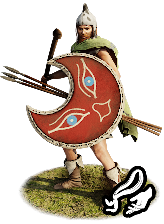

Class: light · Category: infantry · Men per unit: 60
Description
The Thracian Thynoi are ferocious fighters and dangerous opponents, especially to armies carelessly moving through their land. They excel in fighting at night, when ambushes and raids can catch their enemies unprepared. Thynoi mainly fight in the style of Thracian peltasts, both throwing javelins and engaging in close combat. However, in addition, they also make use of clubs, which they use to break enemy spears, rendering them useless. Their light equipment makes them swift-footed, allowing them to quickly engage, fight, and then run away after they lose their momentum. The Thynoi are clothed in the usual Thracian dress of patterned tunics, cloaks, fox-skin caps, and sturdy boots, and armed with a painted Pelte, javelins, and clubs. Their chief weapons are surprise and fear. Because of that, they make for excellent flanking units, but will not hold out in prolonged combat and should avoid trying to challenge cavalry.
Historical background
The Thynoi were a Thracian tribe that was likely closely connected to the Bithynians. The similarity of their names already led ancient historians to hypothesise about this potential connection (Iris Bredow, s.v. Thynoi, in: DNP; Pherekydes FGrH 3 F 27; Hdt. VII.75; Plin. Nat. 5.145). They lived in south-eastern Thrace, where they and the Greeks regularly undertook raids on one another. Xenophon describes them as the ‘most warlike of all men’, who excelled at night fighting. During his time in Thrace, they constantly kept the Odrysian kings on guard, because an ancestor of Seuthes, named Teres, got a large part of his army destroyed and his baggage train robbed by the Thynians after he had entered their territory (Xen. Anab. VII.2.22). They were incorporated into the Odrysian realm along with the Melanditai and the Tranipsai, but became rebellious when the realm fell into chaos (VII.2.32). Seuthes II eventually incorporated them back into the kingdom with the help of Xenophon’s remaining mercenary army of the "Ten Thousand" (Xen. Anab. VII.4.22). Around 279 BC, the Thynoi were ruled by Zipoethes the Bithynian (Chris Webber, The Gods of Battle (2011), "Thyni”). The Herakleiotes of the Black Sea declared war on him, but lost the decisive battle (Mem. Heracl. IX.5).
Xenophon at first only heard the story of the Thynoi ferociousness in battle from Seuthes II, but eventually witnessed them himself. When Seuthes was encamped on the plains of their territory along with the Greeks, the Thynoi fled into the mountains (VII.4.2). It’s there that Xenophon first realises why the Thracians wore their typical fox-skin caps and long cloaks, as it protected them from the cold of the highlands much better than the Greeks, many of whom had their noses and ears frostbitten (VII.4.3-4). Even though the Thracians came down for negotiations during the day, at night they raided the royal forces and Greeks who were encamped in a nearby village. The Thynians broke the Greek spears with their clubs, threw javelins into the houses, or set them on fire. The Greeks did sally out against them on the signal of a trumpet and routed the Thynoi. However, they still threw javelins from the dark at the Greeks who were standing in the light near the burning houses, until Seuthes approached with reinforcements (VII.4.14-19). After that, Seuthes overran the mountains together with his Greek mercenaries, forcing the Thynoi to surrender (VII.4.20-22).
Though it is only a relatively short passage in the source, it shows how dangerous the Thracian mountain tribes, the Thynoi in particular, could be. Their equipment is typically Thracian: colourful cloaks and tunics, fox-skin caps in a Phrygian shape, heavy boots, peltai and javelins. Additionally, they carry the clubs they used to break the spears of the Greeks. They should be used for flanking charges or infantry support, but they should not be relied upon to hold the frontline or take on cavalry. Furthermore, their light armour and small shields make them susceptible to missile attacks.
Stats
| Rank in roster | ||
|---|---|---|
| Men per unit | 60 | █████████· 87% |
| Attack | 7 | █········· 6% |
| Charge bonus | 3 | ██········ 16% |
| Defence | 22 | ██········ 23% |
| · armour | 2 | █········· 13% |
| · defence skill | 17 | ████······ 35% |
| · shield | 3 | ████······ 37% |
| Morale | 7 | █········· 10% |
| Discipline | Low | |
| Training | Untrained | |
| Recruitment cost | 1,520 dn | ██········ 18% |
| Upkeep per turn | 556 dn | ███······· 30% |
| Turns to recruit | 2 |
Weapons
| Primary | Secondary | Primary | Secondary | Primary | Secondary | Primary | Secondary | ||||
|---|---|---|---|---|---|---|---|---|---|---|---|
| Attack | 7 | 5 | Charge bonus | 3 | 7 | Type | thrown · blade | melee · blade | Damage | piercing | blunt |
| Projectile | javelin | — | Range | 60 | — | Ammunition | 5 | — | Properties | Used just before charging into combat · thrown | — |
Defence
| Primary | Secondary | Primary | Secondary | Primary | Secondary | Primary | Secondary | ||||
|---|---|---|---|---|---|---|---|---|---|---|---|
| Total | 22 | — | Armour | 2 | — | Defence skill | 17 | — | Shield | 3 | — |
Condition and terrain
| Hit points | 1 | Ground: scrub / sand / forest / snow | 0 / 0 / 0 / 0 | Charge distance | 30 | Formations | Square |
Technical stats
| Time between blows (primary / secondary) | 2.5 s / 2.5 s | Extra fatigue in hot climates | 0 | Collision mass per man (1.0 is normal) | 0.88 | Spacing between men: close / loose | 1 × 1.2 m / 2 × 2.4 m |
| Default ranks | 5 |
In battle: Can hide in long grass · Can sap · Very good stamina
Who can recruit it
No faction has this on its core roster: it can be raised only in the provinces below.
Any faction holding one of the provinces below can field it.
Exactly what a settlement must have, route by route (1)
| Building | Also requires | ||||||
|---|---|---|---|---|---|---|---|
| Any settlement | Garrison Building or Tier 1 Military Industrial Complex · Thynian area of recruitment · Any Government (Dependency, Indirect Rule or Direct Rule) · Tier 2 Colony not built |
Areas of recruitment
| Zone | Provinces | ||||||
|---|---|---|---|---|---|---|---|
| Thynian | 0 |