
Mercenary Autariatai Nobles
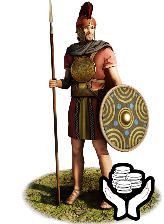
Mercenary. Hired from a regional pool, not recruited from a building.
Class: spearmen · Category: infantry · Men per unit: 40
Description
‘The Autariatai were the most populous and the bravest tribe of the Illyrians.’
– Strabo (Geography 7.5.11).
Autariatai Nobles are the warrior elite of a once mighty people. They are the heaviest infantry the Autariatai can recruit, armed with spears and javelins, and afforded some protection by fine bronze armour such as circular chest protectors and Illyrian style helmets. They form a solid core of flexible and dangerous soldiery.
Historical background
The Autariatai were once a regional powerhouse, famed for crushing the Ardiaioi over precious salt spring resources in Appian’s Illyrike (3). They had maintained a powerful union of peoples and tribes, and provided something of a link between the coastal Illyrians and the peoples of the interior (Sasel Kos, Appian and Illyricum (2005), p. 122). Strabo (7.5.11 C 318) further expounded their strength, noting that: ‘The Autariatai subjugated the Triballi, whose regions extended from the lands of the Agrianes to the Danube, thereby imposing their dominion within an area distant a fifteen-day march from the other Thracians and Illyrians’. This is fairly significant, as the Triballi themselves were no push-over. They displayed a relatively high level of culture and learning, adopted from the Greeks. The Triballi were a thorn in the side of the Macedonians and Greeks throughout the sixth to fourth centuries BC, but were ultimately crushed by both the Autariatai and the Celtic Scordisci (Sasel Kos (2005), p. 135). In recent findings, the Autariatai have been connected to elements of a nascent material culture including Mramorac-type silver belts, which previously had been thought to have belonged to the Triballi. The Autariatai also appear to have been quite prolific builders of hillforts in the valley of the Great Morava during the sixth to fifth centuries BC. These strongholds are often independent from other settlements, their people generally living elsewhere in haphazard and primitive villages made from wickerwork and clay (Sasel Kos (2005), pp. 165-6).
Other archaeological research supports the representation of the Autariatai Nobles in RIS, such as burial findings in high-status graves discovered at Novi Pazar (which has an impressive princely tumulus/burial mound), and Atenica. These are thought to have belonged to tribal chieftains and strongmen, and therefore were likely part of the Autariatai’s tribal confederation (Sasel Kos (2005), p. 173). Militarily significant archaeological findings of the Autariatai mainly come from Glasinac (named after the Glasinac people and their material culture, who established themselves there during the Hallstatt period), and also from tumuli in Western Serbia (Papazoglu, Central Balkan (1978), pp. 458-459). These findings show that the Autariatai were equipped with a variety of weaponry, such as short, curved swords like the Pecine knifes, javelins, and circular wooden shields, although no body armour and helmets were found (Jovanovic, Necropola (1992), pp. 13-18).
By the 3rd century BC, the heady heydays seemed to be coming to an end, with the Autariatai having been defeated by Langaros, the King of the Agrianes (who was betrothed to Alexander the Great’s half-sister, even though an actual marriage never materialised). Their defeat seems to have sent a rather deflating message to other restive Illyrians at the time (Howe, Plain Tales from the Hills (2017), p. 106). A little later, perhaps to make ends meet in their deteriorating situation, the Autariatai served as mercenaries, providing 7,000 men in service of Lysimachos in the winter of 302-1 BC, although 2,000 of them subsequently deserted to Antigonos (Sasel Kos (2005), p. 197). Their situation was compounded by other misfortunes, including an alleged plague of frogs sent by the gods to punish the Autariatai for their joint assault (albeit as displaced vassals) with the Scordisci on the sanctuary of Apollo at Delphi in 279 BC (John Wilkes, The Illyrians (1996), p. 144). In contemporaneous views of the Romans and Greeks, the Autariatai appeared to have been gradually subsumed into a Scordiscan diaspora. But it seems that this was not the case, as La Tene culture, under the Celtic Kingdom of Tylis, failed to gain a significant presence in central and eastern Thrace – this coincidentally was also the area the Autariatai were said to have fled to. Danjel Dzino suggests that this could instead show that the various warrior elite cultures in the region adopted other cultural norms, instead of having a predominant Celtic identity (Dzino, The Celts In Illyricum (2008), p. 59).
Despite having already been subjugated for some time, there is further evidence of the Autariatai retaining some distinct cultural elements in mixed graves that they shared with the Scordisci, dated to the late 4th century BC (Jovanovic, Necropola (1992), pp. 13-18). Whatever the case, they were later defeated in Paionia mid-migration by the Macedonians under Kassandros, and 20,000 Autariatai were resettled to serve as a frontier border march (or meatshield) on Mount Orbelus, bordering both Macedon and Thrace. Orosius (3.23.36–37: Cassander Ptolemy) says somewhat euphemistically of this event that: ‘Kassandros, however, who knew the value and the great numbers of this (The Autariatai) people, offered them his alliance and settled them at the extreme borders of Macedonia, for fear that, driven by necessity, they would trouble Macedonia with war and invade it’. The Autariatai eventually were lost to history after their conquest by Rome (Wilkes (1996), p. 144). It is postulated by historians such as Sasel Kos that they perhaps broke down into their constituent tribes once more, and were described as such by Pliny, rather than maintaining one cohesive overall identity (Sasel Kos (2005), p. 174).
Stats
| Rank in roster | ||
|---|---|---|
| Men per unit | 40 | ███······· 30% |
| Attack | 17 | █████████· 87% |
| Charge bonus | 18 | ███████··· 72% |
| Defence | 48 | █████████· 93% |
| · armour | 7 | ████······ 42% |
| · defence skill | 38 | ██████████ 99% |
| · shield | 3 | ████······ 37% |
| Morale | 14 | ████████·· 79% |
| Discipline | Normal | |
| Training | Untrained | |
| Upkeep per turn | 839 dn | ████████·· 80% |
Weapons
| Primary | Secondary | Primary | Secondary | Primary | Secondary | Primary | Secondary | ||||
|---|---|---|---|---|---|---|---|---|---|---|---|
| Attack | 17 | 13 | Charge bonus | 18 | 20 | Type | thrown · blade | melee · blade | Damage | piercing | piercing |
| Projectile | javelin | — | Range | 50 | — | Ammunition | 2 | — | Properties | Used just before charging into combat | Light spear (braced against cavalry charges from the front) · +8 attack against cavalry |
Defence
| Primary | Secondary | Primary | Secondary | Primary | Secondary | Primary | Secondary | ||||
|---|---|---|---|---|---|---|---|---|---|---|---|
| Total | 48 | — | Armour | 7 | — | Defence skill | 38 | — | Shield | 3 | — |
Condition and terrain
| Hit points | 1 | Ground: scrub / sand / forest / snow | 0 / -1 / 0 / -1 | Charge distance | 30 | Formations | Square |
Technical stats
| Time between blows (primary / secondary) | 2.5 s / 2.5 s | Extra fatigue in hot climates | 1 | Collision mass per man (1.0 is normal) | 1.04 | Spacing between men: close / loose | 1 × 1.2 m / 2 × 2.4 m |
| Default ranks | 5 |
In battle: Can hide in long grass · Can sap · Very good stamina
Where to hire it
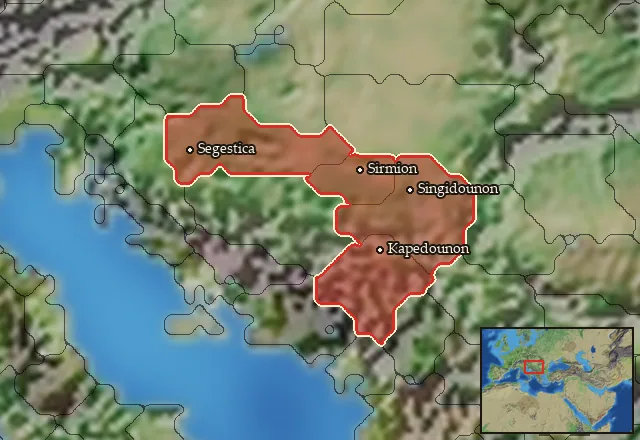
Mercenaries are hired from a regional pool, not recruited from a building. This unit is offered by 1 pool covering 4 regions, at 5,198 dn to hire and 3 experience.
Mercenary pool: Pannonia
At least one of those pools sells to any faction that has an army in range, with no faction restriction.
The 4 regions where this unit appears in a mercenary pool
Amantinia · Autariataia · Savia · Skordiskia