
Mercenary Cilician Renowned Pirates
Mercenary. Hired from a regional pool, not recruited from a building.
Class: light · Category: infantry · Men per unit: 40
Description
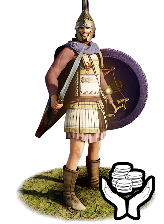
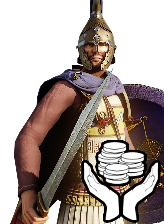
Few people would willingly cross paths with pirates, especially with renowned pirates! Being seasoned sailors and plunderers, these infamous figures and their bodyguards have amassed an impressive array of equipment. Linothoraxes with pteryges, large aspis shields, and Macedonian cloaks combine to make them a distinctive and intimidating presence on either land or sea. Topping it all off, their crested Phrygian, Roman, or Chalcidian helmets make them stand out in any army. In battle, these renowned pirates will first hurl javelins towards their foes, and then close in to finish them off with close-combat weapons such as the gladius, kopis, or curved machaira.
Historical background
Thucydides (I.5) writes that by the 5th century BC, piracy was seen as a disgrace in the great commercial city of Athens:
“[…] The barbarians of the coast and islands, as communication by sea became more common, were tempted to turn pirates, under the conduct of their most powerful men; the motives being to serve their own cupidity and to support the needy. They would fall upon a town unprotected by walls, and consisting of a mere collection of villages, and would plunder it; indeed, this came to be the main source of their livelihood, no disgrace being yet attached to such an achievement, but even some glory. An illustration of this is furnished by the honor with which some of the inhabitants of the continent still regard a successful marauder, and by the question we find the old poets everywhere representing the people as asking of voyagers — 'Are they pirates?' — as if those who are asked the question would have no idea of disclaiming the imputation, or their interrogators of reproaching them for it.”
Thucydides clearly did not agree with this way of life. Aristoteles, a hundred years later, is more nuanced. He lists five ways of naturally providing for one's own household: fishing, hunting, herding animals, farming and, more surprisingly, brigandry (Arist.Pol., 1256a&b). Most people, he writes, pass their time in such a combination of pursuits as their need compels. And this would indeed be the case for (Cilician) pirates. Navigating the seas, ambushing merchants, and distributing loot necessitates some leadership. Pirates would flock to charismatic leaders who led their followers in successfully planned actions. By the timeframe of RIS, their scale of operations had become quite considerable. Piracy was no longer just an opportunistic and isolated event. Larger groups of pirates coordinated militarily, politically, and economically to increasing degree (Philip de Souza, Piracy in the Graeco-Roman World [2012]). Therefore, they had both space for and need of multiple chieftains, some of them being mentioned by name in Roman sources from this period.
While the inhabitants of cities, who depended on trade, considered brigandage and piracy a disgrace, in more remote areas it was simply a way of life. During the timeframe of RIS, Cilicia was a destitute land (see description of the Cilician Pirates). There was no political unity, and conflict ensued. Florus (I, 41, 4) states that the Cilicians’ enterprise into piracy expanded considerably during the first half of the first century BC: “At first, under their leader Isidorus, they confined their operations to the neighbouring sea and committed their depredations between Crete and Cyrenae and Achaea and the sea off Cape Malea, which, from the richness of the spoil which it yielded, they themselves named the Golden Sea.”
Publius Servilius Vatia Isauricus fought Isidorus and several pirate captains in 77-76 BC (Cic. Verr. II.1.56; IV.21; V.66). At the outset, he won some bloody naval engagements and occupied the eastern Lycian and Pamphylian coasts. He then proceeded to attack the pirates in their fortresses, taking the town of Olympos, the stronghold of the pirate Zenicetus (Cic. Verr. II.1.56; IV.21; V.66). Next, he went on to capture the towns of Phaselis and Corycus. It is mentioned that he took multiple other minor pirate strongholds, capturing a number of pirate captains in the process, including the “famous Nicon” (Smith, Dictionary of Greek and Roman Biography and Mythology, Vol III (1867), pp. 1232-1233). The pirates were defeated piecemeal. For example, the two close mountain fortresses of Kragos and Antikragos surrendered to the Romans. Appian writes that afterwards “one after another” surrendered. This account of an incoherent defence presents the Cilician pirates as a decentralised force. The Cilicians were defeated on sea, at the coast, and in their mountainous inland. This defence in depth can be explained by the fact that every chief and crew defended their own loot. The pirate chiefs and their gold were a big show for Servilius Vatia’s triumph in Rome. Even after all those defeats, however, the pirates recovered and grew even stronger than before!
States did not shy away from recruiting pirates if it suited their purpose. Livy (XXXVII, 11) and Appian (Syr., V, 25) both write about a man named Nicander, a pirate chieftain who helped the Seleucids defeat a Rhodian fleet at Samos in 190 BC. Pontic kings also used pirates on a wider scale to bolster their fleet and to annoy the Romans. A pirate chief by the name of Athenodoros, for example, sacked Delos in 69 BC (Phlegon fr. XII,13). Piracy was perhaps seen as a disgrace by many Romans and Greek writers, but that did not stop states from hiring them during wartime. The distinction between pirate chief and mercenary general is not always obvious: Ameinias the Phocian, a pirate chief in the service of the Macedonian king Antigonos II Gonatas, is called a general by Plutarch (Pyrrhus, XXIX, 6).
As historians, however, we have to add some nuance to the popular image of pirates both in ancient and modern times. Even in the 21st century, they are seen as something mythical and lively. This is not a recent idea, as it is already reflected in Plutarch’s Life of Pompey. Plutarch (Pomp., XXIV, 2) underlines that piracy could enhance the reputation of already illustrious nobles: “[...] men whose wealth gave them power, and those whose lineage was illustrious, and those who laid claim to superior intelligence, began to embark on piratical craft and share their enterprises, feeling that the occupation brought them a certain reputation and distinction.” He continues (Pomp., XXIV, 3) about the wealth they gathered and flaunted: “[...] fleets put in here which were not merely furnished for their peculiar work with sturdy crews, skilful pilots, and light and speedy ships; nay, more annoying than the fear which they inspired was the odious extravagance of their equipment, with their gilded sails, and purple awnings, and silvered oars [...]”. This is an overstatement, perhaps, but it nevertheless serves as the inspiration for the present unit in RIS.
Two additional renowned pirates featured during the Roman civil wars. Menas and Menecrates, freedmen of Sextus Pompeius, were Cilicians. They were probably former slaves of his father, who had captured them during his own war against the pirates (Plin: HN, XXXV, 200; DioCass, XLVIII, 45-46). They came in useful when “Sextus Pompeius had found his name among the number of those proscribed, he turned to piracy and laid waste the whole coast of Italy with slaughter and pillage” (Oros, VI, 17-18). Using these tactics, Pompey retained considerable influence. While he styled himself as son of Neptune (Sextus Pompey denarius, Pompeia 28, RSC 20, Syd 1350, Cr483/2), in the 20th century he was described as a “Pirate King” (Woodman, The Caesarian and Augustan Narrative (1983), p. 175).
Stats
| Rank in roster | ||
|---|---|---|
| Men per unit | 40 | ███······· 30% |
| Attack | 13 | ██████···· 57% |
| Charge bonus | 13 | █████····· 52% |
| Defence | 36 | ██████···· 61% |
| · armour | 10 | █████····· 54% |
| · defence skill | 21 | █████····· 54% |
| · shield | 5 | ██████···· 57% |
| Morale | 14 | ████████·· 79% |
| Discipline | Impetuous (may charge without orders) | |
| Training | Highly trained | |
| Upkeep per turn | 788 dn | ████████·· 77% |
Weapons
| Primary | Secondary | Primary | Secondary | Primary | Secondary | Primary | Secondary | ||||
|---|---|---|---|---|---|---|---|---|---|---|---|
| Attack | 13 | 12 | Charge bonus | 13 | 15 | Type | thrown · blade | melee · blade | Damage | piercing | slashing |
| Projectile | javelin | — | Range | 60 | — | Ammunition | 5 | — | Properties | Thrown | — |
Defence
| Primary | Secondary | Primary | Secondary | Primary | Secondary | Primary | Secondary | ||||
|---|---|---|---|---|---|---|---|---|---|---|---|
| Total | 36 | — | Armour | 10 | — | Defence skill | 21 | — | Shield | 5 | — |
Condition and terrain
| Hit points | 1 | Ground: scrub / sand / forest / snow | 0 / -1 / 0 / -1 | Charge distance | 30 | Formations | Square |
Technical stats
| Time between blows (primary / secondary) | 2.5 s / 2.5 s | Extra fatigue in hot climates | 1 | Collision mass per man (1.0 is normal) | 1.12 | Spacing between men: close / loose | 1 × 1.2 m / 2 × 2.4 m |
| Default ranks | 5 |
In battle: Can sap · Very good stamina
Where to hire it
Mercenaries are hired from a regional pool, not recruited from a building. This unit is offered by 2 pools covering 3 regions, at 4,725–5,040 dn to hire and 2–3 experience.
Mercenary pools: Amaseia · Kilikia
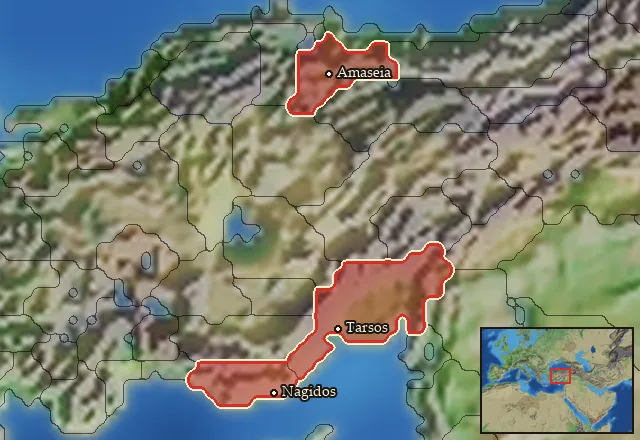
At least one of those pools sells to any faction that has an army in range, with no faction restriction.
Some pools additionally restrict it to Pontus.