
Mercenary Herakleiote Hoplites
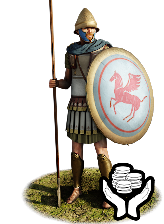
Mercenary. Hired from a regional pool, not recruited from a building.
Class: spearmen · Category: infantry · Men per unit: 40
Description
These men are the proud citizens of Herakleia Pontike, the blossoming centre of Hellenistic culture on the shores of the Pontos Euxeinos, and one of the rare Greek poleis of more than local significance. If need arises, these men will take up their family’s dory and rimmed aspis-shield to hold the ground against any foe who dares to challenge their honour. Protected by sturdy linothorax armour, greaves, and a combination of Pilos and Phrygian helmet types, these men form a useful supplement to fill out your infantry line or to guard the walls of their polis.
Historical background
Herakleia was founded as a colony of Megara, and named after the mythical hero Herakles, whom the Greeks believed to have entered the underworld at a cave on the adjoining Archerusian promontory (Xen. An. 6,2,1; Ephor. fr. 44a; Arr. Peripl. p. eux. 18). From the time of her foundation around 560 BC until the Roman conquest in 70 BC ended her history as an independent state, Herakleia Pontike played a leading role in the political affairs of northern Anatolia and the Black Sea basin. In the late fourth century BC, it temporarily formed the centre of a kingdom that comprised the coastal region from Thynias to Kytoros, especially under the tyrant Dionysios (r. 337/336-305 BC), who emulated his famous namesake from Syracuse. After his death, Herakleia was weakened, however, and conquered by Lysimachos in 281 BC, losing much of its territory (Karl Strobel s.v. Herakleia (7) in: DNP). Herakleia somewhat recovered soon after, but could never regain all of its former territory, though it wielded considerable influence as the most active actor in the anti-Seleucid Northern League. This alliance with Bithynia, Byzantion, Kios, and others made the momentous decision to invite the Galatians into Asia so they could fight Antiochos I, the Seleucid king (Memnon, History of Herakleia c. 11). The Northern League persisted until the end of the 3rd century BC, and though Herakleia fell under Roman control in 70 BC, it would remain a free city within the empire and still protect its former colonies until the 3rd century AD.
The commercially flourishing polis produced a series of notable intellectuals, such as the philosophers Herakleides Pontikos or Chamaileon or the mathematicians Bryson and Amyklas (Burstein, Outpost of Hellenism (1974), p. IX). To these famous citizens we can add the tyrants, with Dionysios first among them, and the historian Memnon, who wrote a history of his mother city which survived in an abridged Byzantine edition. The whole body of citizens is estimated to have amounted to roughly 6,000 (Burstein, p. 37); most of whom would probably have taken the field as hoplites if need arose. This is supported by the appearance of a typical rimmed aspis shield on a Herakleiote coin dated to the time around 300 BC (Saprykin, Heracleia Pontica (1997), fig. 23).
Hoplites’ principal weapon was the thrusting spear (dory), eight to nine feet long, with an ash or cornel wood shaft, iron head, and an iron or bronze but spike. The centre of the shaft was bound with cord for a secure grip. The spear was usually used in an overarm thrust, but it could also be thrust underarm or even thrown. The "Argive" shield (called aspis) is large, 80 cm - 1 meter in diameter, convex, made of wood covered with a thin bronze sheet, and was carried with two handles, a bronze porpax in the centre through which the forearm passes, and a cord antilabe at the rim. Hoplites commonly wore greaves, clipped around the legs by their own elasticity. Over the Greek woollen tunic, chiton, the hoplite wore a non-metallic corselet. The heavier and more expensive iron cuirass had increasingly disappeared since the 5th Century BC, as hoplites sought to be swifter and more flexible on the battlefield. It was replaced by a linen corselet – the linothorax – wrapped around the body, tying under the left arm and was split below the waist into strips called pteryges (feathers) for ease of movement. Hoplites formed up into a formation on a frontage of about 3 feet per man, with each man’s right protected by his neighbour's projecting shield. In this formation, the hoplites found mutual protection from an accumulation of shields to their front, rear and side. In the heat of Greek summer, men often waited until the last moment to put on their armour and shield, usually assisted by slave attendants (Hunt, ‘Military Forces’ (2008), pp. 108-117). By the time in which RIS starts, hoplites had thus become lighter and more vulnerable to missiles than their archaic and classical predecessors. As old-fashioned citizen levy, they may hold a line, but will not perform as good as contemporary elite or professional forces raised by the Hellenistic dynasts.
Stats
| Rank in roster | ||
|---|---|---|
| Men per unit | 40 | ███······· 30% |
| Attack | 9 | █········· 13% |
| Charge bonus | 13 | █████····· 52% |
| Defence | 41 | ████████·· 76% |
| · armour | 10 | █████····· 54% |
| · defence skill | 26 | ████████·· 78% |
| · shield | 5 | ██████···· 57% |
| Morale | 10 | ███······· 29% |
| Discipline | Low | |
| Training | Highly trained | |
| Upkeep per turn | 603 dn | ████······ 42% |
Weapons
| Primary | Secondary | Primary | Secondary | Primary | Secondary | Primary | Secondary | ||||
|---|---|---|---|---|---|---|---|---|---|---|---|
| Attack | 9 | — | Charge bonus | 13 | — | Type | melee · blade | — | Damage | piercing | — |
| Properties | Light spear (braced against cavalry charges from the front) · +8 attack against cavalry | — |
Defence
| Primary | Secondary | Primary | Secondary | Primary | Secondary | Primary | Secondary | ||||
|---|---|---|---|---|---|---|---|---|---|---|---|
| Total | 41 | — | Armour | 10 | — | Defence skill | 26 | — | Shield | 5 | — |
Condition and terrain
| Hit points | 1 | Ground: scrub / sand / forest / snow | -1 / -1 / -4 / -1 | Charge distance | 30 | Formations | Square |
Technical stats
| Time between blows (primary / secondary) | 2.5 s / — | Extra fatigue in hot climates | 1 | Collision mass per man (1.0 is normal) | 1.12 | Spacing between men: close / loose | 1 × 1.05 m / 2 × 2.4 m |
| Default ranks | 5 |
In battle: Can sap · Very good stamina
Where to hire it
Mercenaries are hired from a regional pool, not recruited from a building. This unit is offered by 1 pool covering 5 regions, at 3,885 dn to hire and 0 experience.
Mercenary pool: Bithynia
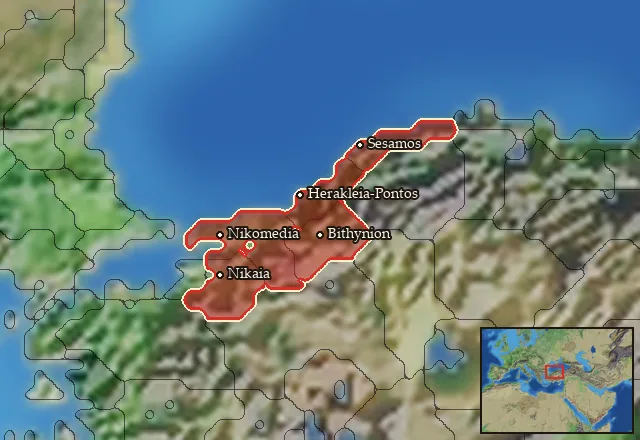
At least one of those pools sells to any faction that has an army in range, with no faction restriction.
The 5 regions where this unit appears in a mercenary pool
Amastris · Bithynia · Hellenike Mariandynia · Notia Bithynia · Salone