
Bactrian Xystophoroi
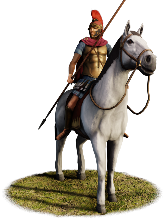
Class: heavy · Category: cavalry · Men per unit: 30
Reforms: Becomes a newer unit with Baktrian Reforms
Description
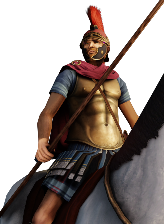
Baktrian Xystophoroi are a heavy cavalry unit named after their iconic weapon, the Xyston: a 3-4m/ 11-14 ft long lance with a bronze butt-spike, used in case it broke during a powerful charge (Sekunda, Macedonian Armies (2012), p. 9). They operate shield-less, using both hands to hold the lance steady while charging the enemy, whereafter they change their fighting style to a one-handed grip in close combat. The Xystophoroi wear heavy armour, either bronze muscle cuirasses or colourful linothorakes; decorated Phrygian, Attic, or Boiotian helmets; and protect their legs with bronze greaves. Their main strength as heavy shock cavalry lies in a devastating charge into enemy cavalry, or the flanks and backs of infantry engaged in melee. Though they can hold their own for a while, the Xystophoroi should not stay in close combat too long. Especially against spear units or under heavy fire by skirmishers, they might face heavy losses due to their lack of shields.
Historical background
Though cavalry had always played a decisive role in Greek warfare, easily outmanoeuvring infantry on the open field (Konijnendijk, Classical Greek Tactics (2018), p. 102seq), barely any polis or koinon, save for a few exceptions, had a notable cavalry force. Those that existed were often trained in throwing javelins from horseback and mainly used for harassment, pursuit, defence, and reconnaissance (Markle, Macedonian Arms and Tactics (1982), p. 104-105). The Greek military commander and historian Xenophon rejected the lance as a cavalry weapon and recommended the use of two javelins instead (Xen. Horse. 12.12). Macedon, however, went a different path and already had a history of using heavily armed and armoured cavalry (Thuc. 2.100.5), which was further improved upon by Philip II (382-336 BC) and perfected by his son, Alexander the Great. Outfitted with a long lance, the xyston, the cavalry was specialized in charging into the flanks and backs of enemy infantry while they were occupied by the Macedonian phalanx, a tactic known as "hammer and anvil" (Anson, Alexander’s Heirs (2014), p. 6).
The xyston was made of strong cornel wood, but could shatter during charge, in which case the horseman used the butt spike on the other end of the lance to continue fighting. This new heavy cavalry proved very effective against the light skirmishing cavalry of Persian and Greek armies and was an essential part of the reformed Macedonian military. Still, skirmishing cavalry like the Thessalians also continued to be used to great effect. The Macedonian cavalry was organized into squadrons of around 200 men, commanded by an ilarch, further divided into four tetrarchiai of 49 men, each commanded by a tetrarch (Sekunda & McBride, The Army of Alexander the Great (1995), p. 14-17). After the death of Alexander in 323 BC, the deployment of bodies of heavy shock cavalry became a standard feature of Hellenistic warfare, often used in tandem with light infantry on the flanks (Sekunda, 2012).
More details are known about the Ptolemaic Xystophoroi, the so called Katoikoi Hippeis. Katokoi were military settlers and Hippeis the social class of the 'knights', thus the man of the cavalry possessed land in Egypt or, less often, in other parts of the Ptolemaic Empire. This elite could afford horses and fought in the style of Alexander the Great himself. They were apparently made up of five different regiments, the Thessalians (CPR XVIII 10, l. 197), Persians (CPR XVIII 15, ll. 298–9), Mysians, Thracians and 'other Greeks' (Fischer Bovet , Army and Society 2014, 126-128). Despite the ethnic designations, there is no indication the five hipparchies, who existed at least from 235 BC until the mid-2nd century, carried different equipment – it is not even sure the Persians especially were actual Persians. Hence, all of them are portrayed as Ptolemaic Xystophoroi with saffron cloaks over belted tunics, some with a blueish Linothorax as portrayed on a local 3rd century BC funerary stela of a man on horseback (Alexandria, Graeco-Roman Museum, inv. 22116).
Stats
| Rank in roster | ||
|---|---|---|
| Men per unit | 30 | █········· 8% |
| Attack | 11 | ███······· 34% |
| Charge bonus | 28 | █████████· 86% |
| Defence | 33 | █████····· 52% |
| · armour | 14 | ████████·· 78% |
| · defence skill | 19 | ████······ 44% |
| · shield | 0 | █········· 0% |
| Morale | 12 | ██████···· 57% |
| Discipline | Normal | |
| Training | Highly trained | |
| Recruitment cost | 2,142 dn | ██████···· 55% |
| Upkeep per turn | 862 dn | ████████·· 83% |
| Turns to recruit | 3 |
Weapons
Its secondary attack is the stronger one: 12 against 11.
| Primary | Secondary | Primary | Secondary | Primary | Secondary | Primary | Secondary | ||||
|---|---|---|---|---|---|---|---|---|---|---|---|
| Attack | 11 | 12 | Charge bonus | 28 | 24 | Type | melee · blade | melee · blade | Damage | piercing | slashing |
Defence
| Primary | Secondary | Primary | Secondary | Primary | Secondary | Primary | Secondary | ||||
|---|---|---|---|---|---|---|---|---|---|---|---|
| Total | 33 | — | Armour | 14 | — | Defence skill | 19 | — | Shield | 0 | — |
Condition and terrain
| Hit points | 1 | Mount | heavy horse | Ground: scrub / sand / forest / snow | -4 / -1 / -8 / -1 | Charge distance | 40 |
| Formations | Square |
Technical stats
| Time between blows (primary / secondary) | 2.5 s / 2.5 s | Extra fatigue in hot climates | 2 | Spacing between men: close / loose | 2 × 4.8 m / 3 × 7.2 m | Default ranks | 5 |
In battle: Very good stamina
Who can recruit it
A core roster unit for one faction, which can raise it anywhere it holds the right building:
Exactly what a settlement must have, route by route (3)
| Building | Also requires | Building | Also requires | Building | Also requires | ||
|---|---|---|---|---|---|---|---|
| Indirect Rule | Tier 2 Military Industrial Complex · Tier 1 Colony · Requires resource horses or horses supplied factionwide | Direct Rule | Tier 2 Military Industrial Complex · Tier 1 Colony · Requires resource horses or horses supplied factionwide | Homeland | Tier 2 Military Industrial Complex |