
Bactrian Hetairoi
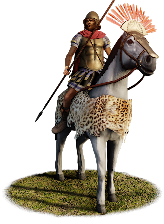
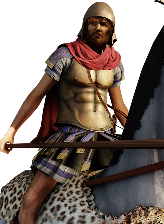
Class: heavy · Category: cavalry · Men per unit: 30
Reforms: Unlocked by Baktrian Reforms · Older units become this one with Baktrian Reforms
Description
Bactrian Hetairoi are the mounted elite of the Bactrian royal army. They combine the Macedonian heavy cavalry tradition with local customs of mounted archery, using both the Macedonian xyston and bows as weapons. Their armour, on the other hand, clearly displays the Hellenistic origin of these men. It consists of steel cuirasses, greaves, and Bactrian helmets, occasionally augmented with lamellar or scale armour pieces. Like other types of Hetairoi, they are best used for breaking enemy infantry in a decisive charge to their rear. In addition, they are capable of softening up enemy formations with hails of arrows, loosened from a safe distance. Their strength and versatility make these horsemen an indispensable addition to any Bactrian army!
Historical background
The Hetairoi, like so many parts of Hellenistic armies, were adopted by the Diadochoi after the collapse of Alexander’s army and empire. Under Alexander, the Hetairoi were made up of Macedonian noblemen, and that tradition was continued by his successors.
While they stayed in their traditional role as shock-cavalry in the Seleucid, Ptolemaic and Antigonid armies, at least in the Seleucid army, the Hetairoi lost their pre-eminent position on the right flank to the cavalry Agema, which was made up of Median and Persian aristocrats (Sekunda, The Seleucid Army (1994) p. 22). Nevertheless, they continued to play an important role, continuing to be equipped and used as heavy shock cavalry, wearing the best kit the royal armouries could furnish for them.
We do not have concrete evidence for the employment of a unit called Hetairoi in the royal Bactrian army, but given what we know about the degree of cooperation between the Macedonian nobility and local elites in the region, it would not be surprising to see them employed in both their military role as bodyguards and in their social role as a tool of integration by binding the sons of local nobles to the royal house.
Even though the Macedonians entered Asia as conquerors, they, or at least their king Alexander, were interested in integrating themselves into existing power structures. Alexander himself married not only a daughter of the former Persian great-king Darius (Arrian, Anabasis 7.4.4) but also the daughter of a Sogdian nobleman (Arrian, Anabasis 4.19.5f). After the mass weddings at Susa in 324 BC, the Macedonian nobility became socially intertwined with the nobility of the old Persian empire. Most of the marriages of Susa were annulled in the years following the death of Alexander. The exception to this rule was Seleukos I, who retained his Sogdian wife Apame, even after the death of his king. After securing dominion over his wife’s homeland and the so-called upper satrapies, Seleukos left these lands to be ruled by his half-Sogdian son Antiochos I, who ruled them as co-king until his father was murdered in 281 BC (Grainger, Seleukos Nikator (1990), pp. 151-154). While we lack comparable evidence of royal ties to local elites for the later Bactrian kings, the overall lack of information on them makes that unsurprising. Considering that it was a marriage alliance and not military victories that ended Alexander’s campaign in Bactria, as well as the continuing difficulties in retaining control of the region, a local degree of cooperation between Macedonian and indigenous elites is almost guaranteed. The tradition of the Hetairoi would have constituted a perfect institution to bind the children of local power-holders and the potential offspring of mixed marriages to the Bactrian kings. Considering their mixed heritage, it seems only sensible to assume that Bactrian Hetairoi would have blended local traditions of mounted archery, a skill prestigious among Persians and inhabitants of the Eurasian steppes alike, with Macedonian shock cavalry tactics. This makes them an extremely powerful and versatile unit on the battlefield.
Stats
| Rank in roster | ||
|---|---|---|
| Men per unit | 30 | █········· 8% |
| Attack | 11 | ███······· 34% |
| Charge bonus | 28 | █████████· 86% |
| Defence | 38 | ███████··· 68% |
| · armour | 16 | █████████· 90% |
| · defence skill | 22 | ██████···· 61% |
| · shield | 0 | █········· 0% |
| Morale | 15 | █████████· 91% |
| Discipline | Normal | |
| Training | Highly trained | |
| Recruitment cost | 3,244 dn | █████████· 88% |
| Upkeep per turn | 1,306 dn | ██████████ 97% |
| Turns to recruit | 4 |
Weapons
Its secondary attack is the stronger one: 14 against 11.
| Primary | Secondary | Primary | Secondary | Primary | Secondary | Primary | Secondary | ||||
|---|---|---|---|---|---|---|---|---|---|---|---|
| Attack | 11 | 14 | Charge bonus | 28 | 35 | Type | missile · archery | melee · blade | Damage | piercing | piercing |
| Projectile | arrow | — | Range | 170 | — | Ammunition | 25 | — |
Defence
| Primary | Secondary | Primary | Secondary | Primary | Secondary | Primary | Secondary | ||||
|---|---|---|---|---|---|---|---|---|---|---|---|
| Total | 38 | — | Armour | 16 | — | Defence skill | 22 | — | Shield | 0 | — |
Condition and terrain
| Hit points | 1 | Mount | hetairoi horse | Ground: scrub / sand / forest / snow | -2 / -1 / -5 / -1 | Charge distance | 40 |
| Formations | Square · Wedge |
Technical stats
| Time between blows (primary / secondary) | 2.5 s / 2.5 s | Extra fatigue in hot climates | 2 | Spacing between men: close / loose | 2 × 4.8 m / 3 × 7.2 m | Default ranks | 5 |
Who can recruit it
A core roster unit for one faction, which can raise it anywhere it holds the right building:
Exactly what a settlement must have, route by route (2)
| Building | Also requires | Building | Also requires | ||||
|---|---|---|---|---|---|---|---|
| Direct Rule | Tier 3 Military Industrial Complex · Baktrian Reforms · Tier 2 Colony · Requires resource horses or horses supplied factionwide | Homeland | Tier 2 Military Industrial Complex · Baktrian Reforms |