
Bactrian Epigonoi Phalangites
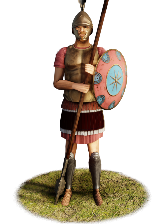
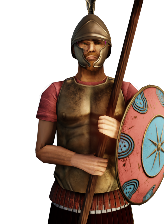
Class: spearmen · Category: infantry · Men per unit: 60
Reforms: Unlocked by Baktrian Reforms · Older units become this one with Baktrian Reforms
Description
These Epigonoi (literally “offspring”) are Macedonian-style Phalangites, recruited among the most promising descendants of Greek and Macedonian settlers born in Bactria. They are armed with the long Macedonian sarissa, as well as a xiphos sword for back up. For defence, they are clad in heavy Greek armour, consisting of metal cuirasses and linothorakes. The Epigonoi are best used at the crucial points of the battle line, were the lighter armed and less well motivated Chalkaspides would not suffice to safely hold back the enemy. These hardened warriors do not need to shy away from a comparison with the elite phalanx of other successor kingdoms, like the Antigonid Agema or the Seleucid Argyraspides.
Historical background
Bactria was a region strategically located south of Sogdiana and the Western parts of the Pamir Mountains. Its population had included groups of Greek settlers from Asia Minor and Cyrenaica for centuries before the start of this mod, who had been deported thence by various Persian monarchs (Hdt. 4.200-4; Str. 11.11.4). Thanks to its geography, Bactria was one of the last centres of Achaemenid resistance against the Greco-Macedonian invasion. For the same reason, this region always remained a potential power base for those with ambitions of their own. After their conquest of the region, therefore, Alexander the Great and his Seleucid successors were keen to secure it by settling a large number of Greek military colonists or ‘katoikoi’. Especially the Seleucids invested strongly into Bactria, both economically and in terms of strengthening its defences with a steady influx of new settlers (Walbank, The Hellenistic World (1992), pp. 131-134).
The Seleucid Empire was prone to imperial overstretch and regional rebellions. Historically, Bactria appears to have seceded in the 250s BC. The Seleucid satrap, Diodotos I Soter (c. 300 BC – c. 235 BC) ‘governor of the thousand cities of Bactria, defected and proclaimed himself king’ (Just. 41.4). Even though the chronology is contested, academic consensus holds that the Bactrian secession was a gradual process taking place around this date, with no great destruction or discontinuity being revealed in the archaeological record (F. Holt, Thundering Zeus (1999), pp. 58-64). Coins from the reign of Antiochus I were over sixty times more common than those of Antiochus II in the Bactrian site of Ai-Khanoum, a major Hellenistic city in the region, reinforcing the image of it drifting out of Seleucid influence in this period (B. Kitt, Dynastic Transitions in the Coinage of Bactria (2001)). Similar to Justin, other literary sources confirm the success and wealth of the new kingdom. Strabo explains Bactrian power by ‘the fertility of the country’ (Str. 11.11.1).
Separation from the Hellenistic homelands would also mean a quickly diminished influx of new settlers of Greek and Macedonian ethnicity and military background. The offspring of colonists already settled in Bactria would constitute a new, if somewhat limited, source of man-power for the Hellenistic core units of the Bactrian army. No Bactrian phalanx is historically attested. It is likely, however, that if a Bactrian dynasty would have successfully established itself as a true rival to the Seleucid monarchy, conquering parts of the Empire, it would also have needed- and been able to form phalanx corps of its own. In RIS, these Epigonoi Phalangites represent the elite of such a Bactrian phalanx, recruited out of the most loyal katoikoi and armed in the fashion of their Seleucid counterparts, the Argyraspides. They are a reform unit, unlocked after a decent degree of progress. With these men as the core of his army, a King of Bactria may aspire to step into the footsteps of Alexander himself and conquer the world. This time, starting in the east and moving westwards toward the great ocean!
Stats
| Rank in roster | ||
|---|---|---|
| Men per unit | 60 | █████████· 87% |
| Attack | 21 | ██████████ 99% |
| Charge bonus | 4 | ██········ 21% |
| Defence | 30 | ████······ 43% |
| · armour | 12 | ███████··· 69% |
| · defence skill | 15 | ██········ 24% |
| · shield | 3 | ████······ 37% |
| Morale | 12 | ██████···· 57% |
| Discipline | Normal | |
| Training | Highly trained | |
| Recruitment cost | 2,212 dn | ██████···· 57% |
| Upkeep per turn | 810 dn | ████████·· 79% |
| Turns to recruit | 4 |
Weapons
| Primary | Secondary | Primary | Secondary | Primary | Secondary | Primary | Secondary | ||||
|---|---|---|---|---|---|---|---|---|---|---|---|
| Attack | 21 | 6 | Charge bonus | 4 | 4 | Type | melee · blade | melee · simple | Damage | piercing | piercing |
| Properties | Long spear (bonus against cavalry, penalty against infantry) · +8 attack against cavalry · very long pike (phalanx) | — |
Defence
| Primary | Secondary | Primary | Secondary | Primary | Secondary | Primary | Secondary | ||||
|---|---|---|---|---|---|---|---|---|---|---|---|
| Total | 30 | — | Armour | 12 | — | Defence skill | 15 | — | Shield | 3 | — |
Condition and terrain
| Hit points | 1 | Ground: scrub / sand / forest / snow | -4 / -1 / -6 / -1 | Charge distance | 0 | Formations | Square · Phalanx |
Technical stats
| Time between blows (primary / secondary) | 2.5 s / 2.5 s | Extra fatigue in hot climates | 0 | Collision mass per man (1.0 is normal) | 1.23 | Spacing between men: close / loose | 1 × 1 m / 2 × 2.4 m |
| Default ranks | 5 |
In battle: Can sap · Very good stamina
Who can recruit it
A core roster unit for one faction, which can raise it anywhere it holds the right building:
Exactly what a settlement must have, route by route (2)
| Building | Also requires | Building | Also requires | ||||
|---|---|---|---|---|---|---|---|
| Direct Rule | Tier 2 Military Industrial Complex · Baktrian Reforms · Tier 2 Colony | Homeland | Tier 2 Military Industrial Complex · Baktrian Reforms |