
Mercenary Cretan Hoplites
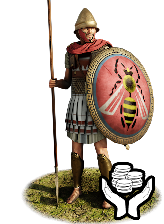
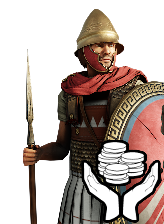
Mercenary. Hired from a regional pool, not recruited from a building.
Class: spearmen · Category: infantry · Men per unit: 40
Description
Ancient Crete was world-famous for its excellent archers. These mercenaries were sought-after by armies all over the Mediterranean, even to the extent that ancient sources generally seem to equate ‘Cretans’ with ‘mercenary archers’ (see the description of Cretan Archers). However, its city-states also fielded heavy infantry. Since Crete is a land of ancient traditions, its hoplites have either retained the traditional, weighty body armour of muscle cuirasses or reinforced their linothorakes with small metal scales. The large, round aspis shield provides much protection in the phalanx, and various types of helmets are in use across the island, with Pilos and Attic types being especially prominent. Like their forefathers, these Cretan citizens fight with spears in the phalanx, but can defend themselves with curved kopis or straight xiphos swords in melee.
Historical background
In the late 2nd millennium BC, the grand Minoan civilisation of Crete perished. The causes for this catastrophe were manifold and are still not completely understood. Invading Mycenean Greeks may have played some role in the process, since Greek-speaking groups began showing up across the island before 1000 BC (Watrous, Minoan Crete (2021), pp. 188-201). By the time of Homer (probably around 800 BC), Dorian Greeks had colonised large parts of the island (Hom. Od. 19.172-177). Various passages in the works of ancient authors such as the Pontic geographer Strabo of Amaseia (Strab. 14.2.6C653) have often been taken to reconstruct a Dorian invasion, akin to the military campaign by which the Dorians had allegedly conquered the Greek mainland. In truth, a slow process of immigration is much more likely in both cases (Tziovas, Re-imagining the Past (2014), p. 272). As Homer suggests, the Dorians became the dominant group, and when the first poleis on Crete were founded in the 8th and 7th century BC, most of them were Dorian (cf. Willetts, The Law Code of Gortyn (1967), p. 5). The so-called Eteocretans (possibly the Minoans, cf. Strab. 12.3.4C542) survived in places like Knossos or Lyttos, but especially in Eastern Crete, but their language and traditions often fused with that of the Dorians (Malla, Olous, Hierapytna etc.: Willetts (1967), pp. 5-6).
Despite their kinship ties, the cities of Crete were more often at war with each other than not. Much of that can be found in the descriptions of the Knossian, Gortynian, Lyttian and Kydonian units, so this text will turn towards the other cities of Crete, instead. One of these was Olous, a coastal town now submerged under the island of Kolokytha (Spinalonga) in eastern Crete. Though not very big, it controlled one of the best harbours on the island and could thus accrue some wealth (Ps-Skyl. 47.28-29). Olous itself was largely peaceful, but its neighbours Praisos and Hierapytna on the extreme eastern end of the island both pursued aggressively expansionist policies. While Praisos became the dominant power in the region in the 4th century BC after conquering several smaller towns (Coutsinas, Défenses crétoises (2013), pp. 186-187), Hierapytna gained the upper hand in the 3rd and eventually conquered Praisos itself in the 2nd century BC (Coutsinas, Hellenistic Olous (2020), p. 36). Itanos, the third polis that lay east of Olous, became a Ptolemaic naval base in the mid 3rd century BC (Coutsinas (2020), pp. 37-38). Olous supported Itanos and the Ptolemies in the Chremonidean War, when Athens, Sparta, Achaia, and the Arcadians fought against the Antigonids on the mainland (Van Effenterre, Crète (1948), pp. 203-204). The Ptolemaic alliance probably safeguarded Olous against the ambitions of Hierapytna and Praisos. When Ptolemaic influence in the Aegean waned in the late 3rd century BC, Olous sought a new guardian, and chose Rhodes (SEG 23.547).
Rhodes was one of the greatest naval powers in the Mediterranean at this point, however, and the two new friends were thus not equal. By 200 BC, a Rhodian garrison had appeared in Olous to protect Rhodian interests. We can easily imagine that the Rhodians had initially sent the troops to help Olous in potential conflicts with its neighbours, or to deter mightier powers in the west (namely Gortyn and Knossos). But once the troops were there, they would not leave anymore, and Olous became part of the Rhodian "empire" (cf. Coutsinas (2020), p. 38). The Rhodians also took over the fort on Spinalonga and retained it until the mid 2nd century BC (cf. SEG 52.873). Olous had thus sacrificed part of its freedom to survive, and unlike Praisos, which fell into Hierapytnian hands, or its western neighbour Dreros, which was destroyed by Lyttos around 200 BC (see the description of the Lyttian Hetairoi), Olous did survive.
Yet, after the end of the Rhodian protectorate, Olous became the victim of the aggression of another regional power: Lato. Another eastern city, Lato had conquered nearby Istron in the mid 3rd century BC (Chaniotis, War in the Hellenistic World (2008), p. 12) and its harbour, the modern Agios Nikolaos, gave it excellent access to the sea. In 121 BC (Chaniotis (2008), p. 12) or 117 BC (Coutsinas (2020), p. 41), Lato seemingly gave Olous an ultimatum: either hand over the small island of Pyrrha, the adjoining sanctuary, and another, even tinier islet, or we will attack. Olous rejected, and war broke out. After two years of fighting, which went rather badly for Olous, Knossos stepped in to mediate, and decided that Olous had to give up all of the territories in question to its stronger neighbour (Coutsinas (2020), p. 41). The Olountians initially gave in, but resumed hostilities a year later. While Knososs now entered the war on the side of Lato, Olous had made a secret agreement with Gortyn and was thus able to at least bring the war to a standstill. The four cities concluded a ceasefire soon after and then decided to appeal to Rome. The senate dispatched a commission under Quintus Favius Maximus, who ultimately confirmed Knossos’ suggestion to give the lands to Lato (Coutsinas (2020), p. 41). At the end of the day, the fight was mainly about honour, and not about the unimpressive shrine and the two small islands that most tourists who visit Agios Nikolaos will never pay any attention to, or the silver coins and the three (THREE!) people that had apparently been enslaved in the original dispute (Chaniotis (2008), pp. 12-13). Therefore, Olous eventually conceded defeat, and respected the judgment of Knossos and Rome.
The history of Olous illustrates the troubles many small city states on Crete and elsewhere faced in the Hellenistic world. Stronger neighbours, such as Lato, Hierapytna, and Praisos were a permanent danger, and when greater powers like Knossos or Rhodes got involved, diplomacy and submission were the only means to save the polis. Meanwhile, Olous also built forts and walls to protect itself and its citizens (Coutsinas (2020), pp. 39-43). Finally, such poleis also needed an army: as the prolonged war against Lato with at least three and a half years of fighting demonstrates, the citizens of Olous were well prepared for the battlefield when it eventually came this far. While Cretans were famous as archers, and even slingers and cavalry are well attested (see the respective descriptions), heavy infantry must also have existed, and there is some evidence to work with. Finkelstein (The Philistines in the Bible, JSOT 27-2 (2002)), for instance, suggested that Cretan Hoplites served as mercenaries together with Carians, Ionians and Lydians in the Saite army in 7th and 6th century BC Philistia. Such an idea is partly based on the 6th century BC "Song of Hybrias”, whose authors boasts to have been armed with sword, spear, and shield – so at least back then, many Cretans fought as Hoplites (PMG 909).
Centuries later, an epitaph from Gaza, written in elegiac form for a late Cretan mercenary named Charmadas, describes how his home town Anōpolis in southwest Crete was subdued by its enemies (Knossians? Gortynians? Kydonians?) by spears (SEG 8.269, ll. ll–12). Other grave inscriptions from the Hellenistic period also mention spears as a Cretan weapon (cf. IC I 16.48 + SEG 28.479 = EHC 15; IC II 23.22; III 4.39). There is thus little doubt that Hoplites (and Thureophoroi) were also a feature of Cretan warfare. Since Crete was very traditional and archaic traditions survived here much longer than elsewhere (like the letter called digamma, which was long extinct in mainland Greece by the Hellenistic period: Chaniotis, Verträge zwischen kretischen Poleis (1996), p. 231), heavier armour and older Attic helmets for the Hoplites seemed plausible. Less mobile than other Hellenistic infantry, but well protected, they are an efficient weapon in the phalanx, both as citizen troops or as mercenaries in a foreign army.
Stats
| Rank in roster | ||
|---|---|---|
| Men per unit | 40 | ███······· 30% |
| Attack | 10 | ██········ 19% |
| Charge bonus | 15 | ██████···· 64% |
| Defence | 45 | █████████· 87% |
| · armour | 11 | ██████···· 64% |
| · defence skill | 29 | █████████· 91% |
| · shield | 5 | ██████···· 57% |
| Morale | 11 | ████······ 39% |
| Discipline | Normal | |
| Training | Highly trained | |
| Upkeep per turn | 680 dn | ██████···· 62% |
Weapons
| Primary | Secondary | Primary | Secondary | Primary | Secondary | Primary | Secondary | ||||
|---|---|---|---|---|---|---|---|---|---|---|---|
| Attack | 10 | — | Charge bonus | 15 | — | Type | melee · blade | — | Damage | piercing | — |
| Properties | Light spear (braced against cavalry charges from the front) · +8 attack against cavalry | — |
Defence
| Primary | Secondary | Primary | Secondary | Primary | Secondary | Primary | Secondary | ||||
|---|---|---|---|---|---|---|---|---|---|---|---|
| Total | 45 | — | Armour | 11 | — | Defence skill | 29 | — | Shield | 5 | — |
Condition and terrain
| Hit points | 1 | Ground: scrub / sand / forest / snow | -1 / -1 / -4 / -1 | Charge distance | 30 | Formations | Square |
Technical stats
| Time between blows (primary / secondary) | 2.5 s / — | Extra fatigue in hot climates | 2 | Collision mass per man (1.0 is normal) | 1.26 | Spacing between men: close / loose | 1 × 1.05 m / 2 × 2.4 m |
| Default ranks | 5 |
In battle: Can sap · Very good stamina
Where to hire it
Mercenaries are hired from a regional pool, not recruited from a building. This unit is offered by 3 pools covering 17 regions, at 3,414–3,824 dn to hire and 0–1 experience.
Mercenary pools: Aegean Islands · Crete · Gytheion
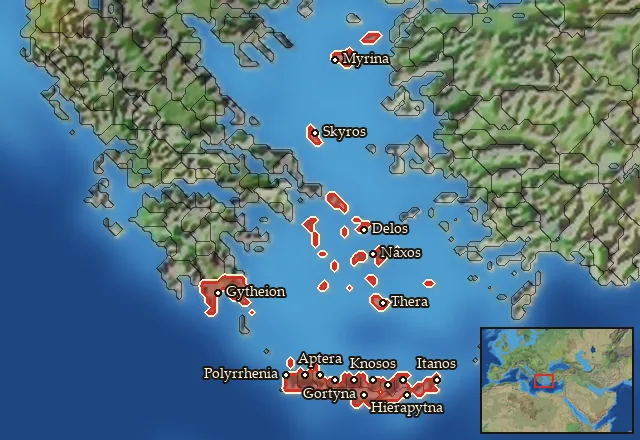
At least one of those pools sells to any faction that has an army in range, with no faction restriction.
Some pools additionally restrict it to Sparta.
The 17 regions where this unit appears in a mercenary pool
Anatolike Kyklades · Apteraia · Dytike Kyklades · Gortynia · Hierapytnia · Ida · Itania · Kalliste · Kydoniatis · Lakonikos Kolpos · Latia · Lemnos · Lyttos · Minoa · Polyrhen · Rithymna · Skyros