
Mercenary Mysian Archers


Mercenary. Hired from a regional pool, not recruited from a building.
Class: missile · Category: infantry · Men per unit: 40
Description
Mysian archers are potent light archers (toxotai), known for their balanced strength and versatility. They wield the same bows as normal Greek archers, but are slightly more skilled and carry small wooden pelte shields covered in bronze. The carrying of shields combined with large daggers and (for some) helmets gives them some durability when caught in a melee, but the lack of linothorax armour makes them less durable skirmishers than the famous Cretan archers. Instead, they rely on mobility and just wear exomis tunics. These tunics are a mix of Greek and Anatolian influences. They have added stripes, and occasionally long sleeves, to the classic Hellenic chiton and exomis, respectively. The richer Mysian skirmishers wear Phrygian helmets that shade the eyes while firing arrows. Those who cannot afford a helmet just wear traditional Mysian headbands to cover their long hair. These archers can open the battle and decimate unarmoured opponents, preferably from high ground. Afterwards, they will fall back and hide behind the shields of the hoplites.
Historical background
The ancient city of Pergamon lay in the South West of a landscape called Mysia, named after the Thracians that settled in Northwest Anatolia in the 12th century BC. Many Mysians lived piously and were vegetarian, because they believed that the consumption of meat was a sin: '(...) In accordance with their religion they abstain from eating any living thing, and therefore from their flocks as well; and they use as food honey and milk and cheese, living a peaceable life (Poseidonios apud Strab. VII, 3, 3, C296). While the Mysians had the utmost respect for life and nature, they were simultaneously fierce warriors. Homer calls them 'hand-to-hand-fighters' (Hom. Il. 13, 5) and Strabo says he did so 'because they were indomitable, as is the case with all brave warriors' (Strab. VII, 3, 3, C296). It is reasonable to assume that even their skirmishers would enter the fight at close range.
A Mysian warrior is depicted on the Çan sarcophagus from the 4th century BC, found near Altıkulaç next to Mysia in North-Western Turkey (Ma, Mysians on the Çan Sarcophagus?, in: Historia, 2008). It depicts a Mysian skirmisher wearing a long-sleeved chiton, a headband, and a small, round pelte shield, being killed by a Persian horseman. It is theorised that the Mysians learned the art of the bow from those Persians (Du Plessis, Seleucid Army (2022), p. 166). Herodotus (VII, 74, 1) wrote that the Mysians went to war wearing ‘their native helmets’, which we interpreted as being akin to the Phrygian helmets, which originated in neighbouring Phrygia. Therefore, some of the men wear those bronze helmets.
In the Hellenistic period, Mysia was mostly under the control of the Attalid dynasty that resided in Pergamon. After Philetairos (343-263 BC) became Lord of Pergamon in the early 3rd century BC, he needed an army to defend the city, and hired Mysians from the adjacent towns and mountains. These mercenaries later became a permanent part of the Pergamene army, fighting as javelinists, archers, line infantry, and even cavalry (Ma, Attalid Army (2013), pp. 65-69; Du Plessis, Seleucid Army (2022), p. 166). Even in the later 3rd and during the 2nd century BC, some Mysians were still hired as mercenaries, as is true for one who was slain by the Bithynian Menas and mentioned on his gravestone (Istanbul Archaeological Museum Inv. 1176, l. 1–8; Bar-Kochva, Menas' Stele and Curupedion (1974), p. 22). Most would, however, be levies or military colonists. In an inscription dating to the late 240s BC, king Eumenes I (r. 263-241 BC), the younger brother of Philetairos, differentiates between three classes of soldiers in the Attalid army: ‘Unpaid’ soldiers, ‘regularly paid’ soldiers, and ‘soldiers decorated with crowns’, probably the guard regiments (OGIS 266.13-16,57). Mysians would be found in all three categories, though the archers would either be part of the first or second. Initially they were equipped in their native gear as archers or skirmishers. They were eventually settled as katoikoi in strategical locations in an area called Mysia Abbaeitis. These were part of the settlement of Mysians, during the years after the Galatian war (168–165 BC), in the frontier zone between Mysia, Lydia, and Phrygia. These military communities were placed in strategic sites, living off produce of the local countryside, and received Greek equipment as they Hellenised (Ma (2013), pp. 65-69). Eumenes II fielded 150 light-armed Mysian archers in the third Macedonian War (Liv. 42.57).
The Seleucid Empire also used Mysians in large numbers. Mysian skirmishers, perhaps also in the role of archers, fought under the Seleucid usurper Achaios the Younger in 218 BC (Polyb. V, 76, 7). At Magnesia in 190 BC, Antiochus III had 2,500 Mysian archers with him (Liv. XXXVII, 40, 12). Apian mentions them as horse archers, but this is not supported by other ancient or modern historians (App. Syr. VI.32). After the defeat at Magnesia, the Treaty of Apameia stipulated that the Seleucids were forbidden to recruit mercenaries in regions that were under Roman influence. This, however, seemed not to include all of Mysia, or the Seleucids simply circumvented the treaty. In 167 BC, Mysian mercenaries put down a Jewish revolt in Jerusalem (Sekunda, Seleucid and Ptolemaic Reformed Armies 168-145 BC (1994), p. 17). In 165 BC, the Seleucids fielded 5,000 Mysians (Griffith, The Mercenaries of the Hellenistic World (1935), p. 147; for more information: Möhring & Strootman, ‘Mysian Light Infantry in the Seleukid Army’, in: The Seleukids at War, 2024).
Mysian mercenaries were also hired by the Antigonid kings, as is implied by Plutarch's description of the Macedonian garrison of Corinth in 243 BC: ‘There were in Corinth four brothers, of Syrian origin, one of whom, Diokles by name, was serving as a mercenary soldier in the citadel’ (Plut. Aratos 18,2). Later on (24,1) he explains there were indeed 400 mercenaries under their command, which is confirmed by the Macedonian advocate Polyainos (2nd century AD: Polyaen. VI, 5, 1). In his still authoritative work on Hellenistic mercenaries, Griffith notes that the manuscript of Plutarch's text was corrupted and that the reading of "Syrians" did not fit the original script – he suggests to amend it to ‘Mysians’ instead (Griffith (1933), p. 68, n. 3). In any case, the Hellenistic world was a world of mercenaries, and Mysians probably appeared in many armies of the Eastern Mediterranean. In 133 BC, the area of Mysia became part of the Roman province of Asia.
Stats
| Rank in roster | ||
|---|---|---|
| Men per unit | 40 | ███······· 30% |
| Attack | 8 | █········· 9% |
| Charge bonus | 1 | █········· 4% |
| Defence | 13 | █········· 5% |
| · armour | 2 | █········· 13% |
| · defence skill | 9 | █········· 3% |
| · shield | 2 | ███······· 25% |
| Morale | 6 | █········· 6% |
| Discipline | Low | |
| Training | Untrained | |
| Upkeep per turn | 459 dn | ██········ 18% |
Weapons
| Primary | Secondary | Primary | Secondary | Primary | Secondary | Primary | Secondary | ||||
|---|---|---|---|---|---|---|---|---|---|---|---|
| Attack | 8 | 3 | Charge bonus | 1 | 1 | Type | missile · archery | melee · simple | Damage | piercing | piercing |
| Projectile | arrow | — | Range | 120 | — | Ammunition | 25 | — |
Defence
| Primary | Secondary | Primary | Secondary | Primary | Secondary | Primary | Secondary | ||||
|---|---|---|---|---|---|---|---|---|---|---|---|
| Total | 13 | — | Armour | 2 | — | Defence skill | 9 | — | Shield | 2 | — |
Condition and terrain
| Hit points | 1 | Ground: scrub / sand / forest / snow | 0 / 0 / 0 / 0 | Charge distance | 30 | Formations | Square |
Technical stats
| Time between blows (primary / secondary) | 2.5 s / 2.5 s | Extra fatigue in hot climates | 0 | Collision mass per man (1.0 is normal) | 0.85 | Spacing between men: close / loose | 1.2 × 2.8 m / 2.16 × 5.04 m |
| Default ranks | 5 |
In battle: Very good stamina
Where to hire it
Mercenaries are hired from a regional pool, not recruited from a building. This unit is offered by 4 pools covering 13 regions, at 3,519–3,942 dn to hire and 0–1 experience.
Mercenary pools: Aiolis · Ankyra · Sardis · Troad Mysia
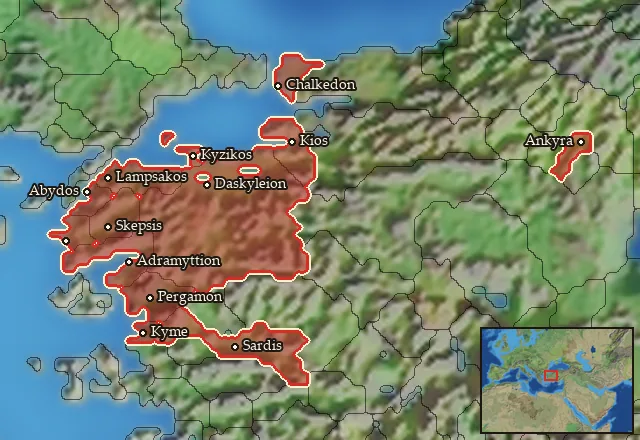
At least one of those pools sells to any faction that has an army in range, with no faction restriction.
Some pools additionally restrict it to Galatians · Seleucid Empire · Seleucid Rebels (Asia Minor) · Seleucid Rebels (Upper Satrapies).
The 13 regions where this unit appears in a mercenary pool
Adramyttenos Kolpos · Ano Troias · Arktonnesos · Chalkedonia · Kaikia · Kianos Kolpos · Lydia · Mysia · Nea Tektosagia · Phrykonis · Pityoussa · Propontis · Troias