
Ptolemaic Agema Cavalry
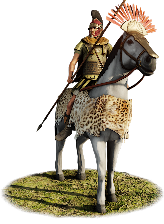
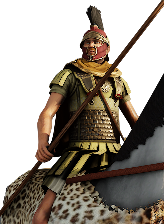
Class: heavy · Category: cavalry · Men per unit: 30
Description
From the time of Alexander, even into the era of the Ptolemaic Empire, these horsemen, though expensive to maintain in top condition, were valuable in any battle a Greek or Macedonian would find himself facing. Well equipped, the Agema, armed similarly to the Macedonian Hetairoi, used their prime weapon, the xyston, a lance of up to 12 feet long, to much effect. When their xyston had done its work in the charge, these horsemen used a sword as a backup, excellent for downward slashing at infantry or stabbing with the point of the weapon. As protection the Agema wore the strong and sturdy muscle cuirass or the lighter, but nonetheless effective, linothorax. This cavalry unit is best used for charging enemy troops caught off-guard and will win most fights against other cavalry or light infantry units.
Historical background
The use of heavy cavalry that delivered a shock charge with lance and edged weapons, rather than fighting as mounted skirmishers, was a reasonably recent development in Greek warfare in the 4th and 3rd century BC. Heavy cavalry was already used by Macedon during the Peloponnesian War (Thuc. 2.100.5), but they were further improved by Philip II (382-336 BC) and their use was perfected by Alexander the Great. Alexander’s heavy cavalry were trained to fight at close quarters with lance and sword and were organised as squadrons which varied in size from 180 to 225 men (Sekunda/McBride 1995; Hammond 1998). After the death of Alexander in 323 BC, the deployment of bodies of heavy cavalry on the battlefield became a standard feature of Hellenistic warfare (Sekunda 2012).
The existence of a Ptolemaic cavalry agema was long doubted, until it was established by Falivene (‘Patterns of the Greek settlement in Egypt during the Ptolemaic period’, 2007). Like the Xystophoroi, they may have included Mysians and Persians who had their own cavalry regiments named after them, at least before the structural reforms in the 2nd century and attested since 235 BC (CPR XVIII 15, ll. 298–9 for Persians). The Ptolemaic cavalry was grouped into hipparchies which included 400-500 men, commanded by hipparchoi, further divided into two ilia (squadrons) of 200-250 men, led by ilarchoi, which in turn were made up of two lochoi. There were five ethnic Hipparchies attested by papyri dated to 222-217 BC: Mysians, Thracians, Persians, Thessalians, and other Greeks (CPR XVIII 10, l. 197; for Thessalians and Other Greeks: Fischer Bovet (2014), pp. 126-128). Double denominations imply that there was no rigid ethnic organisation, only that the ethnic hipparchy may have initially included cavalrymen with the same ethnic designation.
The members of the Ptolemaic agema were already allotted kleroi in the third century BC (Fischer-Bovet (2014), p. 153). One of them, the cavalry soldier Trochinides (PP II/VII 4413 = 2828add = PP IV 8744), who belonged to the fourth hipparchia, leased out his kleros in 223/222 BC, possibly because of an upcoming campaign or he owned several pieces of land. In any case, the example shows that the elite soldiers of the agema also accrued considerable wealth and must have been well paid.
For equipment, Du Plessis (Seleucid Army (2022), p. 84) suggests for the Seleucid Agema an armament similar to the Hetairoi. A funerary Stela of a Soldier on Horseback from Alexandria (Graeco-Roman Museum Inv. 102228) from c. 300 BC shows a cavalrymen equipped with xyston, sword, dark purple saddle, greenish-yellow chiton and pale yellow Linothorax with pteryges and a long saffron-yellow chlamys with purple borders. Some Agema likely wore a violet chlamys as it is probably depicted on the funerary stela of the Macedonian rider Nikanor in Alexandria (Graeco-Roman Museum, 3rd century BC). Cavalrymen obtained horses from the state or buying them with state’s help (Fischer-Bovet, Army and Society in Ptolemaic Egypt (2014), p. 128), buying them with the state’s help. Préaux (L’économie royale des Lagides, 1979) suggests that in the 3rd century BC cleruchs did not necessarily own their horses but might have in the 2nd century BC (Fischer-Bovet (2014), p. 252).
Stats
| Rank in roster | ||
|---|---|---|
| Men per unit | 30 | █········· 8% |
| Attack | 13 | ██████···· 57% |
| Charge bonus | 31 | █████████· 93% |
| Defence | 35 | ██████···· 57% |
| · armour | 14 | ████████·· 78% |
| · defence skill | 21 | █████····· 54% |
| · shield | 0 | █········· 0% |
| Morale | 15 | █████████· 91% |
| Discipline | Normal | |
| Training | Highly trained | |
| Recruitment cost | 2,899 dn | ████████·· 81% |
| Upkeep per turn | 1,167 dn | ██████████ 95% |
| Turns to recruit | 4 |
Weapons
Its secondary attack is the stronger one: 14 against 13.
| Primary | Secondary | Primary | Secondary | Primary | Secondary | Primary | Secondary | ||||
|---|---|---|---|---|---|---|---|---|---|---|---|
| Attack | 13 | 14 | Charge bonus | 31 | 26 | Type | melee · blade | melee · blade | Damage | piercing | slashing |
Defence
| Primary | Secondary | Primary | Secondary | Primary | Secondary | Primary | Secondary | ||||
|---|---|---|---|---|---|---|---|---|---|---|---|
| Total | 35 | — | Armour | 14 | — | Defence skill | 21 | — | Shield | 0 | — |
Condition and terrain
| Hit points | 1 | Mount | hetairoi horse | Ground: scrub / sand / forest / snow | -2 / -1 / -7 / -1 | Charge distance | 40 |
| Formations | Square · Wedge |
Technical stats
| Time between blows (primary / secondary) | 2.5 s / 2.5 s | Extra fatigue in hot climates | 0 | Spacing between men: close / loose | 2 × 4.8 m / 3 × 7.2 m | Default ranks | 5 |
Who can recruit it
A core roster unit for 2 factions, each able to raise it anywhere they hold the right building:
Ptolemaic Empire · Ptolemaic Rebels
Exactly what a settlement must have, route by route (2)
| Building | Also requires | Building | Also requires | ||||
|---|---|---|---|---|---|---|---|
| Direct Rule | Tier 3 Military Industrial Complex · Tier 2 Colony · Requires resource horses or horses supplied factionwide | Homeland | Tier 2 Military Industrial Complex |