
Ptolemaic Basilikon Agema
Class: spearmen · Category: infantry · Men per unit: 40
Description
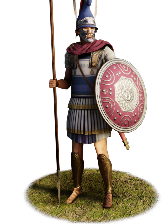
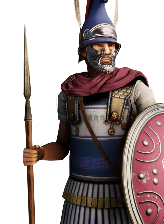
The Basilikon Agema (literally "royal elite") is the best infantry regiment in the Ptolemaic army. When Alexander the Great died, his famed elite soldiers, the Hypaspists and Argyraspides, largely stayed in the East, where they would later become part of the Seleucid army, while some returned to their native Macedon to eventually fight for the Antigonids. The Ptolemies had to form a new regiment of the best of the best. The elite status of the Basilikon Agema as the heirs of the Hypaspists are reflected by their equipment. On their heads, they wear colourful Phrygian and crested Chalcidian helmets; gold decorated, metal reinforced composite cuirasses protect their bodies; and their Aspis shields are stunningly decorated with popular Ptolemaic motifs such as the cornucopia or the head of Medusa. This opulent equipment is completed by purple tunics, shining greaves, and traditional Hoplite spears. The Basilikon Agema is made up of the best soldiers of the Ptolemaic kingdom, and can be trusted to hold out against almost any enemy unit imaginable on the battlefield.
Historical background
Every player of RTR or RS will be familiar with the Hypaspists and the Arygraspides as the elite infantry units of the armies of Alexander the Great and his successors in the Seleucid Empire. Seleukos had managed to secure the services of these veterans when establishing himself as king in the former core lands of the Achaemenid Persian Empire, and these regiments arguably remained the strongest infantry regiments in the world throughout the Hellenistic period (Bar-Kochva, Seleucid Army (1976), pp. 58-67). This presented Seleukos' rivals with the challenge to form a similarly well-trained and armed unit. While the Antigonids had some former elite soldiers and their friends and relatives available in Macedon itself, the Ptolemies had to start from scratch. Little is known about this process, but Ptolemaios must have selected the fittest, bravest and/or most experienced from the men of his army and the military settlers he brought to Egypt and Alexandria, in particular. Four non-Macedonians are attested as members of the unit, but they were probably the minority (P. Lond. 7.1986; P.Petr. 2.16; P.Petr. 2.18). The new regiment was named Basilikon Agema, "royal elite" or "royal guard", after Alexander's "Agema of the Hypaspists" (Bar-Kochva (1976), p. 64; Polyb. V.82.4).
The armament of the Agema in the style of the Hypaspists is confirmed by several stelae from the Ptolemaic garrison at Oroanda, Sidon, from the late 3rd century BC, which were originally very colourful, and even prove that some of the Aspis shields were painted red on the inside (see also Johstono, Ptolemaic Army (2020), plate 3). The Basilikon Agema seems to have consisted of 3,000 men, which fits the number of the Royal Peltasts in Macedon, the Antigonid equivalent of the Hypaspists (Liv. XLII.51.4-5). As the foremost regiment of the royal guard, the Agema was politically important and the kings as well as possible usurpers had to ensure to secure its loyalty (Polyb. V.25.1), just like Roman emperors had to deal with the Praetorians. The papyri (e.g., P. Lond. 7.1986) show each of the soldiers was given 100 aurora of land, which afforded them considerable wealth.
In the late 2nd and in the 1st century BC, the Agema fades from the papyrological record, where a new guard unit called Lonchophoroi takes their place (Fischer-Bovet, Army and Society (2014), p. 146). The name implies a usage of spears (‘lonche’) as well as swords, and the Basilikon Agema was probably always equipped with swords as a secondary weapon, a common feature of the Hoplite panoply.
Stats
| Rank in roster | ||
|---|---|---|
| Men per unit | 40 | ███······· 30% |
| Attack | 14 | ███████··· 65% |
| Charge bonus | 12 | ████······ 42% |
| Defence | 51 | ██████████ 95% |
| · armour | 11 | ██████···· 64% |
| · defence skill | 35 | ██████████ 99% |
| · shield | 5 | ██████···· 57% |
| Morale | 15 | █████████· 91% |
| Discipline | Normal | |
| Training | Highly trained | |
| Recruitment cost | 2,539 dn | ███████··· 72% |
| Upkeep per turn | 929 dn | █████████· 85% |
| Turns to recruit | 4 |
Weapons
| Primary | Secondary | Primary | Secondary | Primary | Secondary | Primary | Secondary | ||||
|---|---|---|---|---|---|---|---|---|---|---|---|
| Attack | 14 | — | Charge bonus | 12 | — | Type | melee · blade | — | Damage | piercing | — |
| Properties | Light spear (braced against cavalry charges from the front) · +8 attack against cavalry | — |
Defence
| Primary | Secondary | Primary | Secondary | Primary | Secondary | Primary | Secondary | ||||
|---|---|---|---|---|---|---|---|---|---|---|---|
| Total | 51 | — | Armour | 11 | — | Defence skill | 35 | — | Shield | 5 | — |
Condition and terrain
| Hit points | 1 | Ground: scrub / sand / forest / snow | -1 / -1 / -4 / -1 | Charge distance | 30 | Formations | Square |
Technical stats
| Time between blows (primary / secondary) | 2.5 s / — | Extra fatigue in hot climates | 0 | Collision mass per man (1.0 is normal) | 1.22 | Spacing between men: close / loose | 1 × 1.2 m / 2 × 2.4 m |
| Default ranks | 5 |
In battle: Can hide in long grass · Can sap · Very good stamina
Who can recruit it
A core roster unit for 2 factions, each able to raise it anywhere they hold the right building:
Ptolemaic Empire · Ptolemaic Rebels
Exactly what a settlement must have, route by route (2)
| Building | Also requires | Building | Also requires | ||||
|---|---|---|---|---|---|---|---|
| Direct Rule | Tier 3 Military Industrial Complex · Tier 2 Colony | Homeland | Tier 2 Military Industrial Complex |