
Machimoi Epilektoi Phalangites
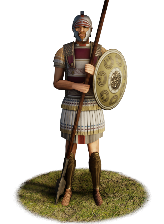
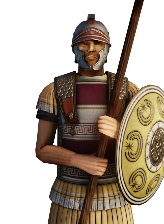
Class: spearmen · Category: infantry · Men per unit: 60
Reforms: Unlocked by Mobilization of the Machimoi
Description
The Epilektoi Phalangites are the elite among the Ptolemaic machimoi forces. They are native Egyptian and Greco-Egyptian soldiers, trained to fight in the style of the Macedonian Phalanx. As companies of picked troops, their military equipment is of much higher quality than the armament of the regular machimoi reservists. Their Hellenic-style armour in form of Thracian and Phrygian helmets, colourful linothoraces, as well as greaves (knemides), were provided by their respective commanders, who received the necessary funds from the Ptolemaic state (Polyb. V.63.11). As weapons they carry a sarissa (a long pike of 22-24 ft./ 7 metres) and a bronze pelte shield with Ptolemaic designs, demonstrating their standing as picked guards for the Ptolemaic court. Their good armour and excellent discipline make the epilektoi phalangites an essential part of the frontline, able to hold the enemy at a distance with their pikes. However, like every other phalanx unit, they should not be sent into battle unprotected, as their flanks and backs remain vulnerable.
Historical background
The term machimoi (μάχιμοι, ‘the pugnacious’, or ‘troops fit for action’) was first used by Herodotus, both for the retinue of the Persian army (Hdt. 7.186.1) and the soldiers of ancient Egypt (Hdt. 2.164f.). During the Ptolemaic era, machimoi may have been native Egyptians, employed as reserves, guards and police units (Burckhardt, s.v. ‘‘Machimoi’’, in: Brill’s New Pauly (2006)). However, their true nature remains an element of debate in the academic literature. It can be questioned if the majority were really native Egyptians, since many Greek names are attested for them on Ptolemaic Papyri. However, adopting Greek names became a standard practice of integration into the new Hellenistic society for most subjects in Egypt and the Near East, so there always remains an element of uncertainty.
For the battle of Raphia in 217 BC, Ptolemy IV Philopator (244-204 BC) recruited 20,000 native Egyptians into his phalanx to strengthen his forces against the army of his rival, Antiochos III (241-187 BC). Though it was not the first time Egyptians were recruited to bolster Ptolemaic forces, their integration into the phalanx gave them the chance to climb the social ranks from this time onwards, not least because the Graeco-Macedonian kings initially relied on their military contributions.
In the 2nd and 1st century BC, the recruitment of Egyptians for both the guards and the field armies became more structured and the machimoi’s socio-economic situation improved significantly, just like that of Egyptians in general (Burstein (2008), p. 74). The status and wages Egyptians could receive by entering the army, along with kleroi grants, must have been very appealing to them. The Ptolemaic kings and queens tried to secure the loyalty of the machimoi by confirming their holdings, especially those of the epilektoi, who were called seven-aroura and ten-aroura men, holding respectable sizes of property (Fischer-Bovet (2014), p. 166).
A picked force of machimoi guarded the royal Ptolemaic court and acted as garrison troops in Alexandria. In the time of Ptolemy V, they were grouped into laarchias and led by two laarchai and hegemones. Laarchias consisted of cavalry machimoi and infantry machimoi, with kleroi allotments ranging from 5 to 10 arourai (for infantry) to 20 aroura plots for horsemen. The kleroi brought them enough income to sustain themselves and their families (Fischer-Bovet & Sänger, Security and Border Policy (2019), p. 169). A drawback, however, could result from them being too long on campaign or active duty. In 164 BC, a laarchia of epilektoi machimoi complained via petition to the dioketes that their families could not undertake the increased cultivation demanded from them by a new royal decree, as they had been stationed in Alexandria (Fischer-Bovet (2014), p. 152).
Stats
| Rank in roster | ||
|---|---|---|
| Men per unit | 60 | █████████· 87% |
| Attack | 18 | █████████· 91% |
| Charge bonus | 1 | █········· 4% |
| Defence | 25 | ███······· 28% |
| · armour | 10 | █████····· 54% |
| · defence skill | 12 | █········· 9% |
| · shield | 3 | ████······ 37% |
| Morale | 10 | ███······· 29% |
| Discipline | Normal | |
| Training | Highly trained | |
| Recruitment cost | 1,758 dn | ███······· 34% |
| Upkeep per turn | 643 dn | █████····· 51% |
| Turns to recruit | 3 |
Weapons
| Primary | Secondary | Primary | Secondary | Primary | Secondary | Primary | Secondary | ||||
|---|---|---|---|---|---|---|---|---|---|---|---|
| Attack | 18 | 3 | Charge bonus | 1 | 1 | Type | melee · blade | melee · simple | Damage | piercing | piercing |
| Properties | Long spear (bonus against cavalry, penalty against infantry) · +8 attack against cavalry · very long pike (phalanx) | — |
Defence
| Primary | Secondary | Primary | Secondary | Primary | Secondary | Primary | Secondary | ||||
|---|---|---|---|---|---|---|---|---|---|---|---|
| Total | 25 | — | Armour | 10 | — | Defence skill | 12 | — | Shield | 3 | — |
Condition and terrain
| Hit points | 1 | Ground: scrub / sand / forest / snow | -5 / -1 / -8 / -1 | Charge distance | 0 | Formations | Square · Phalanx |
Technical stats
| Time between blows (primary / secondary) | 2.5 s / 2.5 s | Extra fatigue in hot climates | -1 | Collision mass per man (1.0 is normal) | 1.14 | Spacing between men: close / loose | 1 × 1 m / 2 × 2.4 m |
| Default ranks | 5 |
In battle: Can hide in long grass · Can sap · Good stamina
Who can recruit it
A core roster unit for 3 factions, each able to raise it anywhere they hold the right building:
Egyptians · Ptolemaic Empire · Ptolemaic Rebels
Exactly what a settlement must have, route by route (3)
| Building | Also requires | Building | Also requires | Building | Also requires | ||
|---|---|---|---|---|---|---|---|
| Indirect Rule | Garrison Building or Tier 1 Military Industrial Complex · Mobilization of the Machimoi · Tier 1 Colony | Direct Rule | Garrison Building or Tier 1 Military Industrial Complex · Mobilization of the Machimoi · Tier 1 Colony | Homeland | Garrison Building or Tier 1 Military Industrial Complex · Mobilization of the Machimoi |