
Equites (Early)
Class: light · Category: cavalry · Men per unit: 30
Reforms: No longer recruitable after A New Man: Gaius Marius (switched off), Polybian Reform · Becomes a newer unit with Polybian Reform
Description
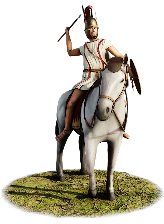
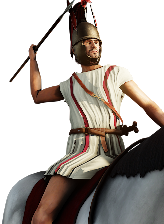
The early Roman equites are bad. There is no way around saying it. You, dear player, can count yourself lucky that we made them as good as they are. With the perfect mix of suicidal self-confidence and the worst equipment imaginable, it is truly a wonder that our dear Romans did not lose a consul in every battle (though not for a lack of trying!). A Roman knight (eques), rich enough to buy his own horse or influential enough to get one paid for by the state, has one single destiny – that is, to die fighting on foot. Equipped with short lances that can double as javelins, small leather bucklers, helmets, and a shiny white tunic with thin red stripes (called “angustus clavus”) that mark them as “knights” of the upper class, you are truly fortunate that these guys stay on their horses, because their real-life counterparts certainly did not!
Historical background
The origins of the early Roman cavalry can be sought in the legendary beginnings of Rome. Romulus established three centuries of cavalrymen (literally 300), called the Celeres (from Latin celer: “swift/fast”). These were selected from three tribes, each contributing 100 men: the Ramnes (after Romulus), the Titienses (after T. Tatius), and the Luceri (Liv I.13; Dion. Hal. II.13; Var. LL V.91; Plin. NH XXXIII.9; Festus Celeres. More on Roman cavalry, especially for the purposes of this description: Armstrong and Notari, Early Roman Cavalry (2024), p. 114). Their numbers were doubled two times, eventually resulting in 1,200 Roman equites, until the whole system was reformed by Servius Tullius (6th century BC). He established 18 centuries of equites within his voting system of the comitia centuriata (Liv. I.43; Armstrong and Notari (2024), p. 115). Each century supposedly contained 200 men, resulting in a total cavalry force of 3,600 around 550 BC. There are many oddities regarding this early Roman cavalry, whose classification, in Armstrong and Notari’s words, “was ambiguous and seemed to include non-economic factors” such as family ties and public relationships, besides the obvious economic factor of wealth (Armstrong and Notari (2024), p. 116).
Polybios remarked on their early fighting style (VI.25): “The cavalry are now armed like that of Greece, but in old times they had no thorakes but fought in loincloths (perizoma), the result of which was that they were able to dismount and mount again at once with great dexterity and facility, but were exposed to great danger in close combat, as they were nearly naked.” Further detailing their equipment, he characterizes their lances as insufficient, fragile, and too bendy to take proper aim, while their bucklers of ox-hides peeled off and rotted in the rain, swiftly becoming useless.
This is the exact equipment this unit carries. Its helmets are the very popular Montefortino helmet, that had become the most common type in Italy by the 3rd century BC (Paddock, The Bronze Italian Helmet, Vol. 2 (1993), p. 469), as well as Phrygian helmets, a typical helmet for Etruscan and Latin aristocrats (like the helmets depicted in the Tomb of Reliefs at Cerveteri or the wall painting in the Giglioli tomb, Tarquinia). We decided to preserve at least some of the equites’ dignity by not giving them loincloths, but instead have them wear white tunics with purple-red thin stripes (angustus clavus) befitting their rank as knights.
Their regular dismounting is such a common motif of Roman battle narratives that one has to wonder if the true anachronism is instead every time Roman equites successfully stayed on their horses! At numerous points, leaping off their horses is connected to the Roman aristocrats saving the day. At the Battle of Lake Regillus against the Latins (Liv. II.20.9; 499 BC), in a battle against the Sabines (Liv. III.62.9; 449 BC), against the Volsci (Liv. IV.38-39; 423 BC), and a different one against the Volsci fought by M. Furius Camillus (Liv. VI.24.10; 381 BC), and finally, at the battle of Lake Vadimo against the Etruscans (Liv. IX.39.6; 310 BC). During the First Samnite War, repeated charges of the equites did not have their intended effect on the Samnite infantry, so the consul dismounted his cavalry to lead an infantry charge, instead (Liv. VII.33.9; 343 BC). In a cavalry battle during the Second Samnite War, the magister equitum was killed, so the Roman cavalry suddenly dismounted, forcing the Samnites to do the same (Liv. IX.22.9; 315 BC). In one sympathetically framed anecdote about L. Papirius Cursor (cos. 326 BC), his cavalrymen asked him to excuse their fatigue, to which he replied, “I excuse you from rubbing your horses’ backs when you dismount” (Liv. IX.16.15). Depictions of so-called “desultores” (men who jump off or between horses) are quite common in Etruscan and Latin iconography of the 6th and 5th centuries BC (Armstrong; Notari (2024), p. 137).
If you think, only the fanciful episodes of early Roman history contain dismounting, you would be wrong. Once we enter the historical period, that is not simply derived from all the glorious Roman family annals, the success of dismounting in the context of larger warfare becomes a bit more ambiguous. At the battle of Heraklea (280 BC), the cavalry of Pyrrhos of Epeiros repeatedly wheeled around to attack the Roman cavalry, who had obviously dismounted and tried to turn the engagement into an infantry battle (Dion. Hal. XX.2.3). At the battle of Ticinius (218 BC), where a melee was fought between Cornelius Scipio’s (cos. 218 BC) and Hannibal Barca’s skirmishers and cavalry, most of the horsemen had (been) dismounted, though the Numidians were still ahorse and proceeded to cycle-charge and rout the Roman troops (Pol. III.65.9; Liv. XXI.46). At the battle of Cannae (216 BC), the consul L. Aemilius Paullus was forced to dismount after being wounded, causing his bodyguard to dismount as well for their last stand (Pol. III.115.3; Liv. XXII.49). Even Scipio Africanus had his horsemen dismount during the Battle of Ilipa (206 BC) with great success, and finally, at the Battle at the Tagus River (153 BC), the Lusitanian forces were beaten back to their camp, where the Roman cavalry had to dismount to continue the fight on foot (185 BC, Liv. IXXX.31). This tendency to dismount can certainly be sought in the Roman duelling culture and their glorification of running headfirst to the death (Armstrong and Notari (2024), p. 119). Between the legendary period of Roman kings (8th century BC) and the 1st century BC, Oakley (Single Combat in the Roman Republic (1985), p. 393-396) notes thirty explicit mentions of duels or individuals known for duelling in the literary sources (nos. 10-30 happening in the “historical” period of the Roman Republic from the late 3rd century BC onwards). This presumably is part of the self-identification with aristocratic virtues of raising horses, riding, personally getting into the action of battle, and duelling important enemy combatants. You can spot your opponent, quickly get off the horse, fight a fast duel with your little spear and buckler in hand, and jump back on your horse if things get dicey. As you have already seen, Polybios laments this early praxis of leaping off the horse, seeking the fault in the bad Roman equipment, and praises Rome’s adoption of Greek arms, thus turning the equites into proper heavy cavalry. Like the Battle at the Tagus demonstrates, however, you may get the Romans to abandon their equipment, but not their mindset. So, be glad we did not make these early equites into an infantry unit!
Stats
| Rank in roster | ||
|---|---|---|
| Men per unit | 30 | █········· 8% |
| Attack | 15 | ███████··· 72% |
| Charge bonus | 18 | ███████··· 72% |
| Defence | 23 | ███······· 25% |
| · armour | 4 | ███······· 33% |
| · defence skill | 17 | ████······ 35% |
| · shield | 2 | ███······· 25% |
| Morale | 10 | ███······· 29% |
| Discipline | Normal | |
| Training | Trained | |
| Recruitment cost | 2,032 dn | █████····· 51% |
| Upkeep per turn | 818 dn | ████████·· 80% |
| Turns to recruit | 2 |
Weapons
| Primary | Secondary | Primary | Secondary | Primary | Secondary | Primary | Secondary | ||||
|---|---|---|---|---|---|---|---|---|---|---|---|
| Attack | 15 | 9 | Charge bonus | 18 | 24 | Type | thrown · blade | melee · blade | Damage | piercing | piercing |
| Projectile | javelin | — | Range | 50 | — | Ammunition | 2 | — | Properties | Used just before charging into combat | — |
Defence
| Primary | Secondary | Primary | Secondary | Primary | Secondary | Primary | Secondary | ||||
|---|---|---|---|---|---|---|---|---|---|---|---|
| Total | 23 | — | Armour | 4 | — | Defence skill | 17 | — | Shield | 2 | — |
Condition and terrain
| Hit points | 1 | Mount | medium horse | Ground: scrub / sand / forest / snow | -1 / 0 / -5 / 0 | Charge distance | 40 |
| Formations | Square · Wedge |
Technical stats
| Time between blows (primary / secondary) | 2.5 s / 2.5 s | Extra fatigue in hot climates | 0 | Spacing between men: close / loose | 2 × 4.8 m / 3 × 7.2 m | Default ranks | 5 |
In battle: Good stamina
Who can recruit it
A core roster unit for 4 factions, each able to raise it anywhere they hold the right building:
The House of Aemilii · The House of Claudii · The House of Cornelii · The Roman Senate
Exactly what a settlement must have, route by route (3)
| Building | Also requires | Building | Also requires | Building | Also requires | ||
|---|---|---|---|---|---|---|---|
| Indirect Rule | Garrison Building or Tier 1 Military Industrial Complex · Tier 1 Colony · not Polybian Reform | Direct Rule | Garrison Building or Tier 1 Military Industrial Complex · Tier 1 Colony · not Polybian Reform | Homeland | Garrison Building or Tier 1 Military Industrial Complex · not Polybian Reform |