
Hastati (Early)
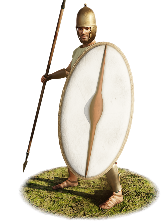
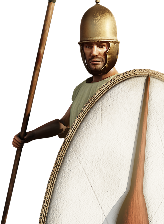
Class: spearmen · Category: infantry · Men per unit: 40
Reforms: No longer recruitable after A New Man: Gaius Marius (switched off), Polybian Reform · Becomes a newer unit with Polybian Reform
Description
Hastati make up the front ranks of a Roman legion. They are the youngest of the heavy infantry and thus the most impetuous. As they lead the initial clash, they also take the brunt of an enemy attack, though their youthful and energetic spirit can lead to a quick rout of undisciplined enemy forces. They are armed with dual-purpose hastae (spears) and protected by helmets, with some wearing pectoral armour.
Historical background
The hastati chronologically make their first appearance in the 6th book of Polybios of Megalopolis (ca. 200 – 120 BC), being described as the first heavy infantry line of the Roman legion of the 2nd century BC. However, they existed long before that, even if the obscurity of early Roman sources leads to a lot of scepticism towards any detail of the early Roman military. Roman authors of the late Republic and early Principate, like Titus Livius (ca. 59 BC – 17 AD?) and Dionysios of Halikarnassos (ca. 54 BC – 8 AD?), are often doubted due to their reliance on Mid-Republican so-called “late annalistic” authors of the 1st century BC, who often invented large parts of early Roman history to suit specific aristocratic families, though we do not yet know all the kinds of sources they may have had access to beyond historical narratives. We at RIS tried to reconstruct the Early Republican soldiers utilising the little information we have of that time.
In his Lingua Latina, Varro says that the term “hastati” derives from the hastae, which can very directly be translated as “spears” (V.89). It is not unlikely, therefore, that these men were initially armed with a multipurpose spear that could both be used for close combat and as a projectile. In the early 2nd century, Ennius writes “the hastati threw their hastae, an iron down-pour came” (Macrobius 6.1.52 = Ennius, Ann. 8. frg. 281; Rawlings, Army and Battle During the Conquest of Italy (2007), p. 57). In the ancient historical narratives, the hastati make their first appearance in the 4th century BC, as part of Livy’s work. In 350 BC, a battle took place at an unknown site in Latium, where the Gauls attacked a Roman position on the hill. The triarii were fortifying the position, while the hastati and principes guarded the groundworks and threw their pila and spears (“pila omnia hastaeque”) at the Gallic charge (Liv. VII.23.7). After that episode, these individual sections of the Roman army make more regular appearances. Situated in 340 BC, during the Latin War, Livy gives his own version of the manipular legion, probably representing an earlier model than that of Polybios. This account is quite confusing and possibly corrupt (Oakley, A Commentary on Livy Books VI-X (1998), p. 461-463), and there have been various attempts to restore it or to get the math to “add up” (Armstrong, Organized Chaos (2020), p. 85). Frustration about this has been shown as early as 1670, when the Scottish author and soldier James Turner wrote: “Titus Livius […] marshals the Roman Legion in such a confused way, that he is not at all intelligible; and hath given just reason to both Learned and Military men, to think that place is corrupt, and a sense made of it, never intended by the author” (Turner, Pallas Armata (1670), p. 84). His account is nonetheless important. Thanks to Livy, we know that the Roman army deployed in a sort of checkerboard formation (commonly called “quincunx” in scholarship) that left intervals open between the maniples so that the hastati could retreat into the lines of the principes, or the latter advance into the spaces left between the former (Livy VIII.8.9). As opposed to the 2nd century BC account of Polybios, Livy describes 15 maniples of hastati and principes each (instead of 10), with each including an attachment of 20 leves armed with javelins (or perhaps these were only attached to the maniples of hastati, this remains unclear). He does not provide any details on the hastati’s equipment beyond them being “scutati”, i.e. scutum-bearers. The manipuli or ordines (orders/ formations) are 60 men strong, and each have two centurions and one standard-bearer (Liv. VIII.8.5-6).
We mostly see allusions to these men’s equipment, though there may be anachronisms as mentioned in the historical background. Livy states that they carried a scutum (an oval oblong shield) by 340 BC, and this generally fits most other sources that reference the Roman (re-)adoption of the scutum in the 4th century BC (heavily associated with the Samnite Wars (FGrH 839 fr. 1; Ath. Diep. 6.273; Sall. Catil. 51.37). As seen earlier, the hastati and the principes both threw spears and javelins to counter a Gallic charge, and there are numerous other references to their use of pila (Liv. IX.13.2; X.29.6 etc.). The bronze helmet dubbed “Montefortino”, after a famous archaeological site where 12 specimen were found, had become the most popular helmet in Italy by the turn of the 4th to the 3rd century BC (Paddock, The Bronze Italian Helmet, Vol. 2 (1993), p. 469). At this time, a sort of equipment standardization had taken place throughout Italy, and many soldiers are depicted armed with spears, Montefortino-type helmets, oval scuta, and swords (occasionally greaves) from Etruria in the north to Magna Graecia in the south. Our early hastati, as the lowest Roman heavy infantry class, represent this equipment standardization.
Stats
| Rank in roster | ||
|---|---|---|
| Men per unit | 40 | ███······· 30% |
| Attack | 12 | █████····· 48% |
| Charge bonus | 14 | ██████···· 60% |
| Defence | 30 | ████······ 42% |
| · armour | 6 | ████······ 38% |
| · defence skill | 19 | ████······ 44% |
| · shield | 5 | ██████···· 57% |
| Morale | 11 | ████······ 39% |
| Discipline | Impetuous (may charge without orders) | |
| Training | Highly trained | |
| Recruitment cost | 1,174 dn | █········· 7% |
| Upkeep per turn | 430 dn | ██········ 16% |
| Turns to recruit | 2 |
Weapons
| Primary | Secondary | Primary | Secondary | Primary | Secondary | Primary | Secondary | ||||
|---|---|---|---|---|---|---|---|---|---|---|---|
| Attack | 12 | 12 | Charge bonus | 14 | 17 | Type | thrown · blade | melee · blade | Damage | piercing | piercing |
| Projectile | pilum_early | — | Range | 40 | — | Ammunition | 2 | — | Properties | Armour-piercing (counts only half the target's armour) · used just before charging into combat | Light spear (braced against cavalry charges from the front) · +8 attack against cavalry |
Defence
| Primary | Secondary | Primary | Secondary | Primary | Secondary | Primary | Secondary | ||||
|---|---|---|---|---|---|---|---|---|---|---|---|
| Total | 30 | — | Armour | 6 | — | Defence skill | 19 | — | Shield | 5 | — |
Condition and terrain
| Hit points | 1 | Ground: scrub / sand / forest / snow | -1 / -1 / -4 / -1 | Charge distance | 30 | Formations | Square |
Technical stats
| Time between blows (primary / secondary) | 2.5 s / 2.5 s | Extra fatigue in hot climates | 1 | Collision mass per man (1.0 is normal) | 1.05 | Spacing between men: close / loose | 1 × 1.2 m / 2 × 2.4 m |
| Default ranks | 5 |
In battle: Can sap
Who can recruit it
A core roster unit for 4 factions, each able to raise it anywhere they hold the right building:
The House of Aemilii · The House of Claudii · The House of Cornelii · The Roman Senate
Exactly what a settlement must have, route by route (2)
| Building | Also requires | Building | Also requires | ||||
|---|---|---|---|---|---|---|---|
| Direct Rule | Tier 2 Military Industrial Complex · Tier 1 Colony · not Polybian Reform | Homeland | Garrison Building or Tier 1 Military Industrial Complex · not Polybian Reform |