
Principes (Early)
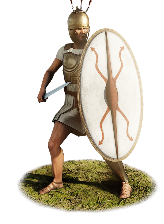
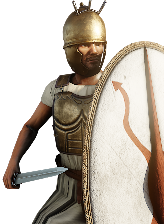
Class: heavy · Category: infantry · Men per unit: 40
Reforms: No longer recruitable after A New Man: Gaius Marius (switched off), Polybian Reform · Becomes a newer unit with Polybian Reform
Description
The principes are positioned in the second line (acies) of the Roman legion. Older than the hastati, they are said to be men in their prime, more experienced and very well equipped. After the skirmishers have weakened the enemy and the hastati have taken the brunt of their initial charge, the well-rested principes enter the fight. They will move into the spaces left between the maniples of the hastati, relieve them, and turn the battle into Rome’s favour. Equipped with magnificent arms, they carry pila as well as Celtic double-edged swords as offensive weapons. Their typical oval scuta (oblong shields), various types of body armour, Montefortino-style helmets, and greaves serve for protection.
Historical background
The principes traditionally made up the second line in the Roman Republican manipular order (10 “speirai” in Pol. VI.21.7; 15 “manipuli” in Liv. VIII.8.6). They were directly positioned behind the intervals left between the manipuli (i.e. companies) of the hastati, who formed the first battle line of the Roman legion. The oddity of their name, which means “the foremost/ the first/ the leaders”, already caused the ancient authors to question its origin. Varro (Ling. Lat. V. 89) asserts that it refers to them fighting with swords, either “from the beginning”, or “[from] the frontline” (“principes qui a principio gladiis”). Publius Flavius Vegetius Renatus (ca. 4th century AD), when describing the “ancient” ways of Roman warfare, actually positions the principes in the first line. This is explained by the fact that they are the most heavily equipped infantry (“gravis armature” Veg. II. 15.3), as well as the oldest and most experienced (“ut in prima exercitati et veteres milites collocentur” III.14.5). Here, Vegetius might have mistaken the principes’ name to mean that they were originally positioned in the first line of battle. This argumentation has been picked up by some modern scholars, who also applied this idea to the supposed pre-manipular position of the principes. Jähns speculates that the names of hastati, principes, and triarii were already in use when the Romans were fighting in a phalanx formation, and principes (like the Greek “promachoi” – “front fighters”) were initially those positioned in the front line, possessing the best arms (Geschichte des Kriegswesens (1880), p. 215). The principes’ change into the second line may have occurred as part of the manipular reform, even though their old name stayed the same. This, however, might have confused annalist authors like Varro. He recognizes the commonly used Roman spear (“hasta”) in “hastati”, even if this unit was counterintuitively armed with pila (Pol. VI.23.8); the “first [men]” or “principes” in the second line; and the “pilum” in the “pilani” – i.e. the triarii, who were actually armed with hastae! (Pol. VI.23.16; see for this discussion: Jähns (1880), p. 222; Kromayer and Veith, Heerwesen und Kriegsführung der Griechen und Römer (1923), p. 278). In their first appearances in Roman history narratives, the principes are regularly paired with the hastati in battle descriptions (see the description of the early hastati; i.e. Liv. VII.23.8 [hastati and principes throwing pila at Gauls]; Liv. VII.34.4 [P. Decius picking the hastati and principes of a legion to distract the Samnites]; or Liv. IX.35.6 [hastati and principes charging with drawn swords]).
While the principes of Polybios’ time (ca. 200-120 BC) were armed in the same manner as the hastati (Pol. VI.23.16), in Livy’s (ca. 59 BC – 17 AD) early account, referring to the Latin War (340-338 BC), they were described as wielding the ‘most magnificent arms’ (Liv. VIII.8.6: “insigni bus maxime armis”). This reinforces the idea that the principes used to be understood as the “main line” of the Roman legion. Similar to the hastati, they carry the scutum (an oval oblong shield), which in the early 3rd century BC still resembled the Gallic flat oval shield (see: Aes Signatum (bronze ingot), dated to 280-250 BC, depicting an oval shield; British Museum Collection nr. 1867,0212.3). In terms of armour, they wear bronze muscle cuirasses, bronze pectoral armour, and linothorakes, which were very common in Latium and Campania in the 4th to early 3rd century BC (see: Burns, The Cultural and Military Significance of the South Italic Warior's Panoply (2006), pp. 307-322). Their helmets are of the popular Montefortino type, decorated with triple-feather crests, as described by Polybios (VI.23.12) and shown on reliefs and preserved in archaeological findings (Galluccio, Glu Elmi di Tipo Montefortino con Decorazioni apicali dal Mare di Sicilia [2023]). Besides the famous pilum (javelin), they are armed with Celtic double-edged swords of the La-Tène type, which were probably the predecessors of the famous gladius hispaniensis. One, dated to the 4th century BC, has been found at San Vittore in Lazio, inscribed with ‘Tr[ebonius] Pomponius, [son of] Gaius, made [m]e in Rome’ (Taylor, Panoply and Identity during the Roman Republic (2020), p. 36). Last but not least, the principes’ left legs are protected by bronze greaves.
Stats
| Rank in roster | ||
|---|---|---|
| Men per unit | 40 | ███······· 30% |
| Attack | 12 | █████····· 48% |
| Charge bonus | 11 | ████······ 38% |
| Defence | 37 | ██████···· 64% |
| · armour | 9 | █████····· 50% |
| · defence skill | 23 | ███████··· 65% |
| · shield | 5 | ██████···· 57% |
| Morale | 11 | ████······ 39% |
| Discipline | Normal | |
| Training | Highly trained | |
| Recruitment cost | 1,373 dn | █········· 12% |
| Upkeep per turn | 503 dn | ██········ 20% |
| Turns to recruit | 3 |
Weapons
| Primary | Secondary | Primary | Secondary | Primary | Secondary | Primary | Secondary | ||||
|---|---|---|---|---|---|---|---|---|---|---|---|
| Attack | 12 | 11 | Charge bonus | 11 | 12 | Type | thrown · blade | melee · blade | Damage | piercing | piercing |
| Projectile | pilum_early | — | Range | 40 | — | Ammunition | 2 | — | Properties | Armour-piercing (counts only half the target's armour) · used just before charging into combat | — |
Defence
| Primary | Secondary | Primary | Secondary | Primary | Secondary | Primary | Secondary | ||||
|---|---|---|---|---|---|---|---|---|---|---|---|
| Total | 37 | — | Armour | 9 | — | Defence skill | 23 | — | Shield | 5 | — |
Condition and terrain
| Hit points | 1 | Ground: scrub / sand / forest / snow | 0 / -1 / 0 / -1 | Charge distance | 30 | Formations | Square |
Technical stats
| Time between blows (primary / secondary) | 2.5 s / 2.5 s | Extra fatigue in hot climates | 1 | Collision mass per man (1.0 is normal) | 1.16 | Spacing between men: close / loose | 1 × 1.2 m / 2 × 2.4 m |
| Default ranks | 5 |
In battle: Can sap · Good stamina
Who can recruit it
A core roster unit for 4 factions, each able to raise it anywhere they hold the right building:
The House of Aemilii · The House of Claudii · The House of Cornelii · The Roman Senate
Exactly what a settlement must have, route by route (2)
| Building | Also requires | Building | Also requires | ||||
|---|---|---|---|---|---|---|---|
| Direct Rule | Tier 2 Military Industrial Complex · Tier 2 Colony · not Polybian Reform | Homeland | Garrison Building or Tier 1 Military Industrial Complex · not Polybian Reform |