
Herakleiote Horophylakes
Class: missile · Category: infantry · Men per unit: 40
Description
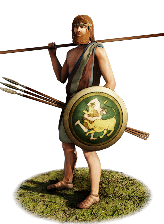
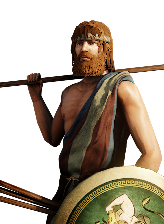
These men are light guards who wander and defend the borders of the chora (territory) of Herakleia on the Black Sea. Clad in a blue chiton or a simple, white exomis, they wear sturdy military boots and headbands to keep their long hair together. Thus, they can move about swiftly, and address potential threats everywhere. As this unit is made up of former ephebes who were picked for bravery, not wealth, some prefer petasos hats as protection against the sun of northern Anatolia instead of the more typical headbands – some can even afford a linen cuirass as body armour. At pace, the horophylakes throw javelins, or stab their enemies with their dory spears. Small, round pelte shields complete their equipment. These young Herakleiotes are well equipped for their tasks and can support the Herakleiote cavalry in exploring, occupying, and safeguarding wide areas of their territory.
Historical background
Horophylakes (literally “border guards”) are first mentioned in Chios in the 5th century BC (IGA 381= Cauer ² 496). The inscription specifies that they were tasked to protect the border stones and punish everyone who (re-)moved them. These rocks were probably connected with territorial claims over areas contested with neighbouring cities or tribes. Even though their meaning may sometimes only have been symbolic, it would have been a very high symbolic meaning. The very existence of a border guard suggests Chios was worried about the integrity of its control over the island and perhaps feared incursions by pirates, brigands, or foreign powers (cf. the description of the Chian Horophylakes). To this end, the horophylakes must have been light infantry, sufficiently agile and fast to patrol along the borders, spot enemies, and intercept intruders.
We do not hear anything about horophylakes for the next three centuries, until they appear in Miletos and neighbouring Herakleia on the Latmos in the early 2nd century BC. The piece of evidence is the text of an isopoliteia treaty between Miletos and its smaller neighbour (I.Milet. 3.150). In the previous half century, the Milesians had slowly expanded in Ionia and encroached on their neighbours one by one. This had led to tensions with Herakleia on the Latmos, situated around 40 km to the east, which were resolved through a grant of isopoliteia ("equal citizenship"). Effectively, this might have meant Miletos took over its smaller neighbour, since its much more numerous citizens were now able to influence political affairs in Herakleia (for context, see: Reger, Sympoliteiai In Hellenistic Asia Minor (2004), pp. 157-158). The treaty document at first records isopoliteia and the names of the involved politicians before explaining all of the details it entailed. Aside from clauses on mutual military support, shared citizenship, offices, and territorial disputes (to be solved by the judgment of an external, democratic city state – perhaps Rhodes or Priene), both parties also agreed to the following:
“If the slaves, who have run away from Miletos to Herakleia and from Herakleia to Miletos, have been brought back to the border guards (horophylakes) in service in the respective cities beginning with the year after Menandros was stephanephoros (at Miletos) (180 BC), [90] those who have undertaken this service (telos) through purchase in Miletos shall report to the prytaneis and those chosen for the protection of the city about the slaves within ten days from the day of the delivery. The latter shall send to the magistrates in Herakleia a letter with a detailed list of the slaves. Those who have undertaken the service of border guards in Herakleia shall report to the magistrates within the same deadline, and similarly the latter shall send a letter to the prytaneis and those chosen for the protection of the city in Miletos. The owners of the slaves in each city shall have the right to have their slaves returned, after they have paid a fee for the restitution of the slave of twelve old Rhodian drachmas and an obol each day for food, within four months at the latest from the time when the letter was written to the magistrates. Otherwise the slaves shall belong to the border guards.” – (.Milet. 3.150, ll. 89-93)
From this, we learn that runaway slaves were a major concern to the Ionian cities, and that catching them was a task assigned to the horophylakes. Apparently, the latter were also rewarded for their job, and could sometimes keep the slaves they had caught. This, as well as the fact that there was cooperation between the border guards of different city states at all, implies that they occupied a respectable position in society. Perhaps, they were made up of former ephebes who had finished their military service. Ephebes were usually the sons of the wealthier citizens or promising youngsters and mainly trained as light infantry during their compulsory two-year service (Kah, Das hellenistische Gymnasion (2004), p. 63; for ephebes in Herakleia Pontike, see: Öztürk, Funerary Inscription [2016]). Having said all this, you, the reader, might wonder what Herakleia on the Latmos, Miletos, Chios, and their horophylakes have to do with our Herakleia on the Black Sea and why they get this unit – right?
First of all, the inscription demonstrates that horophylakes were not exclusive to Chios or Miletos: ‘the border guards (horophylakes) in service in the respective cities’ (l. 89) could well mean that the institution was widespread in Greek Anatolia. Secondly, in 2010, a new inscription was found in Ereğli, the modern successor city to Herakleia. The archaeologists who excavated it quickly realised that it was a funerary stele, which depicts the deceased, Aulus Artemonianos Menios, as well as two wrestling ephebes (Öztürk (2016), p. 100). From the name, it is obvious that the stela has to be dated to the (early) Roman period. It is still very much of use for RIS, since the text praised Artemonianos for three things: he had lived for exactly 100 (!) years, he had served as the commander and instructor of the city's ephebes, and he had been the paraphylax (Öztürk (2016), p. 99). Paraphylakes ("guards of what is around") were very much the same as horophylakes, with similar duties, and are attested across Asia Minor, particularly in the late Hellenistic and early Roman period (Dmitriev, City Government in Hellenistic and Roman Asia Minor (2005), pp. 209–211). Perhaps, the Ionian horophylakes had inspired the creation of paraphylakes across all of Asia Minor, including Herakleia Pontike.
As we have seen, Artemonianios was ephebarch and paraphylax, which further cements the idea that the horopyhlakes were recruited from the ephebes and similarly fought as light infantry. Therefore, the Herakleiote horophylakes in RIS are fast-paced and agile young men armed with javelins and spears. Their panoply consists of light clothes, sturdy boots, the occasional helmet, and some linothorakes, as well as the small, round pelte shield. In battle, they can scout, outflank the enemy, or quickly reinforce troops under pressure. Make sure to keep them away from enemy cavalry, however, or have them operate together with your own horsemen.
Stats
| Rank in roster | ||
|---|---|---|
| Men per unit | 40 | ███······· 30% |
| Attack | 13 | ██████···· 57% |
| Charge bonus | 3 | ██········ 16% |
| Defence | 29 | ████······ 40% |
| · armour | 5 | ████······ 35% |
| · defence skill | 22 | ██████···· 61% |
| · shield | 2 | ███······· 25% |
| Morale | 8 | ██········ 19% |
| Discipline | Normal | |
| Training | Trained | |
| Recruitment cost | 1,234 dn | █········· 8% |
| Upkeep per turn | 452 dn | ██········ 17% |
| Turns to recruit | 3 |
Weapons
| Primary | Secondary | Primary | Secondary | Primary | Secondary | Primary | Secondary | ||||
|---|---|---|---|---|---|---|---|---|---|---|---|
| Attack | 13 | 5 | Charge bonus | 3 | 3 | Type | thrown · archery | melee · blade | Damage | piercing | piercing |
| Projectile | javelin | — | Range | 60 | — | Ammunition | 7 | — | Properties | Thrown | — |
Defence
| Primary | Secondary | Primary | Secondary | Primary | Secondary | Primary | Secondary | ||||
|---|---|---|---|---|---|---|---|---|---|---|---|
| Total | 29 | — | Armour | 5 | — | Defence skill | 22 | — | Shield | 2 | — |
Condition and terrain
| Hit points | 1 | Modifier against mounts | horse +1 · chariot +1 · camel +1 | Ground: scrub / sand / forest / snow | 8 / 0 / 8 / 0 | Charge distance | 30 |
| Formations | Square |
Technical stats
| Time between blows (primary / secondary) | 2.5 s / 2.5 s | Extra fatigue in hot climates | 0 | Collision mass per man (1.0 is normal) | 0.93 | Spacing between men: close / loose | 1 × 2.4 m / 1.8 × 4.32 m |
| Default ranks | 5 |
In battle: Very good stamina
Who can recruit it
A core roster unit for one faction, which can raise it anywhere it holds the right building:
Any faction holding one of the provinces below can field it.
Exactly what a settlement must have, route by route (5)
| Building | Also requires | Building | Also requires | Building | Also requires | Building | Also requires |
|---|---|---|---|---|---|---|---|
| Any settlement | Tier 2 Military Industrial Complex · Herakleiote area of recruitment · Any Government (Dependency, Indirect Rule or Direct Rule) · Tier 2 Colony not built | Indirect Rule | Tier 2 Military Industrial Complex · Tier 1 Colony | Direct Rule | Tier 2 Military Industrial Complex · Tier 1 Colony | Homeland | Tier 2 Military Industrial Complex |
| Any settlement | Tier 2 Military Industrial Complex · Herakleiote area of recruitment · Dependency or Indirect Rule · Tier 1 Colony not built |
Areas of recruitment
| Zone | Provinces | ||||||
|---|---|---|---|---|---|---|---|
| Herakleiote | 0 |