
Neocretan Archers
Class: missile · Category: infantry · Men per unit: 40
Reforms: Unlocked by Second wave of military innovations have arrived!, Ptolemaic Military Reforms, Adoption of the Thorakitai, The Knossian Treaty
Description
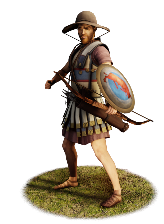
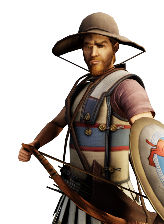
The Neocretans are armoured archers trained in the Cretan style of archery. They were made up of either young Cretans who served as mercenaries abroad, or young Graeco-Macedonians from Poleis and military colonies within Ptolemaic or Seleucid territories who had been trained by Cretan officers. Protected by Pilos helmets, Linothorakes, and small round Pelte shields, they can survive in melee and beat back other light infantry with their curved machaira swords. Their main task, however, is to pepper the enemy with deadly arrows from afar.
Historical background
The so-called Neocretans probably existed in various forms. Some were likely foreigners trained to be as good at archery as the Cretans themselves, others may have been Cretan Neoi, young men who had just completed the Ephebeia (which usually happened at age 18, but could vary from 17 to 20). There are also theories that they were Cretan archers armed in a "new" way, carrying heavier equipment, or the Ephebes of other states such as the Achaian League trained in the way of or even by Cretan archers (see: Du Plessis, Seleucid Army (2022), p. 117, for an overview of current contrasting academic views in Classics and Ancient History). Fischer-Bovet (Army and Society (2014), p. 80), finally, presents the rather trivial explanation that the Neocretans were simply ‘recently hired’, from the Ptolemaic ally Knossos. However, it seems unnecessary to coin a specific term only to express that soldiers had been recruited very recently.
There is only one thing we can rather safely deduce from it all for this unit in RIS. At the battle of Raphia in 218 BC, the Cretan Archers and the Neocretans in the Ptolemaic army are grouped together in one formation (Polyb. V, 65, 7). This strongly suggests that Neocretans were archers and that their equipment cannot have differed much from ‘normal’ Cretan Archers. Polybios mentions elsewhere (V, 36, 4) that roughly a thousand Cretans were stationed in Alexandria – maybe these were the Neocretans? The Seleucid army at Raphia, meanwhile, had 1500 Cretan mercenaries and a thousand Neocretans in their ranks (Polyb. 5.79.10). These were commanded by Zelys of Gortyn, so that we at least have proof for the Cretan commanders of these units – a Philon of Knossos was in charge of the Ptolemaic unit (Polyb. 5.65.7). Later, at the Battle of Magnesia in 190 BC, it is reported for the Seleucid army that it contained 1,000 Neocretans and "[...] one thousand five hundred Carians and Cilicians, armed in the same manner [...]" (Liv. 37.40.12). This may imply that the thousand were either actual Cretans, or the original Neocretans formed at the time of the Raphia campaign by both sides. The one and a half thousand Carians and Cilicians would then represent new recruits into the Neocretan corps. At the end of the day, we can only speculate about the composition and role of the Neocretans, and until new evidence is found, the question will remain to be answered. Finally, Neocretan archers are also mentioned in the Aitolian army (Polyb. V, 3, 1), but in this case it is clear these were actual Cretans from Knossos as Polybios says as much (IV, 55, 5). The Aitolians were in alliance with Knossos during the 210s and had earlier sent their own troops to Crete (Polyb. IV, 53, 6). Polybios must have called them Neocretans because they belonged to the class of Neoi (Head, Armies 2012, 209). They were too young to have wives or children and were thus able to serve abroad.
Little is known about the equipment of the Neocretans, but as mentioned above, some educated guesses are possible. They were obviously armed with Cretan composite bows, and, like other elite units, will have been equipped with Linothorax armour by the wealthy Ptolemaic state. We have some evidence for the remaining gear. The painted stele of Chalkokedes of Lyttos from Demetrias in Thessaly, a Cretan mercenary in Antigonid service, shows him with bow and helmet, while his servant carries a machaira, a rather curious oval shield and two javelins. Unfortunately, the game does not allow us to give the Neocretans javelins and the oval shield seen here is extremely rare – it may in fact be the small Thureos used by the light infantry of the Achaian League in the first two thirds of the 3rd century BC (Plut. Philopoimen 9, 1). The Ptolemaic Neocretans have instead been given small, round Pelte shields: Xenophon (Xen. Anab. 5.2.29-32) says that the Cretans among the 10,000 – the mercenary force he was part of – used round, bronze Peltai (which may just mean bronzed over). It can be seen, e.g., on the stele of Thersagoras of Polyrrhenia in Volos.
Better protected and better trained than normal Greek archers, the Neocretans are a useful addition to any successor army. Just like the real Cretans, they can survive in melee for a while, but it is always better to deploy them with cavalry and infantry. They will fight to defend the pharaoh's land, but they will mainly fight for money.
Stats
| Rank in roster | ||
|---|---|---|
| Men per unit | 40 | ███······· 30% |
| Attack | 10 | ██········ 19% |
| Charge bonus | 3 | ██········ 16% |
| Defence | 24 | ███······· 26% |
| · armour | 7 | ████······ 42% |
| · defence skill | 15 | ██········ 23% |
| · shield | 2 | ███······· 25% |
| Morale | 8 | ██········ 19% |
| Discipline | Normal | |
| Training | Trained | |
| Recruitment cost | 1,591 dn | ██········ 23% |
| Upkeep per turn | 582 dn | ████······ 36% |
| Turns to recruit | 3 |
Weapons
| Primary | Secondary | Primary | Secondary | Primary | Secondary | Primary | Secondary | ||||
|---|---|---|---|---|---|---|---|---|---|---|---|
| Attack | 10 | 7 | Charge bonus | 3 | 6 | Type | missile · archery | melee · blade | Damage | piercing | slashing |
| Projectile | arrow | — | Range | 170 | — | Ammunition | 25 | — |
Defence
| Primary | Secondary | Primary | Secondary | Primary | Secondary | Primary | Secondary | ||||
|---|---|---|---|---|---|---|---|---|---|---|---|
| Total | 24 | — | Armour | 7 | — | Defence skill | 15 | — | Shield | 2 | — |
Condition and terrain
| Hit points | 1 | Ground: scrub / sand / forest / snow | 0 / 0 / 0 / 0 | Charge distance | 30 | Formations | Square |
Technical stats
| Time between blows (primary / secondary) | 2.5 s / 2.5 s | Extra fatigue in hot climates | 0 | Collision mass per man (1.0 is normal) | 0.96 | Spacing between men: close / loose | 1.1 × 2.6 m / 1.98 × 4.68 m |
| Default ranks | 5 |
In battle: Very good stamina
Who can recruit it
A core roster unit for 7 factions, each able to raise it anywhere they hold the right building:
Aetolian League · Lysiad Kingdom · Ptolemaic Empire · Ptolemaic Rebels · Seleucid Empire · Seleucid Rebels · Seleucid Rebels
Any faction holding one of the provinces below can field it.
Exactly what a settlement must have, route by route (11)
Areas of recruitment
| Zone | Provinces | ||||||
|---|---|---|---|---|---|---|---|
| Ptolemaic | 0 |