
Seleucid Indian War Elephants (Heavy)
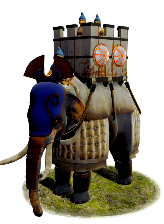
Class: heavy · Category: cavalry · Men per unit: 24
Description
"The elephants followed, trampling on them, tossing them aloft in their trunks, snatching and piercing them with their tusks, and in the end these animals had presented Antiochus with an overwhelming victory […] Antiochus’ Macedonian contingent raised the Paean and gathering round him crowned him "king of glorious victory" with acclamation. Antiochus is said to have wept as he addressed his troops. "Men,” he said, "we owe our lives to these sixteen animals; so let us rather feel shame. For if the strangeness of what they saw had not thrown the enemy into confusion, what should we have been compared with them?” Then he ordered them to decorate the trophy with a carved elephant and nothing else.” (Lucian, Zeuxis, 10-11)
General description
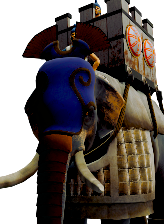
The Indian (Asian) elephant weighs up to 5,5 tons and can be up to 3,5m (11,5ft) tall. They can be identified by their smaller, rounded ears, and only males have tusks. As Polybios (5.84.3-4) describes, "the way in which these animals fight is as follows. With their tusks firmly interlocked they shove with all their might, each trying to force the other to give ground, until the one who proves strongest pushes aside the other's trunk, and then, when he has once made him turn and has him in the flank, he gores him with his tusks as a bull does with his horns.” The elephants would have also carried wooden towers, carrying up to four men, either pikemen, slingers or archers (Polyb., 5.84.2; Livy, 37.40.4; Polyaenus, Stratagems, 8.23.5), but the most important crew member was the Indian driver, known as a mahout, positioned astride the elephant’s neck.
The elephants’ armament in the hellenistic age consisted of a thick rectangular blanket, draped over their back, called a caparison (see the silver phalerae discs at the Hermitage), armour around their legs (see the Myrnia terracotta), plumed frontlets as head protection (Livy, 37.40.4), while some – perhaps the leading elephants – would have worn even more protection (1 Macc, 6.43 mentions one of the elephants having ‘royal armour’). In Caesar’s time, the elephants were known to carry body armour – during his invasion of Britain, he had elephants in scale armour with him (Polyaenus, 8.23.5), while he also had his men trained for facing armoured elephants in Africa (Caesar, BAfr. 72). A first century Roman bed piece (Staatliche Antikensammlung #40) depicts an African elephant with an armoured frontlet like those mentioned by Livy, segmented band armour around the trunk, and scale armour protecting the parts of the body still visible.
Historical background
After Alexander’s death, elephants quickly became adopted into the Hellenistic armies: first by Antigonos, Polyperchon, Eumenes and Cassander; then by Seleukos and Lysimachus, too. They already featured in the first Diadochi engagements, in the battles of Paraitakene and Gaza, but perhaps most effectively at the battle of Ipsos in 301 BC, where Seleukos gathered a force of 400 elephants (for the disparity in numbers according to different sources, see: Bar-Kochva, The Seleucid Army, pp. 76-77) to decisively defeat Antigonos. These elephants were acquired in a peace treaty after his Indian campaign against Chandragupta Maurya, in exchange for his daughter marrying the Indian ruler and the eastern provinces of Gedrosia, Arachosia and India. The Indian text Arthashastra mentions that if the king should seek a peace pact with an enemy, "he should give the man elephants and horses that are sluggish, or energetic ones that have been administered poison.” (Arthasasthra, 12.1.25). This, combined with the aversion of elephants to heat and the dry conditions (ibid. 9.1.45-48) of Syria where they would be stabled by the Seleucids (Strabo, 16.2.10), the logistical difficulties of a campaign – as an elephant daily consumes 120-150 kg of food and up to 225 l of water – and the probability that most, if not all of the supplied herd were bulls (see Bar-Kochva, 79), would explain the diminishing numbers of the Seleucid herd over time. Already in 285 BC, Polyaenus mentions Seleukos fielding only 8 elephants in a battle against Demetrios Poliorketes, and it is possible that by that moment the elephants from Ipsos were no longer alive. The Astronomical Diary No. –273B ‘Rev. 30’- 32’ mentions the satrap of Bactria supplying Antiochos I. with 20 elephants in 275 BC, 16 of them subsequently being used in his battle against the Galatians in 273 BC.
When Ptolemy III invaded Syria during the Third Syrian War (246-241 BC), he also took possession of the Seleucid (Indian) elephants, which, along with the Bactrian rebellion severing the land routes to India, might be the reasons why we do not have sources mentioning Seleucid elephants until the reign of Antiochos III. It is only in the battle against the rebel Molon (Polyb., 5.53.4), that a Seleucid king is again reported to field elephants. These 10 elephants were a significant reduction of the herd, and it took great effort to increase its numbers. At Raphia in 217 BC, Antiochos III was already able to deploy 102 elephants (Polyb., 5.79.13), and after his campaigns in Bactria and India, that number rose to 150 at the battle of Panion (ibid., 16.18-19). However, only 18 years later, this number was reduced again to only 6 elephants at the battle of Thermopylae (Livy, 35.43.6) and 54 at Magnesia (ibid., 37.39.13), where Antiochos assembled his full army.
With the Treaty of Apameia, the Seleucids had to give up all their elephants and were forbidden to use them in future military engagements (Appian, Syr. 38-39; Livy, 38.38; Polyb. 15.18.3). Antiochus IV, however, took an undetermined number of elephants on his Egyptian campaign and thus defied the terms of the treaty (1 Maccabees 1.17). The 42 elephants he displayed at the Daphne parade probably represented his full herd (Polyb., 30.25). The expedition of the regent Lysias into Judea in 162 BC is the last appearance of the Seleucid elephants, as soon afterwards the entire herd was slaughtered by the Roman emissary Gnaeus Octavius (Appian, Syr. 46; Polyb., 31.2.9-11). The Parthian conquest of the East seems to have significantly increased the cost of procuring elephants from India, which is likely the reason why no Indian elephants were mentioned in subsequent Seleucid engagements.
However, in Josephus (Jewish Antiquities) we find that when Ptolemy VI intervened in Syria in 146 BC against Alexander Balas, he took with him his African elephants and used them in the battle at the Oinoparas river (13.17). When Ptolemy Philometor died of his wounds after the battle, Demetrius II massacred the Ptolemaic troops and took possession of those elephants (13.120-121). Later, these elephants were captured by Diodotos Tryphon, who rebelled against Demetrius II and placed the young son of Alexander Balas, Antiochus VI, on the throne in Antioch (13.144; 1 Macc 11.56).
Through the years of facing these beasts of war in battles, Hellenistic generals devised a number of countermeasures to neutralize the elephant threat. At the battle of Gaza in 312 BC, Ptolemy used spiked devices made of iron and connected by chains that prevented the beasts from moving forward, as well as javelin throwers and archers (Diodorus Siculus, 19.83.2, 19.84.1-2). At the siege of Megara, the Megarians daubed a herd of swine with pitch, set fire to it, and let them loose among the elephants, who broke their ranks in confusion and fright. This later caused Antigonos to bring up swine among the elephants, so that they would grow accustomed to them (Polyaenus, 4.6.3). Perseus prepared his horses to the sight of elephants by ordering some wooden elephants to be made, and having a trumpeter sound loud and harsh notes from inside them (Polyaenus, 4.21). The Arthashastra, finally, mentions additional countermeasures: a counterforce of elephants; mechanical devices and carts at the centre of an army (9.2.26); and neutralizing the beasts with frightened herds of cattle, buffaloes and camels carrying bags of dried skin and round pebbles (10.3.22): the pebbles would both produce a noise that would frighten the animals, as well as hurt their feet when they fell on the ground.
Stats
| Rank in roster | ||
|---|---|---|
| Men per unit | 24 | █········· 7% |
| Attack | 6 | █········· 3% |
| Charge bonus | 0 | █········· 0% |
| Defence | 10 | █········· 1% |
| · armour | 9 | █████····· 50% |
| · defence skill | 1 | █········· 0% |
| · shield | 0 | █········· 0% |
| Morale | 13 | ███████··· 70% |
| Discipline | Normal | |
| Training | Trained | |
| Recruitment cost | 5,737 dn | ██████████ 99% |
| Upkeep per turn | 2,100 dn | ██████████ 100% |
| Turns to recruit | 4 |
Weapons
Its secondary attack is the stronger one: 15 against 6.
| Primary | Secondary | Primary | Secondary | Primary | Secondary | Primary | Secondary | ||||
|---|---|---|---|---|---|---|---|---|---|---|---|
| Attack | 6 | 15 | Charge bonus | 0 | 1 | Type | missile · archery | melee · other | Damage | piercing | blunt |
| Projectile | arrow | — | Range | 120 | — | Ammunition | 25 | — | Properties | — | Armour-piercing (counts only half the target's armour) · may throw men into the air · hits an area, not just one man |
Defence
| Primary | Secondary | Primary | Secondary | Primary | Secondary | Primary | Secondary | ||||
|---|---|---|---|---|---|---|---|---|---|---|---|
| Total | 10 | — | Armour | 9 | 20 | Defence skill | 1 | 32 | Shield | 0 | — |
Condition and terrain
| Hit points | 1 · elephant indian 15 | Mount | elephant indian | Ground: scrub / sand / forest / snow | 0 / -1 / 0 / -8 | Charge distance | 60 |
| Formations | Square |
Technical stats
| Time between blows (primary / secondary) | 2.5 s / 2.5 s | Extra fatigue in hot climates | 2 | Spacing between men: close / loose | 7.7 × 9.1 m / 11 × 13 m | Default ranks | 2 |
In battle: Frighten nearby enemy infantry · Animals may run amok
Who can recruit it
A core roster unit for 3 factions, each able to raise it anywhere they hold the right building:
Seleucid Dynasts · Seleucid Empire · Seleucid Satraps
Exactly what a settlement must have, route by route (2)
| Building | Also requires | Building | Also requires | ||||
|---|---|---|---|---|---|---|---|
| Direct Rule | Tier 3 Military Industrial Complex · Elephants · Tier 2 Colony | Homeland | Tier 2 Military Industrial Complex · Elephants |