
Seleucid Cataphracts
Class: heavy · Category: cavalry · Men per unit: 30
Reforms: Unlocked by Military Innovations from the East
Description
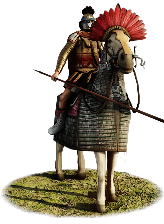
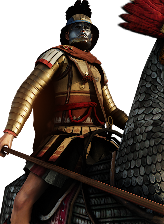
These Seleucid cataphracts are among the most heavily armoured horsemen of the ancient world. Lavishly equipped with full body armour consisting of thick layers of textile reinforced with bronze and steel scales, as well as Boeotian, Konos, or Thracian helmets, some of these men even wear imposing face masks. Seleucid cataphracts confront the enemy with a typical one-handed cavalry lance (xyston). Their charge will cause even the most determined enemy to collapse, and if well-timed might turn a dire situation on the battlefield to your advantage. Due to the enormous weight the rider and horse must carry on themselves, running them all over the battlefield will tire them quicker than other cavalry.
Historical background
During Antiochos III’s expedition to reconquer the eastern satrapies in 210-206 BC, he confronted Parthian cavalry which was characterized by its heavy armour for both rider and horse, as well as its use of a longer cavalry lance, the kontos (Bar Kochva, Judas Maccabaeus (1989), p. 13). These encounters inspired the adoption of cataphracts into the Seleucid army. The first battle which saw the use of Seleucid cataphracts was the Battle of Panion (200 BC) against the Ptolemies. This clearly displayed their effectiveness, as they routed the Ptolemaic cavalry and easily turned the tide of battle decisively in favour of Antiochos. Another example of the successful use of Seleucid cataphracts was the battle of Magnesia (190 BC). There Antiochos, leading his right wing consisting of the Agema and additional regiments of cataphract cavalry, broke through the Roman left wing, consisting of both infantry and cavalry (Du Plessis (2022) p. 99).
While Cataphracts are often thought of as being similar to late medieval knights, armoured from head to toe, they were not originally equipped in that fashion. It is important to note that the Greek word ‘kataphraktos’ literally meant ‘covered up, enclosed’, referring to various types of heavily armoured soldiers, not restricted to cavalry like this unit. Our best sense of what the armour of the Seleucid cataphract might have looked like is a full suit of armour, excavated by the French archaeological mission in Aï-Khanoum (Bulletin de l’ėcole francaise d’ Extreme-Oriente 68 (1980) pp. 60-63). The armour of Aï-Khanoum is made up of a combination of scale and lamellar pieces. It is likely that Hellenistic forces further to the west included more ‘Greek’ armour pieces in their cataphracts’ equipment, such as the metal cuirass, as represented in this Seleucid unit (Sekunda, Seleucid Army (1994) p. 21). In addition, a relief from the temple of Athena at Pergamon shows a Seleucid rider from the Battle of Magnesia, whose spoils were kept in the temple. It displays a rider and horse partially covered in lamellar armour, offering further support to the representation of this unit in RIS (Bugh, Cavalry (2020) p. 73).
Cataphracts were an imposing sight on the battlefield, but not invincible. If they got stuck in melee, an attack on their flanks could prove fatal when infantry attacked body parts of the riders and horses that were unprotected by armour. The cataphracts could also be knocked off their horses (especially since ancient cavalry did not use stirrups), or have their lance grabbed from them, resulting in them being most effective if accompanied by lighter cavalry (Bar-Kochva (1989), p. 13). According to Plutarch, as late as the Third Mithridatic War (73-63 BC), Roman soldiers were instructed to hit cataphracts in the knee and thigh, as it was the only place where they were vulnerable (Plut. Luc 28.2.4).
The great weight of the armoured rider, as well as the horses’ armour, meant that only a few breeds of horses could be used as cataphract mounts. The Seleucids and later Parthians made frequent use of Nisean horses, a breed praised by Strabo as great cavalry horses (Str. 11.13.7) and already employed by the Achaemenid empire.
Stats
| Rank in roster | ||
|---|---|---|
| Men per unit | 30 | █········· 8% |
| Attack | 14 | ███████··· 65% |
| Charge bonus | 40 | ██████████ 99% |
| Defence | 36 | ██████···· 61% |
| · armour | 20 | ██████████ 99% |
| · defence skill | 16 | ███······· 28% |
| · shield | 0 | █········· 0% |
| Morale | 15 | █████████· 91% |
| Discipline | Normal | |
| Training | Highly trained | |
| Recruitment cost | 3,330 dn | █████████· 88% |
| Upkeep per turn | 1,341 dn | ██████████ 97% |
| Turns to recruit | 4 |
Weapons
| Primary | Secondary | Primary | Secondary | Primary | Secondary | Primary | Secondary | ||||
|---|---|---|---|---|---|---|---|---|---|---|---|
| Attack | 14 | 14 | Charge bonus | 40 | 30 | Type | melee · blade | melee · blade | Damage | piercing | slashing |
Defence
| Primary | Secondary | Primary | Secondary | Primary | Secondary | Primary | Secondary | ||||
|---|---|---|---|---|---|---|---|---|---|---|---|
| Total | 36 | — | Armour | 20 | — | Defence skill | 16 | — | Shield | 0 | — |
Condition and terrain
| Hit points | 1 | Mount | horse cataphract | Ground: scrub / sand / forest / snow | -7 / -1 / -8 / -1 | Charge distance | 40 |
| Formations | Square · Wedge |
Technical stats
| Time between blows (primary / secondary) | 2.5 s / 2.5 s | Extra fatigue in hot climates | 5 | Spacing between men: close / loose | 2 × 4.8 m / 3 × 7.2 m | Default ranks | 5 |
In battle: Good stamina · Powerful charge
Who can recruit it
A core roster unit for 3 factions, each able to raise it anywhere they hold the right building:
Seleucid Dynasts · Seleucid Empire · Seleucid Satraps
Exactly what a settlement must have, route by route (2)
| Building | Also requires | Building | Also requires | ||||
|---|---|---|---|---|---|---|---|
| Direct Rule | Tier 3 Military Industrial Complex · Military Innovations from the East · Tier 2 Colony · Requires resource horses or horses supplied factionwide | Homeland | Tier 2 Military Industrial Complex · Military Innovations from the East |