
Akarnanian Hoplites
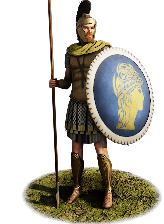
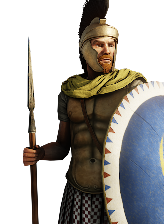
Class: spearmen · Category: infantry · Men per unit: 40
Description
In the rugged terrain of Akarnania, where the landscape is defined by a mix of steep mountains occupied by transhumant cattle herders, fertile valleys filled with poleis, and rough coasts populated by hardy seafarers, the Akarnanian hoplites are a force that represents the unity of those various tribes in one koinon. Though the military of the koinon was known for its skilled light troops from the highlands, adept in using the landscape to their advantage, the hoplites nonetheless fulfilled an important role to meet their mainland neighbours in pitched battle. Renowned for their versatility, they not only defended Akarnania but also served as valued allies in Macedonian (Pol. 2.65.3, Pol. 4.63) and Epeirote (Dion.Hal. 20.1.5) armies, their skills a testament to the diverse demands of their home. Protected by linothorakes and a variety of bronze helmets, their weaponry consists of aspis shields, dory spears, and xiphos swords. In a land where open combat was often superseded by skirmishes and ambushes, these hoplites adapted, blending heavy infantry tactics with the agility required by their homeland's topography.
Historical background
The Akarnanians were a Greek tribe located in the western part of central Greece, their territory stretching along the Ionian coast between the mouth of the Achelous to the south and the Ambrakian gulf to the north. The Achelous was a defining element of the Akarnanian landscape, springing forth from the Pindos, flowing through the rugged lands of the Dolopians, Agraians, and Amphilochians in the Thyamos mountains, down into the Akarnanian valley, past their main polis of Stratos, creating a lush and fertile plain. From there it runs further south, pouring into the sea near Oiniadai, the main port city of the Akarnanians, where it creates a marshland that is inaccessible by armies during the winter and where it forms small islands across from Oiniadai from the dirt, sand, and debris it carries along in its waters (Thuk. II.102). Though it borders on the sea, the access to safe havens for ports and ships was complicated due to the rough and steep western coast creating large lagunes. Additionally, seafaring in the area was made difficult by the hegemony of Corinthian colonies like Anaktorion, Leukas, and Sollion in the north and Astakos in the south, which already occupied the most ideal spots for ports (Beck, Polis und Koinon (1997), p. 31). The remaining port of Oiniadai was then often contested by other powers, first repopulated by Athens which settled Messenian exiles there (Beck (1997), p. 32), then later standing on the Peloponnesian side against the rest of Akarnania during the Peloponnesian War (431–404 BC, Thuk. III.7.4; III.94.1) until it was conquered by Demosthenes (IV.77.2), and later occupied by the Aitolians in the course of anti-Macedonian rebellions in the 4th century BC (Mackil, Creating a Common Polity (2013), p. 92).
Shortly before the Peloponnesian War, after the Corinthian colony Ambrakia captured the Amphilochian polis Argos (called ‘Argos Amphilochia’), the Akarnanians took in the Amphilochians, attacked and recaptured Argos together with the Athenians and Amphilochians, and resettled the city with the latter (Thuk. II.68.5-8). It is in the course of these events that the Akarnanian koinon was created as they integrated the Amphilochians as a member of their league (Beck (1997), p. 34). Since Athens was mainly targeting Corinthian possessions during the starting years of the Peloponnesian War, a lot of the fighting took place close to or in Akarnania. The League gained possession of Sollion and Astakos in the first year of the war (Thuk. II.30), forced a Peloponnesian-Ambrakiote-Epeirote coalition army at Stratos back to Oiniadai (II.80–82), and the whole levy of the Akarnanians (except Oiniadai) was called to support Athens in attacking Leukas (III.94.1). After Demosthenes’ siege of Leukas was called off (against the wishes of the Akarnanians) he was persuaded by the Messenians to attack the Aitolians instead (III.95), but failed miserably (III.98), and returned to fight in Akarnania. At the battles of Olpai (III.108) and the following Idomene (III.112), the Athenian-Akarnanian alliance absolutely crushed the Ambrakiotes, which Thukydides called “the greatest disaster that befell any one Hellenic city in an equal number of days during the war” (III.113.6). Not wanting Athens to gain a permanent foothold near their territory, the Akarnanians spared the Ambrakiotes, and offered a ceasefire and defensive alliance agreement (III.114.3). Overall, the Akarnanian League had massively profited from the war, eventually gaining Koronta, Anaktorion, and even Oiniadai as members of the League (Beck (1997), p. 35).
In 389 BC, even after the Peloponnesian War, the Akarnanians were still allied to Athens, trying to push back Achaian influence, which had spread to the opposite side of the Corinthian gulf, and the League thus besieged the Achaian city of Kalydon (Mackil (2013), p. 62). The Achaians were supported by their Spartan allies who sent Agesilaos with two regiments and a corresponding number of allies to invade Akarnania (Xen. Hell. IV.6.4). As the Akarnanians retreated into the cities, Agesilaos’ pillaging remained without consequence for a few days, until the Akarnanians seemingly underestimated his marching speed and brought their cattle down into the valley for grazing (IV.6.5-6). There, Agesilaos suddenly fell upon them, captured the cattle and though he was ambushed on his way back, he managed to quickly rout the Akarnanian hoplites and peltasts in the mountains with the help of the nimble younger Spartan classes and cavalry (IV.6.8-11). A year later, threatened by another Spartan campaign, the Akarnanians quickly made peace with Sparta and the Achaians (IV.7.1).
During the rise of the Macedonian kingdom under Philip II and Alexander III, the Akarnanian League showed pro-Macedonian sentiment, staying neutral at Chaironeia, and joining the Corinthian League (Beck (1997), pp. 38-39). This increasingly brought them into conflict with their eastern neighbours, the Aitolian League across the Achelous, which often functioned as a kind of soft border between the two leagues (Strauch, Akarnanes, Akarnania in: DNP). After the death of Alexander the Great in 323 BC, the Lamian War broke out as an alliance of Athenians, Aitolians, Thessalians, and Greek mercenaries besieged the Macedonian regent Antipater in Lamia (Diod. Sic. XVIII.12.4). Though Antipater won in the end, the Aitolians, who left the alliance early to attend to their own matters, were left unconquered (XVIII.24.1) and even unpunished (XVIII.25.4), taking up the war again on the side of Perdikkas, raiding Macedonian Thessaly with a force of 12,400 soldiers and adding even more allies to their numbers (XVIII.38.1). Polyperchon, the new regent of Macedonia, used the hostility of the Akarnanians against the Aitolians to distract them from their Thessalian campaign, and crushed their army in battle, recovering Thessaly (XVIII.38.4). This rivalry between the two koina is used again and again in the Greek politics of Macedonian rulers, like Kassandros allying himself to the Akarnanians against Antigonos Monophthalmos, whose allies were the Aitolians (Diod. Sic. XIX.67, 68, 74, 88; IG 2IX 1,2, 462). For a short while, Akarnania was allied to the Epeirote Kingdom under Pyrrhos, who added their troops to his invasion army headed for Italy (Plut. Pyrr. 6; Paus. I.9.7; Dion. Hal. XX.1.2-5). During this time, Leukas was added to the koinon.
Despite a short alliance agreement between the Akarnanians and Aitolians (probably in 262/1 BC: IG 2IX 1,1,3 A; Strauch, Akarnania, in: DNP), the Aitolians managed to convince Alexander II of Epeiros, son of Pyrrhos, to partition Akarnania between his kingdom and the Aitolian koinon (c. 253/2 BC; Pol. IX.34.6, Strauch, Akarnania, in: DNP). After the decline of the Epeirote kingdom, the Akarnanian League once more attached itself to the Macedonians, supporting Antigonos Doson 222 BC at Sellasia (Pol. II.65.4; Plut. Cleom. 28) and reinforcing Philip V in his Aitolian campaign during the Social War in 219 BC (Pol. IV.63.4; V.13.1; Strauch, Akarnania, in: DNP). Though this brought them into conflict with Rome during the 1st and 2nd Macedonian War, the conquest of Leukas in 197 BC forced Akarnania into an alliance with Rome, from whom they received back Oiniadai but not Stratos (Strauch, Akarnania, in: DNP). The Akarnanian koinon lost its political significance under Roman rule, devastated by Caesar’s civil war, disbanded by Augustus, and integrated first into the province Achaia and later, during the 2nd century AD, into the province Epirus.
The classical Akarnanians were excellent fighters and long held on to the old custom of carrying weapons around with them (like the Ozolian Lokrians or Aitolians (Thuk. 1.5.3)). Akarnanian hoplites are occasionally mentioned in the sources though they are far from ubiquitous, as the Akarnanians were rather known for their akontistai (Xen Hell. IV.6.8; Thuk. VII.60; 67), peltasts (Xen. Hell. IV.6.7; Beck (1997), p. 35), and slingers (Thuk. II.81.8). Demosthenes summons a contingent of 1,000 hoplites to Naupaktos to help it in its siege against Aitolia (Diod. Sic. XII.60.3), a number of them positioned themselves on the ridge of a mountain during the invasion of Agesilaois (Xen. Hell. VI.2.37), and the alliance agreement between Akarnania and Aitolia agreed to an auxiliary contingent of either 1,000 infantry (pezoi) and 100 cavalry in a conflict, or 3,000 soldiers, a third consisting of hoplites, in an emergency. These would have been paid 12 obols in a full panoply (πανοπλίαν) and only 9 obols when not fully equipped (ἡ̣μιθωράκιον - “half-armoured”, probably referring to peltasts and thureophoroi) (IG 2IX 1,2, 46). We have decided to depict the fully equipped hoplites in RIS, armed with bronze and iron muscle cuirasses, Attic helmets (as shown on a coin of the League: BMC 21, SNG Copenhagen 423-424) and Graeco-Illyrian helmets, a number of which have been found in the territories of Epeiros, Illyria and Macedonia (Teržan, Helme als Trophäe bei den Skythen (2016), p. 523). Dory spears, short swords, aspides, and greaves were the standard elements of the full hoplite panoply and are thus also included. Though Akarnanian hoplites on occasion threw their dories (Xen. Hell. IV.6.11), this was not standard practice among hoplites and has therefore not been represented.
Stats
| Rank in roster | ||
|---|---|---|
| Men per unit | 40 | ███······· 30% |
| Attack | 9 | █········· 13% |
| Charge bonus | 12 | ████······ 42% |
| Defence | 38 | ███████··· 68% |
| · armour | 11 | ██████···· 64% |
| · defence skill | 22 | ██████···· 61% |
| · shield | 5 | ██████···· 57% |
| Morale | 10 | ███······· 29% |
| Discipline | Low | |
| Training | Highly trained | |
| Recruitment cost | 1,619 dn | ███······· 25% |
| Upkeep per turn | 593 dn | ████······ 39% |
| Turns to recruit | 2 |
Weapons
| Primary | Secondary | Primary | Secondary | Primary | Secondary | Primary | Secondary | ||||
|---|---|---|---|---|---|---|---|---|---|---|---|
| Attack | 9 | — | Charge bonus | 12 | — | Type | melee · blade | — | Damage | piercing | — |
| Properties | Light spear (braced against cavalry charges from the front) · +8 attack against cavalry | — |
Defence
| Primary | Secondary | Primary | Secondary | Primary | Secondary | Primary | Secondary | ||||
|---|---|---|---|---|---|---|---|---|---|---|---|
| Total | 38 | — | Armour | 11 | — | Defence skill | 22 | — | Shield | 5 | — |
Condition and terrain
| Hit points | 1 | Ground: scrub / sand / forest / snow | -1 / -1 / -4 / -1 | Charge distance | 30 | Formations | Square |
Technical stats
| Time between blows (primary / secondary) | 2.5 s / — | Extra fatigue in hot climates | 3 | Collision mass per man (1.0 is normal) | 1.28 | Spacing between men: close / loose | 1 × 1.05 m / 2 × 2.4 m |
| Default ranks | 5 |
In battle: Can sap · Very good stamina
Who can recruit it
A core roster unit for one faction, which can raise it anywhere it holds the right building:
Any faction holding one of the provinces below can field it.
Exactly what a settlement must have, route by route (4)
| Building | Also requires | Building | Also requires | Building | Also requires | Building | Also requires |
|---|---|---|---|---|---|---|---|
| Any settlement | Garrison Building or Tier 1 Military Industrial Complex · Akarnanian area of recruitment · Any Government (Dependency, Indirect Rule or Direct Rule) · Tier 2 Colony not built | Indirect Rule | Garrison Building or Tier 1 Military Industrial Complex · Tier 1 Colony | Direct Rule | Garrison Building or Tier 1 Military Industrial Complex · Tier 1 Colony | Homeland | Garrison Building or Tier 1 Military Industrial Complex |
Areas of recruitment
| Zone | Provinces | ||||||
|---|---|---|---|---|---|---|---|
| Akarnanian | 0 |