
Ankonitan Hoplites
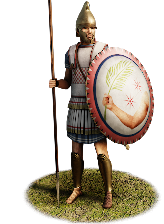
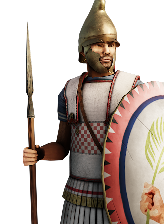
Class: spearmen · Category: infantry · Men per unit: 40
Description
Ankonitan Hoplites are the heavy infantry made up of the citizenry of Ankon, a Syracusan colony on the Italian Adriatic coast. Their equipment consists of a mix of Hellenistic and local arms. These include Pilos, Attic, and Celtic Montefortino helmets, linothorakes, greaves, and aspides for protection, as well as dory spears, javelins, and xiphoi (straight bladed, double-edged swords) as offensive weapons. As these hoplites are only a levy of a relatively small trading polis, they rarely have to be called up for action. Their city prefers to develop good commercial relations with its more bellicose Umbrian and Picentine neighbours rather than attempting to challenge them in battle. For this reason, this relatively untrained levy may be good enough for defensive purposes, but will not be able to hold the line against more elite and professional units.
Historical background
Ankon was a city on the Adriatic coast, separated from Sena Gallica by the river Esino (Strab 5.4.10). The foundation of the city is still somewhat of a mystery due to the varying information in ancient sources. According to Strabo, it was a colony of exiles who fled from the Syracusan tyrant Dionysios I (ca. 430 BC - 367 BC) around 387 BC. A potential source for this information, however, could have been Philistos, a temporarily exiled general of Dionysios I, who nonetheless wrote a positive biography of the tyrant. This led to the theory that he was among the exiles settled at Ankon, making it more of a peripheral military and commercial base of Dionysios’ so-called “Adriatic Empire” and not an independent foundation (Wilkes; Fischer-Hansen (2004), p. 327; Woodhead, The “Adriatic Empire” of Dionysius I of Syracuse (1970), pp. 503-512; Finley, A History of Sicily (1968), p. 504). No matter the reason for the Greeks settling in these lands, the continuous existence of a Bronze Age settlement of the indigenous tribes in the area (Umbrians? Picentines?) and the relatively small size of the pre-Roman Greek city of Ankon imply a self-contained community of Greeks in foreign lands that did not attempt to seek conflict with the local Italic peoples or expand its influence (Lomas, Beyond Magna Graecia (2006), p. 177). However, according to Pseudo-Skylax, Ankon could already be called a Greek “polis” in the 4th century BC (Pseudo-Skylax 16). The city was built on a cape, which bends towards the north to form a harbour, looking like an elbow, which also became the favoured symbol of the Ankonitans (Strab. 5.4.2). The cult of Diomedes has a long history in the Adriatic, and Syracusan influence can be observed in the dedication of an Ankonitan sanctuary to that Homeric hero (Wilkes; Fischer-Hansen, The Adriatic (2004), p. 323). On the slopes and in the valley of the Monte Conero, the land abounded in wine and wheat, and to Ankon was also ascribed the invention of bread made from spelt (Plin. NH. 18.27).
Ankon’s significance grew, along with other urban centres in the area (like Asculum, Pisaurum, and Potentia) after the Second Punic War. Especially Ankon was developing monumental public architecture and a “Hellenizing” culture, reflecting its increased involvement in the commercial and military activities of the Romans in the Adriatic Sea and Illyria (Colivicchi, From Sea to Sea (2024), p. 290). Thus, filling the large gap of ports between the Po valley and Southern Italy, it acted as the central base for the two Roman Adriatic defence fleets of L. Cornelius (Ankon to Tarentum) and C. Furius (Ankon to Aquileia) during the Histrian War in 179 BC (Liv. 41.1). Eventually, thanks to its role as the major port of the region and as the commercial centre for Italian-Illyrian trade, Traian developed the port and canals of the city, for which he was honoured with an arch that can still be visited today (Hülsen, in: RE Vol. I, 2 (1894), p. 2115).
Before the Roman period, Ankon barely had any military capabilities. Nonetheless, its citizenry, like that of any Greek polis, would have been armed when the need arose to defend the city against the local Italic tribes living in its chora and direct neighbourhood. Ankonitan Hoplites are protected by pilos helmets, depicted as a hat on an amber bow of a fibula showing Aphrodite with her lover Adonis (Metropolitan Museum, c. 500 BC: Bonfante, Mother and children (2013), p. 433), Attic helmets, or Celtic Montefortino helmets, which were found extensively at Montefortino in the modern district of Ancona, occupied in antiquity by the Celtic Senones (Connolly, Greece and Rome at War (1991), p. 120; Paddock, The Bronze Italian Helmet Vol. 2, Roman helmets (1993), p. 570: Montefortino helmet with provenance in Ancona [Table 8, Musée du Louvre 1122 MNC, 1030]). The spear and aspis shield as well as the linothorax were standard elements of a hoplite’s panoply. Last but not least, the javelin was an important weapon in Italic warfare during the 4th and 3rd centuries BC (Lumsden, Ante Bella Punica (2016), p. 111), and remains of pilum-like javelins were found in Issa, another Syracusan foundation (Ugarković, On funerary rites of Hellenistic Issa (2017), pp. 150-155).
Stats
| Rank in roster | ||
|---|---|---|
| Men per unit | 40 | ███······· 30% |
| Attack | 14 | ███████··· 65% |
| Charge bonus | 11 | ████······ 38% |
| Defence | 41 | ████████·· 76% |
| · armour | 10 | █████····· 54% |
| · defence skill | 26 | ████████·· 78% |
| · shield | 5 | ██████···· 57% |
| Morale | 10 | ███······· 29% |
| Discipline | Low | |
| Training | Highly trained | |
| Recruitment cost | 1,679 dn | ███······· 31% |
| Upkeep per turn | 615 dn | █████····· 46% |
| Turns to recruit | 2 |
Weapons
| Primary | Secondary | Primary | Secondary | Primary | Secondary | Primary | Secondary | ||||
|---|---|---|---|---|---|---|---|---|---|---|---|
| Attack | 14 | 9 | Charge bonus | 11 | 13 | Type | thrown · blade | melee · blade | Damage | piercing | piercing |
| Projectile | javelin | — | Range | 50 | — | Ammunition | 2 | — | Properties | Used just before charging into combat | Light spear (braced against cavalry charges from the front) · +8 attack against cavalry |
Defence
| Primary | Secondary | Primary | Secondary | Primary | Secondary | Primary | Secondary | ||||
|---|---|---|---|---|---|---|---|---|---|---|---|
| Total | 41 | — | Armour | 10 | — | Defence skill | 26 | — | Shield | 5 | — |
Condition and terrain
| Hit points | 1 | Ground: scrub / sand / forest / snow | -1 / -1 / -4 / -1 | Charge distance | 30 | Formations | Square |
Technical stats
| Time between blows (primary / secondary) | 2.5 s / 2.5 s | Extra fatigue in hot climates | 1 | Collision mass per man (1.0 is normal) | 1.12 | Spacing between men: close / loose | 1 × 1.05 m / 2 × 2.4 m |
| Default ranks | 5 |
In battle: Can sap · Very good stamina
Who can recruit it
No faction has this on its core roster: it can be raised only in the provinces below.
Any faction holding one of the provinces below can field it.
Exactly what a settlement must have, route by route (1)
| Building | Also requires | ||||||
|---|---|---|---|---|---|---|---|
| Any settlement | Garrison Building or Tier 1 Military Industrial Complex · Ankonitan area of recruitment · Any Government (Dependency, Indirect Rule or Direct Rule) · Tier 2 Colony not built |
Areas of recruitment
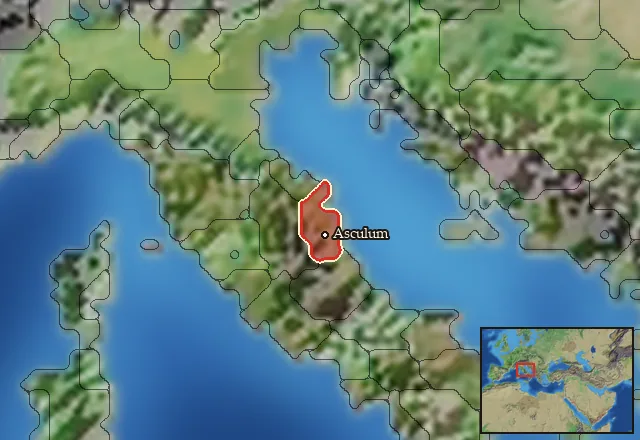
| Zone | Provinces | ||||||
|---|---|---|---|---|---|---|---|
| Ankonitan | 1 |