
Bosporan Archers
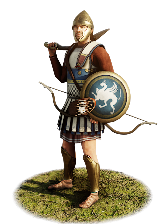
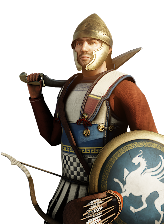
Class: missile · Category: infantry · Men per unit: 40
Description
The bows of Artemis are ready to defend the Greek cities of the Kimmerian Bosporos. While the Hellenes have already used composite bows for centuries, the Bosporans have taken a lesson or two from the Scythians to improve their archery. Aside from gorytos and bow, these soldiers carry small round pelte shields and curved machaira swords into battle, allowing them to fend off lightly equipped infantry in melee. Shiny bronze greaves protect their legs, and some have cladded themselves in the ever-reliable linothorakes, cuirasses made out of layers of clothes. Underneath, they are wearing typically Greek chitones with long sleeves, and chlamydes. Helmets round off their panoply: (crested or plumed) Chalcidian and pilos types are preferred, with some being made of iron to better resist blows against the head and deflect enemy missiles. All in all, these well-trained warriors are impressively armed archers, who are an asset to any Bosporan commander.
Historical background
Archery was widespread in the Greek world ever since at least the Mid-Bronze Age. Homer most likely already described composite bows, made up of different materials to make the weapon more efficient (Drews, The Coming of the Greeks (2018), p. 168). Usually, the base was made of hard wood before one layer of horn was added on each side – as suggested by Homer for the most famous bow in history, that of Odysseus (Hom. Od. 21.388-430; Landels, Engineering in the Ancient World (2000), p. 100). Yet, there was a common prejudice against archers as being cowards, which probably played a part in demoting bowmen to a minor role in many Greek armies from the Archaic to Hellenistic periods (Spence, Historical Dictionary of Ancient Greek Warfare (2002), p. 59). This was clearly the case in Athens, for instance, where fallen archers are only mentioned on monuments as an afterthought after the lists of fallen hoplites (IG I² 79, 929; Connor, Early Greek land warfare (2004), p. 33). Some regions developed an emphasis on archery, however. Chief among these was Crete, as is well known from Cretan archers prominently starring on battlefields from Italy to Egypt (Morrow, Plato's Cretan City (2022), p. 26). The Cretans used heavier arrows and stronger bows for greater penetration and less range, while Scythians constructed different composite bows with unique double convex shapes that shot very light arrows which could fly fast and far, probably over 200m (Lee, Warfare in the Classical Age (2006), p. 489; French/Grayson/O'Brien, Traditional Archery (2007), p. 10). In the Bosporan Kingdom on the northern shores of the Black Sea, these traditions would all come together.
After the establishment of a ruling dynasty at the Kimmerian Bosporos in the early 5th century BC, the ‘tyrants’ initially relied on Thracian mercenaries and a small citizen force of hoplites (Mielczarek, Army of the Bosporan Kingdom (1999), pp. 22–23, 47; Diod. 20.22.4). This changed considerably in the course of the 4th century, when Leukon I conquered the thriving Milesian colony Theodosia near Pantikapaion and the kingdom of the Sindike to the east of Phanagoreia (Dem. 20 (Against Leptines).33, CIRB 1111, CIRB 6, CIRB 6a, CIRB 8). As a limestone figure of a warrior now in the Kerch Archaeological Museum shows, the Sindians primarily fought as archers (Medvedeva/Musin, The Imperial Archaeological Commission (1859–1917) (2019), p. 477). Meanwhile, the contemporaneous Kul-Oba vase, arguably made in a Bosporan workshop for Scythian allies, depicts the famous Scythian archers with their typical caps (Gajkudevič (1971), p. 145, fig. 11). These left an impact on the Greek soldiers of the royal army as well: bows and and gorytoi were used ever more often, and buried even in Greek graves, which usually did not contain weapons (Mielczarek (1999), p. 48). It demonstrates that these items were seen as valuable possessions, and archers were rated much more highly than in places like Athens. In fact, Scythian and Greek equipment had been buried together since the earliest days of the colonies, and adding bows was only the latest step (Mielczarek (1999), p. 50).
From the 2nd century BC onwards, deceased Bosporan Greeks even began to be portrayed as bowmen on their grave stones, something otherwise only known from Crete (Sekunda, Army of Pyrrhus of Epirus (2019), see illustrations). The finest example is a stele of a warrior from Phanagoreia, which is now housed in the Pushkin Museum of Fine Arts in Moscow (Mielczarek (1999), pl. IX). The fallen soldier wears a chlamys over a long-sleeved chiton as well as gorytos and bow. Perhaps it is a sign that at this point, in roughly the mid-2nd century BC, specific archer units were formed that had received extra training, and who performed much better than the usual militia bowmen. Therefore, we have added Chalcidian and iron pilos helmets for better protection. A Chalcidian helmet appears in the 4th century kurgan of Kurdzhips on the Kuban (Rabinovich, Shlemy skifskogo perioda (1941), p. 144) and one was found together with Scythian arrow-heads and a sword in the Kukuvatskii kurgan in Crimea (id., 124-143). Meanwhile, iron pilos helmets were widespread from the end of the 4th century BC (Mielczarek (1999), p. 51-52). Since the man on the stela from Phanagoreia wears no helmet, the Bosporan archers are diversely armed, some without headgear, others with Chalcidian helmets, and yet others with the extra stable iron pilos. Bronze greaves, regularly found around Pantikapaion (Mielczarek (1999), p. 53-54), safeguard the legs, while the small pelte shields can be moved around to deflect missiles. If the bowmen are forced into melee, they use the bent machaira, the most common type of sword excavated in the area of the Bosporan Kingdom (Mielczarek (1999), p. 51-52). These also correspond to the Scythian sword found in the Kukuvatskii kurgan. Finally, some of the archers have been given linothorakes, to reflect that they might hail from wealthier strata of Bosporan society, whose representatives could afford body armour.
Stats
| Rank in roster | ||
|---|---|---|
| Men per unit | 40 | ███······· 30% |
| Attack | 11 | ███······· 34% |
| Charge bonus | 4 | ██········ 21% |
| Defence | 23 | ███······· 25% |
| · armour | 6 | ████······ 38% |
| · defence skill | 15 | ██········ 24% |
| · shield | 2 | ███······· 25% |
| Morale | 8 | ██········ 19% |
| Discipline | Normal | |
| Training | Trained | |
| Recruitment cost | 1,679 dn | ███······· 31% |
| Upkeep per turn | 615 dn | █████····· 46% |
| Turns to recruit | 3 |
Weapons
| Primary | Secondary | Primary | Secondary | Primary | Secondary | Primary | Secondary | ||||
|---|---|---|---|---|---|---|---|---|---|---|---|
| Attack | 11 | 7 | Charge bonus | 4 | 6 | Type | missile · archery | melee · blade | Damage | piercing | slashing |
| Projectile | arrow | — | Range | 170 | — | Ammunition | 30 | — |
Defence
| Primary | Secondary | Primary | Secondary | Primary | Secondary | Primary | Secondary | ||||
|---|---|---|---|---|---|---|---|---|---|---|---|
| Total | 23 | — | Armour | 6 | — | Defence skill | 15 | — | Shield | 2 | — |
Condition and terrain
| Hit points | 1 | Ground: scrub / sand / forest / snow | 0 / 0 / 0 / 0 | Charge distance | 30 | Formations | Square |
Technical stats
| Time between blows (primary / secondary) | 2.5 s / 2.5 s | Extra fatigue in hot climates | 0 | Collision mass per man (1.0 is normal) | 0.94 | Spacing between men: close / loose | 1.2 × 2.8 m / 2.16 × 5.04 m |
| Default ranks | 5 |
In battle: Can hide in long grass · Very good stamina
Who can recruit it
A core roster unit for one faction, which can raise it anywhere it holds the right building:
Any faction holding one of the provinces below can field it.
Exactly what a settlement must have, route by route (5)
| Building | Also requires | Building | Also requires | Building | Also requires | Building | Also requires |
|---|---|---|---|---|---|---|---|
| Any settlement | Tier 2 Military Industrial Complex · Bosporan area of recruitment · Any Government (Dependency, Indirect Rule or Direct Rule) · Tier 2 Colony not built | Indirect Rule | Tier 2 Military Industrial Complex · Tier 1 Colony | Direct Rule | Tier 2 Military Industrial Complex · Tier 1 Colony | Homeland | Tier 2 Military Industrial Complex |
| Any settlement | Tier 2 Military Industrial Complex · Bosporan area of recruitment · Dependency or Indirect Rule · Tier 1 Colony not built |
Areas of recruitment
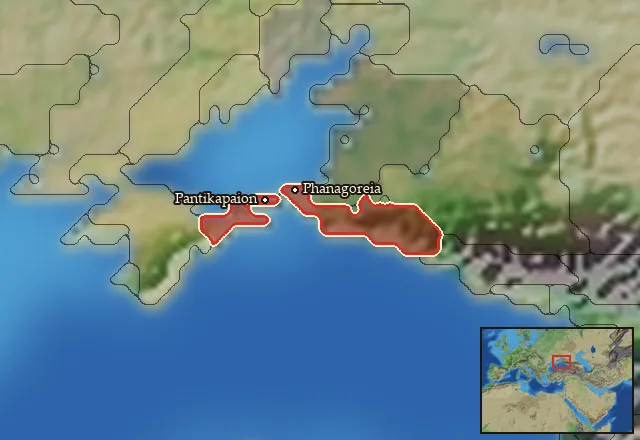
| Zone | Provinces | ||||||
|---|---|---|---|---|---|---|---|
| Bosporan | 2 |