
Bosporan Thureophoroi
Class: spearmen · Category: infantry · Men per unit: 40
Description
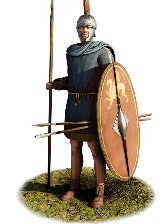
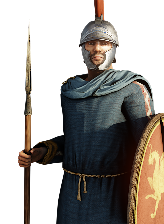
These foot soldiers are thureophoroi, flexible fighters protected by large, oval shields. While some only wear long Phrygian caps, most have helmets of the Pilos or the specific North Pontic Pseudo-Attic type, made either of bronze or iron. The thureophoroi wear Irano-Greek tunics, allowing them to be fast and agile. They can fight both in close ranks with the spear, or in a more loose formation when peppering their enemies with javelins from afar. The long sleeves of the tunics are needed in the cold winters of the north, where warm summers are followed by unrelenting periods of darkness, ice, and snow.
Historical background
When Ionian Greeks established outposts around the Kimmerian Bosporos in the 6th and 5th centuries BC, they had entered a foreign land. Far removed from their Greek homes, they found much more fertile soils and plenty of game and fish, but also harsh, long winters and dangerous, unpredictable nomads. In this strange environment, it was easy to get rich, and soon, the Bosporan cities exported incredible amounts of grain. Pantikapaion on the western side of the strait, built around Mt Mithridates, was also famous for its salted fish (MacDonald, Kingdom of the Bosporus (2005), p. 2). To feel at home, the new settlers also needed the protection of their gods and goddesses. The most important sanctuary in the area was the temple of heavenly Aphrodite Apatoura, outside Hermonassa in the eastern half of the realm (MacDonald (2005), p. 3). This Aphrodite was known for her deceitful character (the meaning of ‘Apatoura’), since she had allegedly once lured the attacking giants into a cave where Herakles slaughtered them in an ambush. The inhabitants of Phanagoreia, the Bosporan metropolis on the Asian side, liked this story so much that they erected a magnificent temple for Aphrodite Apatoura that dominated the city’s skyline (Strab. 11.2.10C495).
The Hellenic inhabitants of the region thus preserved their Greek identity, and though there were many influences from the native Scythians, Sarmatians, Taurians, and Maiotians, classic features of Hellenic culture like religion, language, or political participation in the city-states survived until the end of the kingdom in Late Antiquity (Gajkudevič, Das Bosporanische Reich (1971), p. 492). A final cultural factor in the kingdom were the Thracians, who had originally arrived as mercenaries under the founding Archianaktid dynasty. In 438 BC, a Thracian mercenary captain called Spartokos seized control over the Bosporan army and, perhaps using money and threats, became the successor to Archianax as the leader of the Bosporans (MacDonald (2005), p. 13). From the time of Spartokos’ grandson Leukon I (r. 389-349 BC), the Spartocids bore the official titles Archon (of Pantikapaion, Phanagoreia, and the other Greek cities) and Basileus (of the Sindians, Scythians, and other non-Greek peoples). Basileus was Greek for ‘king’, but since the ancient Hellenes were averse to monarchs, the Bosporan rulers used Archon (‘the ruling/leading one’) to describe their position vis-a-vis the Greek cities, just like the ‘tyrants’ of Syracuse in the same period (Burstein, The Greek Cities of the Black Sea (2010), pp. 145-146).
Under the Spartocid rulers, the Bosporan army was mostly made up of Thracian mercenaries (Mielczarek (1999), p. 47; Diod. 20.22 for the That River Battle in 310/309 BC). Yet, Greek citizen soldiers always existed and would become the main part of the royal forces during the period in which the Bosporan Kingdom served as a dependent ally of the Roman Empire, from the late 1st century BC to the 6th century AD (Gajkudevič (1971), p. 420). From the mid 3rd century BC, most of the citizenry was armed as thureophoroi, with spears, javelins, and large, Celtic style shields with umbos (Mielczarek, Bosporan Army (1999), pp. 39-41 and 55). Such thureoi are also prominently depicted on the coins of Leukon II (r. ca. 240-220 BC), showing how important service as thureophoroi was for the Greek citizens of the realm. The lighter, dual-purpose equipment was probably better suited for warfare against their mobile enemies in the northern steppes than that of traditional Hoplites.
The thureophoroi in RIS wear Sarmatian or Greek clothes, inspired by the 3rd century BC Pantikapaion terracotta figurines (Mielczarek (1999), pl. VI a,b). Some of the soldiers can afford a chlamys, a warming cloak popular in Greece. Most of the stelae show no body armour, but bronze greaves were very common in the Kimmerian region and protect the legs of our thureophoroi (Mielczarek (1999), pp. 56-57). The Pantikapaion figurines have high, Phrygian caps, but Attic and Pilos helmets (made of bronze or iron) were also widespread among the soldiers of the kingdom (Mielczarek (1999), pp. 51-52). The Attic helmets were of the so-called North Pontic Pseudo-Attic type, of which one from the Hellenistic period was found near Tanais at the northeastern outskirts of the Bosporan area of influence (Symonenko, Sarmatian Helmets (2015), fig. 3, no. 3). Thus well-equipped for all situations and agile, thureophoroi remained a part of the Bosporan army well into Roman times, as is attested, for instance, by the stela of Rhodon, son of Helios (early 1st c. AD; Mielczarek (1999), pl. XV).
Stats
| Rank in roster | ||
|---|---|---|
| Men per unit | 40 | ███······· 30% |
| Attack | 15 | ███████··· 72% |
| Charge bonus | 7 | ███······· 29% |
| Defence | 37 | ██████···· 64% |
| · armour | 3 | ██········ 21% |
| · defence skill | 29 | █████████· 91% |
| · shield | 5 | ██████···· 57% |
| Morale | 11 | ████······ 39% |
| Discipline | Normal | |
| Training | Trained | |
| Recruitment cost | 1,670 dn | ███······· 30% |
| Upkeep per turn | 611 dn | █████····· 45% |
| Turns to recruit | 2 |
Weapons
| Primary | Secondary | Primary | Secondary | Primary | Secondary | Primary | Secondary | ||||
|---|---|---|---|---|---|---|---|---|---|---|---|
| Attack | 15 | 10 | Charge bonus | 7 | 9 | Type | thrown · blade | melee · blade | Damage | piercing | piercing |
| Projectile | javelin | — | Range | 50 | — | Ammunition | 2 | — | Properties | Used just before charging into combat | Light spear (braced against cavalry charges from the front) · +8 attack against cavalry |
Defence
| Primary | Secondary | Primary | Secondary | Primary | Secondary | Primary | Secondary | ||||
|---|---|---|---|---|---|---|---|---|---|---|---|
| Total | 37 | — | Armour | 3 | — | Defence skill | 29 | — | Shield | 5 | — |
Condition and terrain
| Hit points | 1 | Ground: scrub / sand / forest / snow | 0 / 0 / -1 / 0 | Charge distance | 30 | Formations | Square |
Technical stats
| Time between blows (primary / secondary) | 2.5 s / 2.5 s | Extra fatigue in hot climates | 0 | Collision mass per man (1.0 is normal) | 0.96 | Spacing between men: close / loose | 1 × 1.2 m / 2 × 2.4 m |
| Default ranks | 5 |
In battle: Can hide in long grass · Can sap · Good stamina
Who can recruit it
A core roster unit for one faction, which can raise it anywhere it holds the right building:
Any faction holding one of the provinces below can field it.
Exactly what a settlement must have, route by route (4)
| Building | Also requires | Building | Also requires | Building | Also requires | Building | Also requires |
|---|---|---|---|---|---|---|---|
| Any settlement | Garrison Building or Tier 1 Military Industrial Complex · Bosporan area of recruitment · Any Government (Dependency, Indirect Rule or Direct Rule) · Tier 2 Colony not built | Indirect Rule | Garrison Building or Tier 1 Military Industrial Complex · Tier 1 Colony | Direct Rule | Garrison Building or Tier 1 Military Industrial Complex · Tier 1 Colony | Homeland | Garrison Building or Tier 1 Military Industrial Complex |
Areas of recruitment
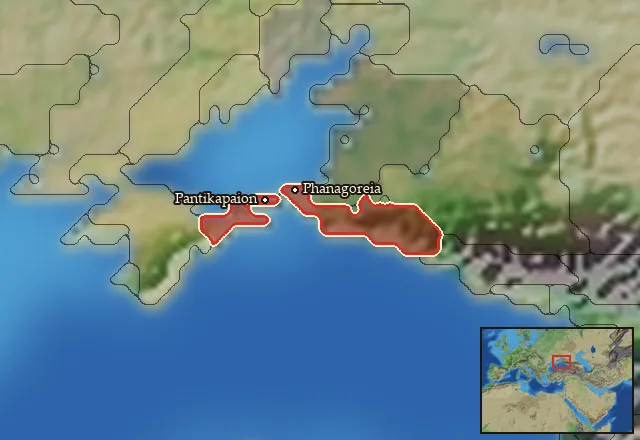
| Zone | Provinces | ||||||
|---|---|---|---|---|---|---|---|
| Bosporan | 2 |