
Etennian Hoplites
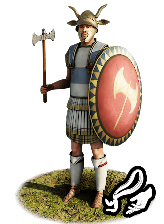
Class: light · Category: infantry · Men per unit: 40
Description
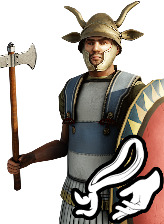
These hoplites are not Greeks, but Pisidians, specifically Etennians. They hail from Etenna or Kotenna, a city in the mountains beyond the Pamphylian coast at Side, where Pamphylia merges into Pisidia. Like Hellenes, the citizens of Etenna go to war as Hoplites. They wear the classic, round shield called aspis - not hoplon -, pilos helmets, and the leather corselet known as linothorax. However, any Greek would be startled to see that some of the Etennians choose traditionally Pisidian, horned helmets, Pisidian clothes, including white leg wraps, and axes like those popular in Lycia and Caria. Their armament makes the Etennian Hoplites a unique unit that can be used both in attack and defence.
Historical background
RIS’ chief historian Mausolos conceived the idea for this unit on a rainy work day during the pandemic. While reading the fifth book of Polybios’ Histories, he stumbled upon the description of a war between Selge in Pisidia and Achaios, the Seleucid usurper against Antiochos III (r. 223-187 BC). When Achaios moves against the Selgians, he sends for reinforcements. Polybios (ca. 200-118 BC) writes:
‘‘The Etennes, who inhabit the highlands of Pisidia above Side, sent Garsyeris (the Seleucid general serving under Achaios) eight thousand hoplites, and the people of Aspendos half that number.” - (Polyb. 5.73.3)
Eight thousand hoplites are an impressive number, but the passage presents various issues. The first is the location of the Etennes. While coinage from Etenna is known, it does not specify anything about the town (Walbank, Commentary on Polybius (1957), p. 599). The historian and geographer Strabo (ca. 63 BC - 25 AD) speaks of a Katenneis near the city of Perge in Pamphylia (Strab. 12.7.1C570). Two lists from late antiquity know a Kotenna and an Etenna, meanwhile (Ruge, s.v. Etenna, RE 6.1 (1907), pp. 706-707). Accordingly, Walter Rughe argues that they are separate places, while George Bean (The Site of Etenna (1970)) thought Kotenna, Etenna, and Katenneis were all the same. Since the problem cannot be resolved, no dedicated publications have followed since, and we have assumed Etenna as being near Perge and Side, which also fits their involvement in a war against Selge, which lies northwest of Perge.
The second problem is the identity of the Etennians. A people located in the mountains of Pisidia fights as … hoplites? One would rather expect light infantry or missile infantry, but not Hellenic style hoplites (cf. Gschnitzer, Das Gebirge im Geschichtswerk des Polybios (1996), p. 181). Perhaps, despite their location, the Etennians were Hellenised early on. After all, the neighbouring Selgians had links to Sparta, and the Pamphylians were all but Greek (for more info, see the descriptions: Selgian Slingers; Pamphylian Heavy Javelinmen), and Etenna itself minted coins in the Hellenistic style. At the same time, we have mixed the typical hoplite panoply with traditional Pisidian equipment to represent the blend of cultures, which brings us to our penultimate question: what did these Etennian Hoplites look like? To start with, we have given the Etennians typical pilos, Phrygian, and konos helmets. Some of these sport an unusual attribute, however: horns. Herodotus (7.76) tells us the Pisidians usually wore helmets with oxen horns attached to the sides, or bronze imitations of those. Their bodies, meanwhile, are protected by linothorakes, the linen corselets common throughout the Greek world. Their shield is a big, round aspis, because no one can rightly be called a hoplite if he does not possess an aspis, while Pisidian leg wraps complete the picture - these are attested on the grave stela of Dioskourides of Balboura, a Pisidian mercenary in Ptolemaic service in the late 3rd century BC (Macridy-Bey, À travers les Nécropoles sidoniennes (1904), pp. 547-572 = Mendel (1914), p. 102 = Sekunda, Hellenistic infantry (2006), pp. 146-148).
The biggest difference to Greek hoplitai is the primary weapon: while Greeks fought in a phalanx with spears, our Etennians prefer a bipennis or labrys, the double axe beloved in Caria as the symbol of Zeus Labraundeus (Kouremenos, The double axe (2016), pp. 45-46). In Pisidia, the doubled-headed axe was worn by the “saviour god” (Greek: theos sozon) who is represented on reliefs from Khodja-Tach, on the border to Phrygia in the northwest (Phocis, Double-Headed Axes (1898), pp. 308-309). The few coins from Etenna itself that survive also use the motif: on the obverse of the first century BC bronze issues, two men are running next to each other. One holds a harpa, a mythological dagger, while the other brandishes a labrys (BMC 1-3; SNG von Aulock 5017; Aulock Pisidien II, 422, 425, 433; Imhoof KM 8-9). On the shields of the RIS Etennians, you will spot symbols prominent in the coinage of Pisidia such as the triskele (see, e.g., the silver stater in SNG Paris 1922-3 from Selge, dated to the period 325-250 BC), a serpent (cf. the same Etennian coins with the axeman) or, once again, the labrys. The unique combination of this axe with the arms of a hoplite make the Etennian hoplites an intriguing unit for every talented general.
Finally, the last question is whom the Etennians fought for, and that one is the easiest to answer. Polybios has already told us that Kotenna, Etenna, or Katenneis formed a largely autonomous community that probably allied with the Ptolemaic and/or Seleucid kingdoms when necessary. The Ptolemies were the main employer of Etennian mercenaries: dozens of Etennian names are attested in Ptolemaic mercenary lists (Launey, Recherches (1949), pp. 471-476). Accordingly, Hadrien Bru (The Pisidians between Seleukids and Ptolemies (2024), p. 183) concludes that Etennians are among the best-represented Pisidians in the diaspora. Among these were not just simple soldiers, but also officers. One example is Apoasis, son of Miorbollos, who was the captain of a contingent of Etennian soldiers stationed on the Red Sea coast of Egypt as part of an elephant hunting squad during the joint reign of Ptolemy IV, his wife Arsinoe, and their son Ptolemy V (208-206 BC: Hall, Greek Inscriptions from Egypt (1898), p. 275). Therefore, Etennian Hoplites are available as AoR units in Etennia and as factional mercenaries for the Ptolemies. Though they also fought for the Seleucid pretender Achaios and, later, in the Roman army (see, e.g., CIL III 6627 = CIL III 14147 = ILS 2483 = AE 2001.2048 for Etennians in Roman Egypt), both factions will have to control the area to be able to recruit them (or all three factions, when you include the Seleucid rebels!).
Stats
| Rank in roster | ||
|---|---|---|
| Men per unit | 40 | ███······· 30% |
| Attack | 8 | █········· 9% |
| Charge bonus | 20 | ███████··· 74% |
| Defence | 32 | █████····· 49% |
| · armour | 9 | █████····· 50% |
| · defence skill | 18 | ████······ 38% |
| · shield | 5 | ██████···· 57% |
| Morale | 11 | ████······ 39% |
| Discipline | Normal | |
| Training | Trained | |
| Recruitment cost | 1,688 dn | ███······· 31% |
| Upkeep per turn | 618 dn | █████····· 47% |
| Turns to recruit | 2 |
Weapons
| Primary | Secondary | Primary | Secondary | Primary | Secondary | Primary | Secondary | ||||
|---|---|---|---|---|---|---|---|---|---|---|---|
| Attack | 8 | — | Charge bonus | 20 | — | Type | melee · blade | — | Damage | slashing | — |
| Properties | Armour-piercing (counts only half the target's armour) | — |
Defence
| Primary | Secondary | Primary | Secondary | Primary | Secondary | Primary | Secondary | ||||
|---|---|---|---|---|---|---|---|---|---|---|---|
| Total | 32 | — | Armour | 9 | — | Defence skill | 18 | — | Shield | 5 | — |
Condition and terrain
| Hit points | 1 | Ground: scrub / sand / forest / snow | 0 / -1 / 0 / -1 | Charge distance | 30 | Formations | Square |
Technical stats
| Time between blows (primary / secondary) | 2.5 s / — | Extra fatigue in hot climates | 1 | Collision mass per man (1.0 is normal) | 1.1 | Spacing between men: close / loose | 1 × 1.2 m / 2 × 2.4 m |
| Default ranks | 5 |
In battle: Can sap · Very good stamina
Who can recruit it
No faction has this on its core roster: it can be raised only in the provinces below.
Any faction holding one of the provinces below can field it.
Exactly what a settlement must have, route by route (1)
| Building | Also requires | ||||||
|---|---|---|---|---|---|---|---|
| Any settlement | Garrison Building or Tier 1 Military Industrial Complex · Etennian area of recruitment · Any Government (Dependency, Indirect Rule or Direct Rule) · Tier 2 Colony not built |
Areas of recruitment
| Zone | Provinces | ||||||
|---|---|---|---|---|---|---|---|
| Etennian | 0 |