
Etruscan Lancer Cavalry
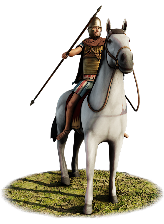
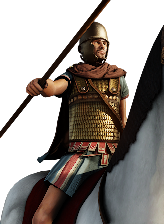
Class: heavy · Category: cavalry · Men per unit: 30
Description
As an Etrurian lancer might have remarked: “For Tinia, god of the thunderbolt, sky, and storm, our cavalry shall thunder across the plains of Italy and either conquer the enemy or die proudly in service of Etruria!”
Recruited from the Etruscan aristocracy and their household retainers, these nobles are good quality horsemen who follow the Hellenistic style of combat. Equipped with a basic cavalry panoply that is comparable to the average Greek Xystophoros, these men lack shields, focusing instead on achieving maximum momentum and impact when charging. Their elite status allows them to afford the finest panoplies available in Central Italy, wearing Etruscan lamellar cuirasses, Hellenistic muscle cuirasses, or scale-reinforced linen armour (linothorakes) covered with decorated tunics, as well as bronze Attic-Phrygian, Chalcidian, or Montefortino helmets. While their devastating charge can easily rout lighter infantry and disrupt enemy flanks, their lack of a shield makes them fragile if left alone in prolonged melee combat. These Etruscan nobles cling to the Hellenistic ideal of heroic horsemen. Similar to the heroes of old times, they charge with fury upon their foes, striking fear as they trample their enemies under the hooves of their horses or pierce them with their lances.
Historical background
The martial identity of the Etruscan equestrian class was closely tied to aristocratic self-fashioning and social prestige. As Taylor notes, "depicting a cavalryman evoked the wealth and status required for equestrian service" (Taylor, 'Etruscan Identity and Service in the Roman Army: 300–100 B.C.E.', in: AJA 121-2 (2017), p. 276). On 4th-century BC stone monuments, such as the Bologna stele, as well as 2nd-century BC cinerary urns from Volterra, Etruscan horsemen are consistently depicted wearing Hellenic armour while riding down Celtic footmen (Taylor (2017), p. 282). Furthermore, Steingräber highlights that during the late Classical and early Hellenistic periods, "Macedonia had become a new ideological and cultural model for the rulers and aristocrats in different areas of Italy", influencing palatial architecture, weapons, and equestrian tomb iconography (Steingräber, 'Greek Contributions to Tomb Paintings in Etruria', in: Jockey (ed.), Les arts de la couleur en Grèce ancienne (2018), p. 181).
Indeed, the Greek kit increasingly proved a marker of social distinction for Etruscan warriors (Taylor (2017), p. 278). Taylor also notes a divergence between the martial aesthetic promoted by the two Hellenized Roman and Etruscan aristocracies: “Etruscan art emphasized elite cavalry combat featuring ostentatiously hellenized forces, while the Romans, even elite Romans who dabbled in Hellenic fashion, were quite comfortable portraying themselves as a decidedly non-Greek fighting force” (Taylor (2017), p. 283). Nevertheless, the Etruscans also featured unique elements in their panoply, with one piece of distinctly Etruscan armour still occasionally appearing alongside Greek-style armour. That armour was the "lamellar cuirass, which consisted of overlapping and interlocking vertical strips of protective material (metal, leather, or linen), an expensive and intricate design. Such lamellar armour is readily visible on the Mars of Todi, found in Umbria but of Etruscan manufacture” (Taylor (2017), p. 278).
Even during the 3rd century BC, these noble horsemen still fought to preserve Etruscan autonomy against Roman expansion. In 283 BC, when the Celtic Boii advanced south, "certain of the Etruscan cities had renounced their treaties with Rome and joined in the attack, with the result that Roman armies had been occupied in Etruria for two full years after the battle of Lake Vadimon" (Staveley, 'Rome and Italy in the early third century', in: Walbank et al., The Cambridge Ancient History VII.2 (2006), p. 423). However, despite their heroic struggle, the Etruscans were gradually beaten down by Roman armies, with the city-states of Vulci and Volsinii being defeated in 280, and Caere in 273. The process of conquest was certainly complete by 264, when Volsinii was destroyed in the aftermath of a revolution in the city (Staveley (2006), p. 381). Thus, militarily defeated, the Etruscan communities remained nominally independent but bound to Rome by treaties of alliance. The exception to this system of alliance was Caere, which, following its defeat in 273 BC, was forced to surrender half its land, and incorporated as a municipium sine suffragio (Staveley (2006), p. 381).
This was not the end of Etrurian unrest in the region and in 241 BC, following the end of the First Punic War, Rome launched a final campaign against the township of Falerii. Two Roman consular armies "destroyed the fortified city of the Faliscans, transplanted the inhabitants to a new town some three miles distant from the old site, and confiscated half their territory" (Staveley (2006), p. 431). Decades later, during the Second Punic War (218–201 BC), Roman control over Etruria remained precarious. The Senate felt the need "to garrison two legions here throughout most of the Second Punic War" to prevent Etruscan uprisings (Van Son, 'The Disturbances in Etruria During the Second Punic War', in: Mnemosyne 16-3 (1963), p. 268). Nevertheless, Etruscan horsemen and infantry served alongside the legions against Hannibal, not always performing well, as the Etruscan cavalry is blamed by Livy for being the first to flee during an ambush by Hannibal Barca which saw the Consul Marcellus die after being “run through with a lance” (Liv. 27.27). However, city-states like Arretium supplied Scipio’s 205 BC African expedition with thousands of helmets, shields, and long spears (Liv. 28.45.15), showing their efforts to help Rome during the war. Still, one must point out that by 205 BC, this would be the safest option for the Etruscan cities. Hannibal had been pushed to the South of Italy. The Etruscans would have rightfully feared potential future Roman retaliation due to a perceived lack of support as well as its potential dissention to Carthage.
Stats
| Rank in roster | ||
|---|---|---|
| Men per unit | 30 | █········· 8% |
| Attack | 12 | █████····· 48% |
| Charge bonus | 29 | █████████· 88% |
| Defence | 30 | ████······ 43% |
| · armour | 11 | ██████···· 64% |
| · defence skill | 19 | ████······ 44% |
| · shield | 0 | █········· 0% |
| Morale | 11 | ████······ 39% |
| Discipline | Normal | |
| Training | Trained | |
| Recruitment cost | 2,117 dn | █████····· 54% |
| Upkeep per turn | 852 dn | ████████·· 82% |
| Turns to recruit | 3 |
Weapons
| Primary | Secondary | Primary | Secondary | Primary | Secondary | Primary | Secondary | ||||
|---|---|---|---|---|---|---|---|---|---|---|---|
| Attack | 12 | 10 | Charge bonus | 29 | 22 | Type | melee · blade | melee · blade | Damage | piercing | piercing |
Defence
| Primary | Secondary | Primary | Secondary | Primary | Secondary | Primary | Secondary | ||||
|---|---|---|---|---|---|---|---|---|---|---|---|
| Total | 30 | — | Armour | 11 | — | Defence skill | 19 | — | Shield | 0 | — |
Condition and terrain
| Hit points | 1 | Mount | heavy horse | Ground: scrub / sand / forest / snow | -3 / -1 / -8 / -1 | Charge distance | 40 |
| Formations | Square · Wedge |
Technical stats
| Time between blows (primary / secondary) | 2.5 s / 2.5 s | Extra fatigue in hot climates | 3 | Spacing between men: close / loose | 2 × 4.8 m / 3 × 7.2 m | Default ranks | 5 |
In battle: Good stamina
Who can recruit it
A core roster unit for one faction, which can raise it anywhere it holds the right building:
Any faction holding one of the provinces below can field it.
Exactly what a settlement must have, route by route (3)
| Building | Also requires | Building | Also requires | Building | Also requires | ||
|---|---|---|---|---|---|---|---|
| Direct Rule | Tier 2 Military Industrial Complex · Tier 2 Colony | Homeland | Garrison Building or Tier 1 Military Industrial Complex | Any settlement | Tier 2 Military Industrial Complex · Etruscan area of recruitment · Dependency or Indirect Rule · Tier 1 Colony not built |
Areas of recruitment
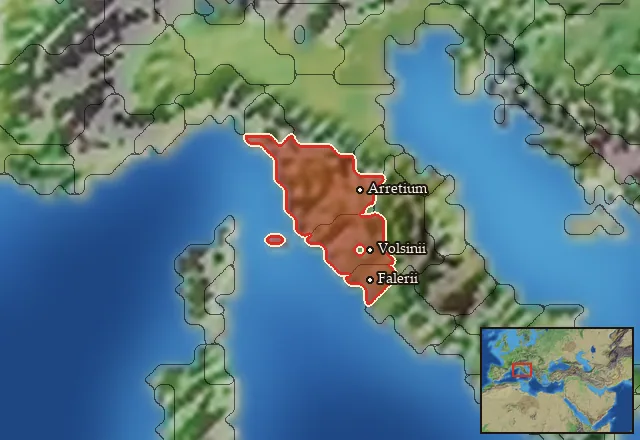
| Zone | Provinces | ||||||
|---|---|---|---|---|---|---|---|
| Etruscan | 3 |